Showing posts with label Christmas. Show all posts

Friday, December 24, 2010

White Christmas

The movie world is a very different place now than it was in 1954, when White Christmas was released theatrically.  Want proof?  It was the year's top grossing movie (yes, a Christmas movie was the year's big earner), with around $12 million earned.  To put that in perspective, that is less than Sharon Stone earned for Basic Instinct 2, one of the biggest flops of all time.

Back in the good ol' days of World War II, on Christmas Eve 1944, the men under the command of Major General Thomas Waverly (Dean Jagger) are treated to a show, unbeknownst to the Major General.  You see, a famous Broadway singer, Bob Wallace (Bing Crosby) is in the troop, and a low-level solider, Phil Davis (Danny Kaye), managed to convince his superiors to let Bob sing to everyone.  Sure, they're surrounded by mortar fire and unprotected, but it's Christmas Eve, sir...!  Well, after General Waverly announces his presence to the crowd, Bob and Phil give him a farewell tribute song, because the Major General is being relieved of his command.  The song ("The Old Man") explains that these men will follow Waverly wherever he wants to go (except toward battle) because "we love him."  That might seem like an odd lyric to repeat during a military tribute song, but you have to remember that Don't Ask Don't Tell wasn't in effect until 1993 --- side note: thank goodness that nonsense has finally been repealed.  Anyway, some mortar rounds finally reach the group and everyone scatters; Phil saves Bob's life and takes a small arm wound in the bargain.  That's okay, though, because Phil takes this life debt and turns it into a successful Broadway partnership with Bob when they get back from the war.

Fast forward a few years, and the fabulous team of Wallace and Davis are getting boffo reviews on Broadway, thanks to a montage where the characters don't appear to age a day.  Success is great, but Phil is getting tired of the grind; he keeps trying to find Bob a woman so he'll slow his professional life down, if just by a little.  Enter the Haynes Sisters; Judy (Vera-Ellen) and Betty (Rosemary Clooney).  They are the kid sisters of "Freckle-Faced Haynes, the dog-faced boy" (actually, the grown-up Little Rascal, Alfalfa), they have a song-and-dance act, and they want advice from the famous Wallace and Davis team.  Judy and Phil notice (while they are dancing) that Bob and Betty seem to be getting along (they're actually arguing), so Phil connives a way to get himself and Bob up to Vermont the next night, where the Haynes sisters will be featured performers at a ski lodge.  That particular ski lodge happens to be owned by former Major General Waverly, and it is in major financial trouble, thanks to unseasonably warm weather.  Who wants to ski on green grass?  Dirty hippies, that's who.  And they won't even exist for another thirteen years, so that's a bust.  Can Wallace and Davis help save General Waverly's business?  Will Bob ever fall in love?  Those questions and more will be answered by the end of this gripping mystery/thriller/peyote-influenced art film musical.

How does this former blockbuster stand up to the test of time?  It helps that the fim knows its strengths.  Bing Crosby and Rosemary Clooney have powerful voices, and their scenes are obviously catered to that.  Danny Kaye and Vera-Ellen are talented dancers (her more than him), and their scenes cater to their talents, as well.  I also appreciate that this musical confines the songs mostly to performances and leaves the plot development to the dialogue --- that also means that the songs take place in reality and everyone around knows that they're supposed to be singing (for the most part).  Nothing drives me battier than watching a musical where everyone in a scene is suddenly a professional singer and dancer and then, when the scene is over, they all continue on with their lives.  Yes, I'm a crotchety old man when it comes to musicals.  And while this isn't the first use of "White Christmas" in a film (that honor goes to Holiday Inn), its inclusion here is the obvious highlight of the soundtrack; the rest of the Irving Berlin-written songs are pretty solid, too, especially "Snow" and "Count Your Blessings Instead of Sheep."  Heck, even the trite "Sisters" is entertaining when Crosby and Kaye perform it.

The performances are decent, but nothing special.  Honestly, I expected more out of Michael Curtiz (director of Casablanca), but I suppose that directing a musical is a very different experience than directing a drama; like I mentioned before, the movie plays to its strengths, and that is largely because of Curtiz.  Rosemary Clooney probably does the best job expressing emotions, but her character is ridiculously fickle when it comes to those same emotions.  Bing Crosby doesn't have much range, but he's there to provide a voice.  His character is more or less pushed through the film by Danny Kaye, who shoulders most of the comedic burden, even as he propels the plot forward; I don't particularly like Danny Kaye, but his overacting fits well in this setting.  Vera-Ellen is definitely the acting lightweight in this movie; while she is a talented dancer, it looks like she is never dancing in character, and since dancing is her focal point here, that's a problem.  You might also look at Vera-Ellen and notice how ridiculously thin she is --- she can't have more than twelve pounds of flesh and organs on that frame --- and wonder why she always has something covering her neck in this movie.  If you're curious, check this out.

You would think that the primary parts of this film that age poorly would be the singing and dancing (well, that's what I would assume, anyway), but that's not the case here --- except when Rosemary Clooney sings "I wash my hair with snow," because that's damned unlikely.  The plot definitely proves itself as the weakest link in this story.  How much of this movie would have been cut if characters had just stopped acting on half-bits of information?  Two of the biggest plot points in the film are based upon a character misconstruing the facts and not bothering to explain themselves to Bing Crosby.  The acting is mostly acceptable for a musical, but Vera-Ellen makes a point to look directly at the camera whenever she dances, which just bugs me.  This isn't porn, Vera, you don't have to gaze at the viewer like that...pay attention to the other people in your scenes! 

Overall, though, White Christmas gets the job done.  It's pretty entertaining, the songs are pretty good, and the people doing the singing and dancing are obviously good at what they do.  The movie even manages to pull on the ol' heartstrings when General Waverly makes his uniformed appearance near the end of the movie.  I don't know if this deserved to be the clear number one hit of 1954, but it stands the test of time as a good musical and a pretty solid Christmas movie.

Wednesday, December 22, 2010

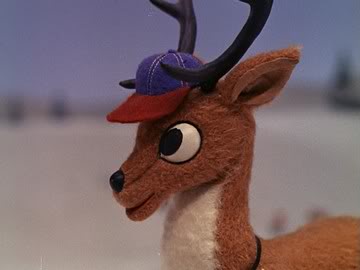
Rudolph the Red-Nosed Reindeer

I know, I know...Rudolph the Red-Nosed Reindeer is technically a television special, not a movie.  I normally don't review television, but I think the self-contained nature of the story and the fact that it is not part of an ongoing show make it more of a TV movie than anything else.  Anyway, I watched it, so I'm reviewing it.  If you don't like it, go suck an egg's nog.

Rudolph the Red-Nosed Reindeer is the story of Rudolph, a reindeer born with a genetic anomaly.  This mutated freak has a nose that glows as bright as a red light bulb and emit a sound similar to that of a whistling kettle.  The poor reindeer obviously had a terminal birth defect that caused his nasal capillaries to be too close to the outer layers of skin, giving it a reddish hue; the glowing must come from radiation poisoning, not terribly surprising, given the proximity of the North Pole (where the story takes place) to Soviet Russia and their reckless handling of toxic waste; the whistling no doubt comes from the swelling of Rudolph's brain, with some of the pressure being slowly released through his nostrils.  The poor buck probably only had a few Christmases in him before he suffered a series of incapacitating, and eventually fatal, strokes.

Comet: Racist Asshole
Rudolph Donnerson (they're in the North, so I assume reindeer follow the Nordic tradition of surnames) was born to his mother and Donner, one of Santa Claus' elite flying reindeer.  Let me speak frankly here; Rudolph was born into slavery.  Just moments after being born, Rudolph managed the miracle of recognizing his parents and surmising their names --- obviously a talented boy --- but then this Santa Claus entered their family cave (they can't even afford a barn!) to make sure the newborn recognized his master.  Donner and Santa both noticed Rudolph's birth defect, and Donner promised to "take care of it," because there was no way Santa would let a freak of nature join his elite, sleigh-driving slaves.  Rudolph learned to hide his shame by putting a nameless black mass over his nose; I don't really know what it is made out of, but I assume most of the building materials in the Donnerson cave are made of reindeer poop.  After a year in the cave, Rudolph is allowed to finally meet other reindeer.  While Rudolph manages to woo a young doe (At age one?  I don't support babies making babies) and excel in his first attempt at breaking the laws of nature (he flies with ease), his poo nose falls off and the other reindeer shun him.  The only adult reindeer present, Comet, announces that Rudolph will never be allowed to play their reindeer games ever again, because of his nose.  And also because Comet is an adult that has no shame sculpting the leaders of tomorrow with his bigoted rhetoric.

Around this time, Rudolph decides to run away from home, like all children should when they feel like they don't fit in.  Better yet, Rudolph runs away into the wastes of the Arctic circle, where there is no food or shelter for him.  Luckily for Rudy, he befriended a runaway elf, Hermey, who wanted to become a dentist, like all well-adjusted people.  Hermey doesn't bring anything of value to the table except a voice even more nasally than Rudolph's.  Together, the two run away from their problems, meet a moronic prospector, battle a surprisingly monkey-like Abominable Snowman, talk to Aslan-if-Aslan-had-bat-wings, and meet some crappy toys.  I don't want to spoil the end of the story for everyone (it's not like anyone wrote a song about him or anything), so I'll just say that running away from his problems helped Rudy solve them.
"Yes, we'll make them pay...and we'll start by pulling off all their noses...!"

I like to think that I have given this TV special a pretty fair and unbiased summary so far, but I have to tell you that I am not terribly fond of Christmas movies that promote racism, slavery, runaways, shame, or false noses made of reindeer poop.  Even if I was okay with the subject matter, this picture is a technical mess.  Watching these characters move their mouths in a rhythm that is, by no stretch of the imagination, anything resembling a human speech pattern just makes me admire the people behind the Muppets and Robot Chicken all the more.  I like stop-motion animation most of the time, but this is sloppy, even if it is aimed at mouth-breathing toddlers.  The only person of note in the cast or behind the scenes is Burl Ives, but the animators couldn't even get his snowman narrator right; when it comes time for him to sing the piano-based song, "Silver and Gold," they have him strumming a guitar.  The best thing to come out of this stop-motion train wreck is Burl Ives' contributions to the soundtrack; "Holly Jolly Christmas" and "Rudolph the Red-Nosed Reindeer" are classics that still sound good today.  I suppose you have to admire a story that is so willing to show the weaknesses of its characters, but I think less blatant stupidity and more sympathy for the socially outcast would have made for a better short film.  This isn't the worst Christmas move or TV special (not by a long shot), but it certainly isn't good.  Rudolph just goes to show you that nostalgia can be used for bad things, too.
"Never forget...Santa can crush you like a bug and no one will care, because you're my property.
One more thing...why were all the elves skinheads? I get that they hate anything different from them and this is a Christmas movie, but do they have to be Neo-Nazis?

Tuesday, December 21, 2010

Scrooged


When reading up on the production of Scrooged, I learned that this was the first movie that Bill Murray starred in after Ghostbusters --- that's four years of his prime that he spent out of the limelight.  Usually, when a comedian takes that long of a break, they never get their groove back (Dana Carvey, I'm looking at you).  Then again, Bill Murray is an unusual guy, so it should not be surprising that his career has been just as odd.

Scrooged is an updated-for-the-80s version of Charles Dickens' A Christmas Carol.  In fact, Frank Cross (Bill Murray) is a television executive that is masterminding a multimillion dollar live broadcast of Dickens' classic on Christmas Eve.  If you know the story of Scrooge, then you know the gist of the story.  Frank is an absolute bastard and a tyrannical boss, so his late boss (John Forsythe) reaches from beyond the grave to warn Frank to change his ways or be eternally damned.  That evening, Frank is visited by the ghosts of Christmases past, present and future.  But will he learn from his extra-special extrasensory night, or will he dismiss it as the effects from "Russian vodka poisoned by Chernobyl?"  Obviously, since this is a Christmas story and it is based on one of the enduring Christmas classics, radioactive vodka (distilled from tear-soaked turnips) ends up playing an important part and Frank eventually mutates into the Toxic Avenger.  Or he lives happily ever after and is forgiven by everyone for years of abuse after just one evening of sincere regret.

Like most movies starring Bill Murray, the focus of this film is definitely on him.  However, this film has its share of of noteworthy supporting roles.  In a normal movie, you would suppose that the romantic interest (Karen Allen) or the nemeses at work (Robert Mitchum as Frank's increasingly loopy boss and John Glover as his competition) would provide the bulk of the film's drama and depth.  Here, not so much.  All three did a decent job, but were nothing special.  No, in A Christmas Carol (and, therefore, in this update), the key supporting characters are the Ghosts of Christmas Past and Present.  Both are unusual roles, since neither has any character development and both basically just guide Frank through time and space while doing some narration, but both manage to steal scenes away from Bill Murray, which is quite a feat.  David Johansen (lead singer of the New York Dolls) is perfect as the seedy, cigar-smoking, cab-driving Ghost of Christmas Past, and he clearly has a blast in every scene.  Johansen would be the surprise of this movie if Carol Kane wasn't so awesome as the Ghost of Christmas Present.  Making her into a physically abusive sadist might be an unusual take on the character, but Kane plays it up with such childlike glee that it's fun to watch her beat the living hell out of Frank.

Also worth noting is Grace (Alfre Woodard), who serves as the stand-in for the Bob Cratchet character and provides maybe the most emotional depth to the film; on the flip side of Grace's put-upon-but-still-valued role, Eliot (Bobcat Goldthwait) is the angry, unappreciated version of Bob Cratchet that decides that going postal will solve his problems.  This movie has a lot of cameo appearances and bit roles, too.  Miles Davis and Paul Shaffer play street musicians; Brian Doyle-Murray and his brothers, John and Joel Murray, play Frank's father, brother, and a random dude, respectively; Robert Goulet, Lee Majors, Mary Lou Retton, and John Houseman all played themselves; and even the television broadcast within the movie had stars like Buddy Hackett and Jamie Farr.

Juggling all those noteworthy actors was probably a task in and of itself, but director Richard Donner did a good job.  Aside from finding recognizable faces for every important role (except for the Tiny Tim analogue) and getting them to fill their bit parts admirably, he also managed to do some pretty imaginative things with the special effects in the film.  The Ghost of Christmas Future looked pretty cool with his "ribcage of the damned" and sometimes-but-not-always television face.  The makeup on the deceased John Forsythe was pretty awesome, too.  In fact, the only thing in this movie that doesn't look good is Frank's hair in the flashback scenes.

Apparently, "Scrooged" translates into
"Chief Attack Ghosts" in Spanish
I have two problems with this film, and the first deals with Bill Murray.  I love Bill Murray.  He's awesomely funny and has developed into a talented dramatic actor.  That said, he basically plays himself in just about every movie until Rushmore.  This can be a good thing; Murray is always funny, even in his bad movies, and he is let loose for a good portion of this film.  Unfortunately, he and Donner decided that Frank Cross had to be unlikable at the film's start so that he could transform by the film's end.  That sounds fine --- Scrooge isn't a nice guy, either --- but in execution, it's a little too much.  There's certainly some black humor in Murray's quieter moments in the first quarter of the film, but when he's screaming, he's just screaming.  The likable jerk that Murray plays so well doesn't show up in these scenes; instead, we are treated to Murray being mean and not deflecting anything with a smirk or self-deprecating joke.  I like the rest of Murray's performance, but I think there are a lot of missed comedic opportunities in the "before" phase of this movie.

My other gripe has more to do with the source material than anything else, but I suppose you should shift some blame to the screenwriters, too.  I'll be honest with you...I hate Charles Dickens.  Well, maybe not the man, but definitely his writing.  His style is overly wordy (because he was paid by the word), his characters are unrecognizable as human beings, and his plots are usually contrived.  I will credit him with some pretty good high concepts, but that's the only way I have found to appreciate Dickens --- by stripping his stories down to their bare bones and then imagining a more amusing tale from there.  [Steps off soapbox.]  Personally, I find the emotional part of this story to be a little insulting.  Frank is mean for years and then wins everyone over immediately?  That seems far too saccharine to coexist in a film with moments of black comedy.  I readily admit to being a soft touch with Christmas movies --- I'm a hot mess of tears, snot and giggles for the entire running time of It's a Wonderful Life --- but the happy ending to Scrooged is too abrupt, too shallow, and/or maybe too overreaching to move even an easy mark like me.  "But it's the source material's fault, Brian!"  Whatever.  If they changed the story to modernize it, they could have tried to make it a little more plausible or a little more emotional.

Don't get me wrong --- I love me some Scrooged.  I watch it every year and I laugh at all the same parts ("It's a bone, you lucky dog!" gets me every time, for some unknown reason), but this is a movie with some fundamental flaws to it.  This might be the least heartwarming Christmas movie I have ever seen, but Murray's charm and the combination of Kane and Johansen always bring me back, year after year.