Over the past few weeks, I have reviewed nothing but the 2012 Oscar nominees. I need a break, and I am dubbing that break "Iron Sky." I stumbled across this movie thanks to Netflix, and IMDb claimed that people who liked Iron Sky also liked the Men in Black trilogy, Galaxy Quest, Dreddand, uh, Tank Girl.Those are surprisingly likable "similar to" picks, so I decided to read up on Iron Sky a little. I got as far as the first half of the first sentence of the Netflix description before I hit "play."
Secret moon Nazis attacking Earth? That sounds positively amazing. Sign me up.
The year is 2018, because this is a historical document from our future. Take note, students! America has sent a manned flight to the moon because the President, a Sarah Palin analogue (Stephanie Paul), decided that the easiest way to gain minority support was to send a black astronaut to the moon. I don't necessarily follow that logic, but in all fairness, the film doesn't address how successful that plan is. It should be noted that the astronauts did not land on the sunny, closer side of the moon; they landed near the dark side of the moon. That turns out to be a bad idea, for reasons that do not include prog rock or laser shows.
Yes, that is an astronaut being executed by a Nazi stormtrooper
It seems that the Nazis sent a group to colonize the moon in the last days of World War II because of course they did. In the intervening 70 years, they have built an advanced society that honestly believes that they are going to invade the Earth and bring peace to the planet.
How? Military-grade cleavage.
Apparently, there has been some disconnect over the years between the military branch of the moon Nazis and the propaganda branch. Klaus (Götz Otto), the heir apparent to the Moon Führer (played by Udo Kier because why not?), is well aware of the horrors that the Nazis will drop on Earth, but his prospective love interest/Earth expert/propaganda teacher, Renate (Julia Dietze), actually believes that Nazis will improve the world. She believes that the Nazis were well-loved, and references the "ten-minute" film tribute, The Great Dictator, as proof. However, once the Nazis are face-to-face with modern Americans, they realize that they might be a little outclassed; the surviving astronaut's smartphone is a more powerful computing device than the room-sized computers that the Nazis have.
Of course all Nazi scientists look like Einstein
To gain the necessary knowledge and materials to conquer the world, Renate and Klaus head to Earth. But how will Renate react when she sees that the world isn't eagerly awaiting the return of the Nazis with open arms? And what will happen when Klaus decides to rain hellfire from space?
Answer: B-movie space battles, that's what
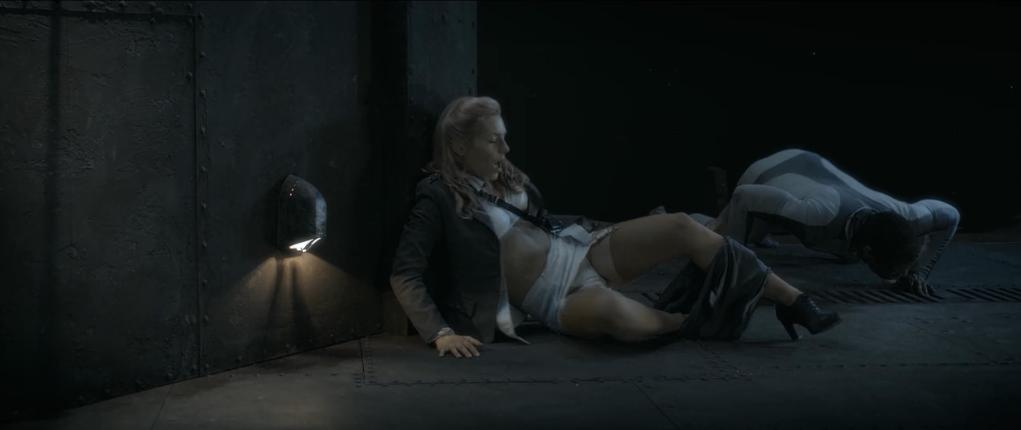
When you watch a movie about Moon Nazis, you can be reasonably sure that the acting will not be a main priority. To its credit, Iron Sky's acting isn't painfully bad. Julia Dietze is actually pretty decent as Renate, even though her character is (arguably) the stupidest person in the film. She had a silly role and didn't do it half-assed, so kudos to her. How dumb was her part? She was undressed by a depressurized hull.
Dietze's role was pretty thankless, but the rest of the cast had even less to work with. Christopher Kirby got to speak in stereotypical black slang and was the butt of very generic black jokes. It gets worse when his character is Aryan-ized; if you thought the jokes about black people were weak, wait until you get the jokes about someone who used to be black.
"Nein! I do not want to wait for pain!"
Götz Otto was mediocre as the main villain; he was unlikable enough, but the gags kept him from coming across as truly evil. Udo Kier was actually a pretty good choice to play a creepy German character, but his part was small and underwhelming. Stephanie Paul was...well, she was an obvious analogue to Sarah Palin, so your appreciation of her depends on how funny you find broadly drawn Palin jokes.
I am jealous that Fake Palin talks to holograms, though
Rounding out the cast, Peta Sergeant was almost fun as a somewhat skanky political advisor. Almost.
The main problem for most of the cast was that the script for Iron Sky is pretty awful. There's not much you can do when you're in a movie about Moon Nazis and the film isn't very much fun. The script is certainly to blame for most of that --- the "jokes" barely deserve finger quotations, much less actual ones --- but the general plot was also underwhelming. Iron Sky is about Moon Nazis invading Earth. There is no excuse for extended chunks of boredom. And yet, the audience is subjected to sub-SNL-quality political satire to fill the gaps between astronauts getting shot and space battles.
YOU HAVE STORM TROOPERS! JUST INVADE, ALREADY!
That is, ultimately, the worst thing about Iron Sky: it should be a lot of fun, but it thinks it is being clever. It is not clever in the least. Director and co-writer Timo Vuorensola is mostly to blame for this clusterfuck, but when you have characters acting like complete jackasses, with zero chance of any comedic return, that blame deserves to be spread out a little.
I was legitimately excited to watch Iron Sky, and the first few scenes on the moon didn't disappoint. Unfortunately, the rest of the movie is fairly slow and tedious. I wasn't looking for Shakespeare, but I was hoping for something gleefully stupid. Instead, Iron Sky is filled with characters trying to be funny, but not quite understanding how to make that happen. You might think that such a drab effort would sour me on stupid Nazi movies, but that is not the case. In fact, one of the worst movie studios working today managed to make a far more amusing stupid Nazi movie at almost the exact same time as Iron Sky...and I'll review it tomorrow. Meanwhile, Iron Sky gets a little credit for its premise and the opening scenes, but it was a sincere disappointment from a "laugh and drink to this" perspective.
Here we go. As tween/desperate adult audiences everywhere prepare for the final episode of the Twilight Saga, somebody somewhere decided to remind horror/action fans that there were movies getting vampires wrong as far back as 2003. Underworld: Awakening is the fourth entry in the Underworld series and is the sequel to the second film (2006's Underworld: Evolution), because making a sequel to the third movie would have been silly. I'm not going to argue that there is absolutely no reason to make this movie --- I find the "Kate Beckinsale in tight, shiny leather" argument particularly compelling --- but did we really need another movie where vampires shoot guns at werewolves?
Okay, that trailer actually looks halfway decent. The basic premise of the series (vampires vs. lichens lycans) has been upended, and now both classes are being hunted by the deadliest game of all: man. There's some promise there. What I hated about the original Underworld was how completely de-powered the vampires felt next to the werewolves; making the enemy human changes that power dynamic. Maybe vampires are more powerful, but there are just so many humans, using so much technology, that the Underworldians will have to change their MO. That sounds worth checking out, right?
Underworld: Awakening begins with Selene (Kate Beckinsale), the vampire shoot-'em-up expert, and Michael (Scott Speedman), her vampire/werewolf (Vampwolf? Werepire?) boyfriend, on the run, after the events of Underworld: Evolution. Boom boom boom, bang bang bang, and Selene (and presumably Michael) has been captured by the human military. The next thing you know, Selene has been cryogenically frozen and the rest of the movie is the camera slowly zooming in on her ice-block-face.
And by "rest of the movie," I of course mean "title sequence," because Selene breaks free of her icy cage and runs for her life. She quickly learns that she has been frozen in some sort of science lab for twelve years and that the world is very different following the same trend it was when she was captured. The humans have concentrated their efforts and have wiped werewolves off the face of the planet, and are pretty close to doing the same to vampires.
Tip for wiping out vampires: start with the ones who have their own movies
But what set Selene free? And what happened to Michael? Well, her escape wasn't entirely her own doing; someone dubbed Subject 2 by the lab scientists also broke out that night. Who or what is Subject 2? Why do the scientists want it so badly? The plot tries to focus on these points until enough time has passed for the film to return to its roots. Remember the whole "Lycans are exinct" thing? It turns out that was greatly exaggerated.
The acting in Underworld: Awakening isn't exactly great, but it's certainly good enough for a movie about vampires with guns. Kate Beckinsale is once again very stoic in the lead, although the script makes her seem a lot stupider this time around. Let's be honest --- the hardest part of playing Selene is looking good in her outfits, and Beckinsale still pulls it off. Thankfully, that isn't something that is crassly exploited by the filmmakers to draw attention away from the story.
I prefer the phrase "remorselessly objectified"
Stephen Rea played the doctor heading the research on frozen vampires. Rea's a fine actor, but he is a one-note villain here. Michael Ealy was decent as the rogue cop who somehow comes to the conclusion that being lied to by his superiors means that he should help vampires. I'm not saying that he's wrong, but it is a little weird at how little it takes to convince him. Charles Dance picks up the thematic baton as the elder vampire who just can't agree with Selene on anything. I'm not saying that his character is irrational, but every single Underworld has had a stuffy old vampire who causes unnecessary conflicts, and I'm bored with it. Theo James played the flip side of that coin as the young vamp that supports Selene. Kris Holden-Ried was the primary werewolf threat and was supposed to be rather intimidating, but I just couldn't get over how much he reminded me of Chris Martin from Coldplay.
"IT WAS ALL YELLOW!"
That, of course, led me to making several Coldplay lyric references whenever he was onscreen, which accidentally turned out to be one of the highlights of the film for me. Rounding out the cast is India Eisley, who got to be a girl of mystery. She was okay, I guess, but her part required her to snivel and cower a lot, which got a little annoying. None of the actors were particularly impressive or distractingly bad, which is almost an accomplishment when you are the third sequel in a series.
This movie was directed by Swedish filmmakers
Måns Mårlind and Björn Stein. It's okay if you haven't heard of them, because this is only their second English-language film, and the other was a box office dud. The most notable choice Mårlind and Stein made was to play Underworld: Awakening completely straight. This series has always taken itself very seriously, but there were usually a few moments where the characters reveled in their abilities or each other. That doesn't happen here. The story (ridiculous as it is) is told plainly, the backstory from the other movies is explained crisply, and there are action scenes every few minutes.
"Hi, we're cannon fodder for Scene 43"
The action (for the most part) looks pretty good. Sure, the Lycan transformations are hit and miss, but that has been an ongoing problem for this series; why fix it for the fourth movie? More importantly, Beckinsale still looks good doing wire stunts. There just aren't any great moments. So it's a serviceable action movie with a science fiction/horror vibe, right? Actually, no. It's a mediocre action movie with a sexy leather-clad lady and pretty terrible sci-fi script. The screenplay credit is split between four people (including J. Michael Straczynski and Underworld co-creator Len Wiseman), so it's pretty clear that the story had a few overhauls. And it shows. Do you like plot twists? Do you like them better if the "twist" isn't surprising in the least? Well, that's what you get with Underworld: Awakening. Mårlind and Stein did an okay job with what was given to them --- I seriously doubt that the relatively unknown Swedish duo was given much leeway with their first big budget movie --- but what they had was a sorry excuse to make a quick buck off of a franchise that had already had one too many sequels.
Above: every Underworld action scene, ever
The biggest problem I had with Underworld: Awakening was how dull it was. This should have been an interesting take on Underworld's already unique angle on vampires. But it isn't. The humans never stand a chance against Selene and her friends and it is incomprehensible that they were ever a threat. But then the not-at-all surprising reveal of werewolves as the primary antagonists happens, and we're right back at the beginning of the series. The only difference is that this time, we have a little girl character to be helpless instead of Scott Speedman.
Adding a kid to the mix is always a sign of desperation
The only thing that kept me interested in the film was pointing out conceptual flaws in it. For instance, if vampires have been hunted to the brink of extinction by man, then it can be concluded that technology and superior numbers are what gave man the edge. And yet, the difficulties vampires have with humans seems to only be dictated by the script. When Selene needs to be captured, she gets blown up; when she needs to escape, she kills four heavily armed men that have her in their gun sights with ease. And if vampires are that fast, why don't we see that more often? The only new element that this sequel added was a non-powered human doing some of the killing, and even his scenes were hilariously unlikely. My personal favorite was when Michael Ealy was firing at a car and managed to kill the driver and shoot out the a front tire with only three bullets.
Even he doesn't believe he's that good of a shot
Underworld: Awakening probably wasn't designed to bring in a new audience. If you thought that a series about vampires and werewolves trying to kill each other with guns was incredibly stupid before (and it is), this movie isn't going to change your mind. I've always enjoyed laughing at these movies, but this was just plain boring. While the action was plentiful, it was nothing new. While the story was stupid, it wasn't stupid-funny. I was hoping for a mindless action movie, but what I got was just mindless. In short, this movie sucks. And not in the "sexy leather-clad vampire" sort of way.
Watching The Mirror Crack'd this Fall stirred a long-dormant movie appetite for me. While that movie wasn't great, it reminded me how much I enjoy a good mystery. It also reminded me how few Agatha Christie film adaptations I've watched. While scanning through Netflix's instant queue, I stumbled across Endless Night, a movie I've never heard of based on a Christie book I have never read. I figured that a story I was unfamiliar with would keep the mystery intact longer ---and I was right --- but that does not necessarily mean that you should go into this film with the same amount of foreknowledge I had.
Michael (Hywel Bennett) is a bit of a loser. He holds random jobs for a few weeks at a time, but inevitably walks out or gets fired. He's a bit of a dreamer, and he dreams of life as a very wealthy man. While working as a chauffeur, Michael befriends a world-class architect, the peculiar-looking Santonix (Per Oscarsson), and the two idly come up with some grand plans for a fabulous home (which Michael could never afford) on Michael 's favorite piece of real estate (which Michael will never own).
Architect or cubist Picasso inspiration? You decide
One day, as Michael visits the plot of land he loves so much, called Gypsy's Acre by the locals, he accidentally meets a very sweet girl, Ellie (Haley Mills). The two quickly fall in love, but it turns out that Ellie is one of the wealthiest people in England. Amazingly, that inconvenience does not prevent Michael from marrying her.
Michael, having the tough news broken to him
The two marry, despite disapproval from Ellie's family, and have Santonix build them a modern home on Gypsy's Acre. Then the real problems begin. One of the locals, whose family once owned Gypsy's Acre, appears to be trying to creep the new couple off the land; she doesn't do much except stare at their house, but according to a reliable source, you shouldn't trust gypsies to do no harm. On top of that, Michael has to deal with Ellie's overbearing family, who are all too aware that he is now heir to a fortune that was once theirs. To make matters even more awkward, Ellie invites her best friend/hired companion, the gorgeous Greta (Britt Ekland), to live in their new home.
Yeah, I'd hate to have her live with me
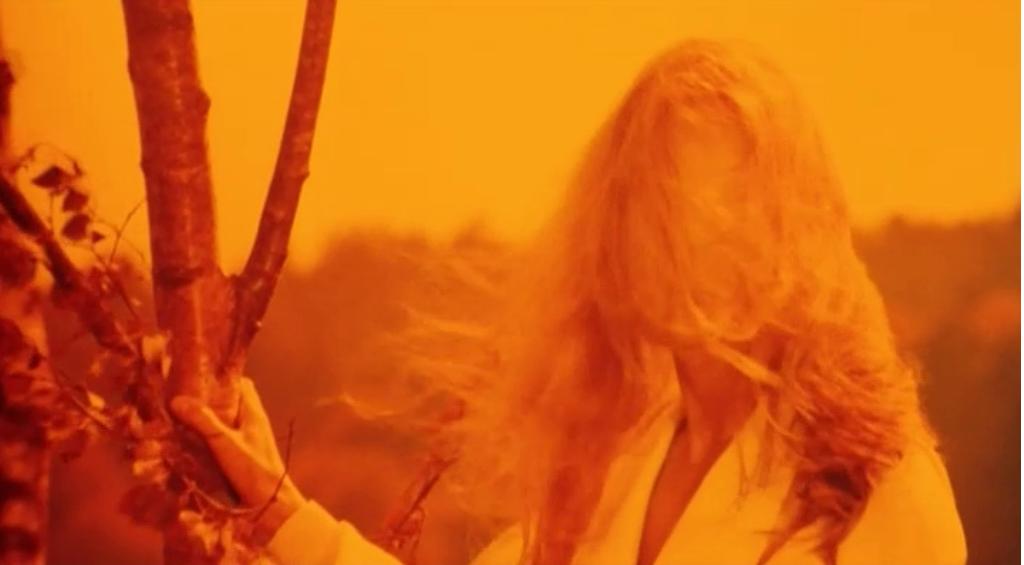
To recap, Michael has gone from a poor schlub with no prospects to a happily married man that is ridiculously wealthy, living his dream and his biggest problems are bitter old women giving him a hard time. Life is tough sometimes. However, the story is told in flashback by Michael and parts of it have nightmarish undertones. What could have happened that made Michael dream of this image in this odd hue?
Please please please let Beetlejuice be responsible
I was never a big fan of Haley Mills as a child actress, but she's a little better than I expected in Endless Night. Her character is very sweet and innocent, but I was surprised to not find her annoying. Well, not too annoying. On an amusing note, when Haley sings, her voice was dubbed over by Shirley Jones; so, when you see the scene and think "Gee, her lips and throat don't quite match the operatic voice in this scene," you are absolutely correct. When I have to start by praising the mediocre talent of a former Disney star, you can tell that the acting is not great. Specifically, Hywel Bennett was consistently awful. The script has a few opportunities for Michael to seem sympathetic or likable, but Bennett manages to deadpan his way through every chance he got. I understand that he needs to be a little mysterious for the mystery at the story's center, but there's a big difference between being bland and reserved. Britt Ekland was also horrid. Ekland isn't typically in films for her acting talent, but she really shouldn't be asked to cry on cue; her "acting" made me wince on multiple occasions. George Sanders was fine, but sorely underused as the only cast member that understood the concept of subtlety. On the bright side, this was the first time I saw Lois Maxwell outside of a James Bond film; all she does is give Michael the cold shoulder, but it showed more range than I thought her capable of.
Miss Moneypenny disapproves
Endless Night was directed and adapted for the screen by Sidney Gillat. Gillat had a long career, primarily as a writer (including a few early Hitchcock films, like The Lady Vanishes), but if this is a representative example of his directorial skills, he should have stuck with his typewriter. I will admit that a decent amount of the problem with Endless Night is Christie's source novel --- it focused on psychology instead of mystery --- but Gillat did absolutely nothing to save the concept. Michael is the narrator, and it is clear that he is an unreliable narrator; Gillat could have run with that idea, having Michael reconstruct scenes when he is caught narrating a lie, forcing the audience to wonder how much of this story actually happened. That's not the route Gillat goes. Instead, Michael just bookends the story in a very loose way. Even worse, the introductory bookend was wretched; coming across as hilariously melodramatic and just plain goofy. Of course, as director, you can also blame Gillat for getting such wooden performances from his cast, too.
"You want us to...act?!?"
There are some technical flaws that I noticed, too, with the most notable being the alleged night scene --- where Ellie wakes from a deep sleep only moments after Michael got up and decides to follow him outside, just like any married couple would ***eye roll***--- that was clearly filmed during the daytime and then artificially darkened. My least favorite aspect of this film was how dull the reveal is. Yes, Gillat made sure to not explicitly hint at the secret before the plot twist, but it was neither shocking nor entertaining. He failed to build an ounce of suspense.
He did, however, build an ugly house for this movie
Even with poor direction and embarrassing acting, Endless Night could have stood out for its twist/reveal/mystery. Had Gillat fostered the notion of Michael as an unreliable narrator, the reveal toward the end could have been fairly cool. Instead, it seems less the work of a dastardly genius and more like a sitcom plot. Bad story, bad acting and a lame twist lead to a bad movie. On the other hand, there is a certain amount of kitsch value to a film with such a ridiculous house, a scene where Haley Mills has no face, and Britt Ekland has the least convincing crying-changing-into-laughter scene ever. This is definitely a bad movie that has aged poorly, but you can laugh at it for a small bit of enjoyment.
Remakes are a funny thing. On the one hand, you are making a movie to appeal to a newer, younger audience. On the other hand, you are hoping for the built-in audience of fans who loved the original to also support the new movie. Of course, there is almost always a backlash from the older fans who argue that the original was a classic that should not be sullied by a slick remake. The filmmakers behind The Thing (2011) opted to sidestep that issue by making this neither a remake or a sequel, but a prequel to John Carpenter's low-budget classic The Thing (1982). Hollywood knows how much you love prequels! Especially prequels that doesn't come right out and tell you if they are, in fact, a prequel or not! Seriously, how hard would it have been to not use the exact same title as the original? Was The Thing: Episode I - The Phantom Menace taken? How about 2 Thing 2 Furious? The Thing 2: Electric Boogaloo? Hell, given the plot, they could have gone the James Cameron route and just titled it Things. But no, we have The Thing (2011). ***sigh***
A group of Norwegian researchers has tracked down the remains of an alien spaceship that has crash-landed in Antarctica. That alone would win them some sort of award, but the leader of the expedition, Dr. Halvorson (Ulrich Thomsen), focuses exclusively on the alien corpse they found frozen in the tundra. The team extracts the block of ice with the alien and brings it back to their base. There, Dr. Halvorson drills into the ice block and takes some DNA to study. And that's when things (HA!) start to go badly. The alien wakes up and escapes; it was strong enough to both explode out of the ice block and jump through the ceiling of the facility. Worse, the alien appears to be killing people and then disguising itself as one of them. How can you tell who's human and who's not when you're trapped in Antarctica and don't want to precisely imitate The Thing (1982)?
Okay, sometimes that is easier done than other times
The acting in The Thing is surprisingly solid, given that this is a survival/horror movie. Mary Elizabeth Winstead is perfectly adequate as the heroine. I would have liked to see some shades of grey in her choices, but that's more of a story problem than an acting one. I was expecting more from Joel Edgerton, though; his acting was decent, but he spent a large chunk of the movie off-camera. Eric Christian Olsen and Adewale Akinnuoye-Agbaje were also also fine. Nobody really stood out among the recognizable actors, but nobody was bad, either. The rest of the cast (AKA the cannon fodder) was comprised of Norwegian actors who spoke little English. Of them, only Jørgen Langhelle impressed me, if only because he was the only character who couldn't speak English, but he still communicated in a fairly realistic way.
The direction, on the other hand, was less impressive. Matthijs van Heijningen Jr. made his feature-length debut with this movie, and it gets a bit rough in parts. What makes the original The Thing so compelling is the suspense and the ambiguity. This movie has little of either. Instead of focusing on how anyone could be infected/assimilated, this film opts for the tone of a standard monster movie, making it feel more like a somewhat action-free Resident Evil than anything else.
Give that starfish some teeth and Milla Jovovich will kill it
It's not a bad idea to change the tone of this film significantly from that of the original film, but it's clear that van Heijningen Jr. wasn't doing that intentionally. There are moments where the characters are accusing each other and acting paranoid, but those scenes lack tension and suspense. Why? Because the film doesn't focus on who has been alone and could be a monster. Without the audience noticing who could be a Thing, it feels absolutely random and devoid of suspense or emotional investment. And then there is the fact that many of the characters die of starfish-arm-powered chest punctures and everyone who is suspected of being a Thing actually is shown Thing-ing out. I blame the director for taking a decent premise and boring me with poor execution.
One of the most iconic parts of The Thing (1982) was its truly stellar use of practical effects. I recall hearing the filmmakers comment about how much effort was going into the practical effects of The Thing (2011), back when they were promoting the film, but there is also a substantial amount of CGI. What practical effects were in the movie were actually pretty good. Specifically, the alien autopsy had a pretty cool bit, although I imagine most species would have more internal organs than were shown here.
Oh, it had a person-sized pouch in its tummy?
Aside from that, though, I was significantly unimpressed. The CGI wasn't that bad, but it was uninspired. The monsters certainly became monstrous, but I would have liked to see more adaptation in the forms; mouths and eyes for the creature appeared to remain on the human head, which was puzzling because the original form from the ice seemed far more amorphous.
Becoming an alien, or about to projective vomit? You decide
The most disappointing aspect of the special effects for me was how much they clearly imitated Resident Evil. Sure, there was some continuity to the FX in the original film, but I hated the starfish-shaped killer appendages. Is the Thing trying to murder the hell out of Antarctica, or is it supposed to be assimilating people and making its way to mainland to conquer the Earth?
It's backup plan was to audition for The Addams Family
Even with the poor direction and the disappointing special effects, The Thing could have been a mediocre movie. But it's not. Why? To put it simply, this film doesn't follow its own logic. Mary Elizabeth Winstead's character is a paleontologist who is hired to examine the alien. That makes sense, right? And yet, not only is everything she says dismissed, she doesn't even do the preliminary examination of the alien's blood or body! What the hell is she there for, if not those exact reasons? For that matter, why is everyone so interested in the alien body, but not the ship? The group extracts a huge ice cube with an alien inside it and where do they keep it? In the heated building, of course. To be fair, it was still cold in the building, but why risk any thawing/spoiling when you can just leave it outside? It's not like a passerby is going to steal it. Speaking of the alien, its ship was found hundreds of yards beneath the surface of the ice, and yet the alien was found only inches below. I'm not saying that is impossible, but it seems unlikely. Even less likely is the irrational acceptance of fire as a cure-all in this movie, despite important evidence to the contrary.
Above: a demonstration of "Dr. Halvorson's Botanical Syrup and Skin Bronzing Solution"
So they all discover the monster, right? And then they burn the shit out of it, right? Well, it is soon discovered that the blood from the dead creature was not dead, which means that the crispy critter was also not dead.
And we're not talking Miracle Max or "mostly dead," either
So fire doesn't kill these Things. And yet, it does. You would think a little thing like its blood surviving char-broiling would lead to the "dead" Things coming back to life, but no. And nobody has a problem with that.
From a production aspect, I have to wonder why this movie was ever made. Was anyone dying to know how the alien was discovered? I don't think so. No, I suspect that someone saw the opportunity to make some cash by remaking a well-remembered horror flick and figured out a way to differentiate this from all the other horror remakes out there. After all, the original movie touched on the Norwegian group that went through virtually the exact same experience as Kurt Russell and friends; why not exploit that to make virtually the same movie, but not have to deal with fans whining about the changes made in the update? Of course, if they really wanted to differentiate this film from the original, then it wouldn't have the same damn title. If this movie wasn't such a faded ditto copy, I would be a little more lenient and say it was just sub-par. Aping a classic without the guts to admit it, along with its clumsy execution makes this movie pretty awful.
On a side note, what are the odds that Joel Edgerton's character A) has an earring in 1982 and B) is desperate for news about the Cleveland Cavaliers, who were in the middle of a 9-year period of atrociousness?
I start to think of Christmas movies right after Thanksgiving is over. I don't always watch them right away, but I make a flexible list of movies that I'd like to watch as I prepare to buy useless trinkets for others. I had had Antichrist in my Netflix queue for several months now --- mostly because the idea of Willem Dafoe in a Criterion Collection movie that I was oblivious to intrigued me --- and I figured that it might balance the saccharine-sweet movies I knew I would be watching just before the holiday.
Note to self: being right is not the same thing as being happy.
Antichrist begins in black and white, with a close-up of sexual penetration. So, if you are the sort of person who doesn't like seeing testicles (prosthetic or otherwise) in their movies, this might be a good time to turn the movie off, because it will get worse. While He (Willem Dafoe) and She (Charlotte Gainsbourg) are enjoying themselves, their toddler-aged son, Nic, is wandering about their home. Ultimately, Nic falls out an open window to his death.
Meanwhile, his parents sing "Tears in Heaven" softly in the shower
That was just the prologue, and the film doesn't get any more cheerful than that. The film switches to color, and we learn that this is a film with chapters, which doesn't make it seem pretentious at all. Chapter One is Grief, Two is Chaos Reigns, Three is Despair (Gynocide), and Four is The Three Beggars. Obviously, the couple is devastated by the loss of their son. She is hit harder than He is, and she winds up in a hospital numb from grief and medication. He happens to be a therapist, so he makes the entirely wise decision to take her home and treat her himself. Not surprisingly, that doesn't work so well. He adjusts his methods and decides that the best treatment for Her is exposure therapy; in other words, he will discover what makes her afraid and will help her confront it in a safe way. Why the film veered from grief to fear, I'm not entirely sure, but the two can be connected, so I won't nitpick. The couple hikes to a remote cabin, called Eden (this film is absolutely not heavy-handed), where they spent time last summer as She tried to write a thesis paper on Gynocide. Here, He will try to help Her overcome her grief and fear by making her face them. Of course, that doesn't always lead to peaceful interactions...
The Green Goblin loves "girl talk" time
Antichrist is a bizarre experience. Those familiar with Lars von Trier's other movies might not be surprised by that fact, but if you put this on with the assumption that you are going to be entertained, you will be grossly disappointed. This is my first von Trier film, so I won't make any generalizations about his work, but Antichrist is definitely meant to be harrowing and artsy. If that sounds like your brand of whiskey, you might find something redeeming here. The cinematography is, for the most part, effective. I didn't care for the amount of hand-held photography or how frequently the camera went out of focus in the first third of the film, but von Trier definitely succeeded in capturing the most uncomfortable moments in the story on film. There are tons of camera shots that are filled with Meaning, but much of the symbolism was lost on me, since I was busy being horrified.
The "bullet time" shot seemed unnecessary, though
Von Trier did a great job with the actors; aside from some basic stupidity on His character, Willem Dafoe was very good and Charlotte Gainsbourg managed to grieve convincingly on camera, even as her character went bat-shit crazy. It is difficult for two characters to carry an entire film, but these two did it well. They weren't fun to watch, but I have to admit that they gave some quality performances.
I wasn't sure I would be able to take that rational of a look at Antichrist. My immediate reaction to the film was something along the lines of "Wait...what? AAAA! Why would you do that? AIEEEE! What is that supposed to --- AAAUGH! $@@#%#^&!!! &#$%#$*@%*$!!!" And I went on speaking in symbols for the rest of the day.
"Chaos Reigns"
I went into this movie expecting it to be kind of weird. When Dafoe does independent films, they are rarely typical and I was aware of von Trier's reputation. But this...wow. What an uncomfortable experience. I could handle the weird crow, the deer with the dead fawn sticking out of it, and the fox or weasel or whatever the hell it was that was shredding itself. Those are all bizarre and unsettling things, but that is within the range of things I will accept on film. I was not expecting frequent nudity from the two stars, but I can handle that, too, even if the scenes are not intended to be erotic. On a side note, why do non-porn movies featuring masturbation scenes usually involve crying? Is that the only way directors can indicate that a scene is not meant to be porn-y? The genital mutilation pushed Antichrist over the edge for me. Once that started happening, I checked out. I managed to finish the movie, but more to prevent any temptation to ever watch the film again (to combat any argument that I "missed" something) than out of any affection for the story or characters.
Not pictured: THE HORROR
I assume that my reaction was something close to what von Trier was going for. Antichrist is a film steeped in directorial intent, and it was obviously not mangled in post-production to make the film more palatable for the masses. I get that the characters are handling the grief process absolutely incorrectly; instead of accepting, there is treatment and punishment. I also understand that these two were probably already a little off before the death of their son; she had come to believe that women are evil and he was a controlling man that apparently ignored his infant child and (probably) his wife. I am sure that there is a lot more here that I do not understand, because I don't want to have to go back and revisit the film and its symbolism. As much as I appreciate the acting in the film and the unusual story, I cannot overcome my revulsion to the film. Some might see Antichrist as a triumph of artistic will and another example of a provocative filmmaker shocking his audience. I see this as a miserable way to waste 100 minutes, observing self-satisfied direction, on-screen torture, and delusions of artistic grandeur. I would give this a lower rating, but it is not incompetent. It is just intentionally painful.