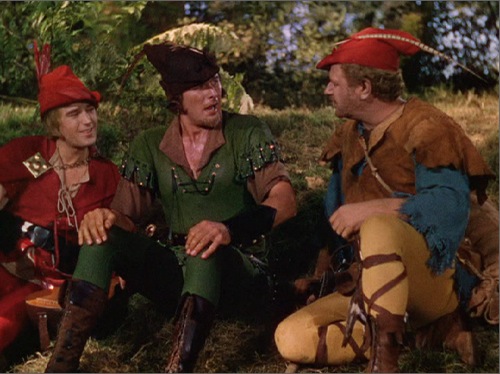
I had never seen an Errol Flynn movie before sitting down to watch
The Adventures of Robin Hood. It's not all that surprising, I suppose; swashbuckling movies have been out of style for decades, and the rest of Flynn's body of work consists mostly of action-adventure movies in a period where I prefer moody noirs. Honestly, I can't think of an instance where someone has even recommended an Errol Flynn movie to me; it is entirely possible that my knowledge of Flynn comes from references made by
Nightcrawler in X-Men comic books. Still, a legend is a legend, and I thought it was past time I gave Mr. Flynn a chance.
I think we all know the basic story in
The Adventures of Robin Hood by now. The rightful king of England, Richard the Lionheart, is kidnapped by another country as he attempted to return home from the Crusades. Richard's slimy brother, John (
Claude Rains), has been temporary ruler of the land for some time, and has enjoyed living a life of luxury while oppressing the Saxon lower classes. When he hears of his brother's trouble abroad, John takes it upon himself to raise taxes to pay for Richard's ransom.
 |
| If this was a movie trailer, you would have heard a record scratch after I typed that |
Just kidding! John is allegedly raising the cash to save the crowd favorite king, but he is secretly plotting to use the money to legitimately crown himself king. Won't anyone stand up to this mean, mean man? Enter Robin, Earl of Locksley (
Errol Flynn). He takes it upon himself to denounce John (in John's own castle, to boot!) and promises to fight him at every opportunity. I could go into more detail, but the rest of the film basically follows the same major plot points that the later remakes have. Basically, Robin Hood becomes a thorn in John's side and Robin does his best to topple the would-be king.
 |
| And by "topple," I of course mean "impale" |
Okay, so my first impression of
The Adventures of Robin Hood wasn't that great. It's certainly not bad, but it failed to impress me the same way that contemporary films like
Pepe le Moko,
Mr. Smith Goes to Washington, or even another epic like
Gunga Din. I have my suspicions as to why that is, but I'll wait a bit to explain.
 |
| Hint: it has nothing to do with silly hats |
The acting in
The Adventures of Robin Hood is okay for the time period, but not remarkable on the whole. Errol Flynn is naturally who you picture when you think of this movie, but there is something about his performance that doesn't click with me. Flynn's action scenes were pretty good for the time period and it appears that he did many of his own stunts, so I like him in those bits. It's the abruptness of his performance elsewhere that just felt odd to me. He would go from a feisty political rant to hands-on-his-hips-head-tilted-back laughter at a moment's notice. I will admit that Flynn looks like he's having fun on-screen, but he comes across more as an egomaniacal jerk than a hero to me.
 |
| "'Sup, bitches?!?" |
Olivia de Havilland is fine as Maid Marian; she gives a lot of dreamy eyes to Robin Hood to convey her love --- which is by no means a bad method --- but I thought the attempts to make her more than a damsel in distress, while interesting, ultimately failed.
Basil Rathbone was solid as Robin's chief enemy,
the Sheriff of Nottingham Sir Guy of Gisbourne. He didn't ham it up, but Rathbone did seethe dislike for his enemy well. Claude Rains was suitably slimy as Prince John. I spent most of the time he was onscreen staring, mouth-agape at his ridiculous wig and disgusting beard.
 |
| Great. Now I've hurt his feelings. |
Melville Cooper was pretty good as the Sheriff of Nottingham, although his character is a lot dumber and far less threatening than just about anyone else who's played the part. As for Robin's Merry Men,
Patric Knowles matched Flynn's hands-on-hips laughter,
Alan Hale played a surprisingly regular-sized Little John, and the always vocally distinctive
Eugene Pallette was probably my favorite underling as the ornery Friar Tuck.
 |
| "Why, you're in Technicolor, too!" |
Two men get credit for directing
The Adventures of Robin Hood.
William Keighley was hired first, but was eventually replaced by
Michael Curtiz when the producers were not impressed by the action scenes. And yet, enough of both men's work made the final cut to justify co-director credits, which is odd. I can definitely attest that some of Curtiz's action direction worked well; the sword fighting scenes in the castle are still a standard for sword fights in film. Personally, I would have rather seen less fencing swordplay and more
Princess Bride-style fighting, but it's still good, especially for the era. I don't like that many action scenes are sped-up to look faster, but Flynn is clearly at his best in these sequences.
It should also be pointed out that many of these scenes have become iconic; watching shadows fencing in the castle was a nice touch and Robin splitting an arrow to win the archery tournament is still classic. The size of the production is also impressive. The sets are enormous and there are tons and tons of extras, all wearing their gaudiest tights and hats. The color in this film is surprisingly vivid, even by today's standards; I don't normally point out the novelty of color in films, but everything is gorgeous and bright, especially the outdoors scenes.
Everything about this movie screams "epic," for better or worse. To go along with the huge scale, the acting performances are also very broad. Here's the thing about the acting in
The Adventures of Robin Hood:
the supporting cast is playing to fit Errol Flynn's lead. If you don't
like how he delivers his lines or reacts to certain things, the
supporting cast isn't going to impress you, because they are more or
less props for Flynn to dash around. This is not a subtle movie that wins you over through clever dialogue or interesting camera techniques. This is a Hollywood blockbuster, dedicated to spectacle. In that, it is successful. But there are so many moments in
The Adventures of Robin Hood that are not epic, and that is where this film stumbles.
 |
| Another mistake: introducing cat-style grooming to romances |
Sure, I can agree that an arrow in the torso causes instant death, every time. Yes, I am aware that Robin Hood is shown eating meat off the bone a comical amount of the time. No, I don't care that the whole Normans and Saxons subplot is blown way out of proportion. What I can't stand is that only villains are irritated by Robin Hood. He rubs every single character he meets wrong at first, but eventually wins them over by being a complete dick and then laughing out loud. And he's an attention whore! When Richard finally reveals himself to John, it's definitely a King Moment; after maybe a second of time to react, Robin jumps in front of everybody and essentially screams "Look at me!!!" Maybe my problem is that I never bought into Errol Flynn's performance enough and enjoyed the ride. There are enough over-the-top quirks in this film that I can see being sources of joy for a true fan, the same way I enjoy the imperfections of many of my favorites. Unfortunately, I was hoping for a classic and found the 1938 equivalent of a Summer blockbuster. It's fine for what it is, I suppose, but I was left wanting more.