Showing posts with label Gregory Peck. Show all posts

Wednesday, October 13, 2010

The Omen (1976)

Robert Thorn (Gregory Peck) was in an Italian hospital, distraught, when a priest (Martin Benson) approached him with a fantastic idea.  Why should Robert bother his wife with an inconsequential detail like the death of their newborn son only hours after childbirth, when he could lie to her instead?  The priest points to another newborn infant, a child whose mother died during childbirth on that very same day --- the orphaned child would be the same age as Thorn's lost child, and it even kind of looked like Robert's wife, Katherine (Lee Remick).  C'mon...!  It's just a little white lie, and it's not like he's lying to a real person, it's just his wife, a woman!  Plus, if a priest says it's okay, it must be up there with cleanliness, right?

Hoo boy.  The Omen is that rare breed of horror movie that managed to get a talented group together and focus on scary stuff instead of cheap thrills.  That said, the whole "unplanned adoption" angle is a pretty goofy start to a movie that ends up being genuinely chilling.  As the years went by, Robert and Katherine raised their little boy, Damien, with no unseemly incidents.  On his fourth birthday, though, his nanny committed suicide in front of the entire birthday party.  A replacement nanny, Mrs. Blaylock (Billie Whitelaw), mysteriously showed up, without any notice or any connection to the family at all.  While very committed to Damien, the lady was a bit creepy.  Around this time, Robert is approached by another priest, Father Brennan (Patrick Troughton) who claims that young Damien is the Antichrist.  Not surprisingly, Robert doesn't take the priest's words too seriously.  However, as peculiar deaths start to surround the Thorns, that idea becomes more credible and the suggestion of eliminating the evil --- killing Damien --- becomes a serious consideration.

I don't know why --- maybe it's the focus on the Book of Revelations --- but I always assumed that The Omen would be one of those horror movies that tries to strike fear into Catholics first, and the rest of the world second.  Maybe that's true; I'm not Catholic, so I can't speak for them.  I can, however, say that this movie was awesome.  Why?  Well, a big part of it is the fact that an actual movie star acted in the film.  I really enjoy Gregory Peck and his no-nonsense manliness.  He doesn't appear to be mean, but I imagine that, if you lost an arm in battle, he would scowl and ask if you wanted him to kiss it and make it better.  I don't have anything more than a feeling to back this up, but I imagine that, after seeing a Clint Eastwood western, Gregory Peck would leave confused, asking "What was he smiling at?"  Basically, Peck was a classic Hollywood leading man, and he was still good at it in the 70s.  When casting the part of a man who might kill his own child --- sure, he'd regret it, but a man's gotta do what a man's gotta do --- I doubt there was anyone else on the casting list.

Gregory Peck is about to hock a loogie on you.
The rest of the cast is good, too.  Lee Remick manages to play her conflicted role quite well and Billie Whitelaw is one scary lady.  The smaller roles are also well done.  Martin Benson is good as the evil-ish priest and Patrick Troughton balanced desperation with instability very well.  David Warner managed to overcome a ridiculous haircut to play a key role as the photographer, too.

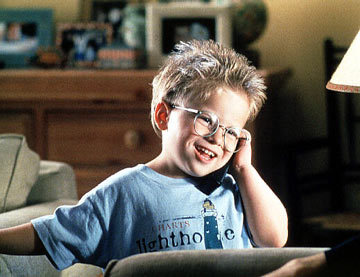
This was director Richard Donner's first big movie, and he does a fine job with the directing.  It's always a crapshoot when older movies have child stars, like this film does.  Do you end up with a Haley Joel Osment, or a Jonathan Lipnicki?  Donner manages to direct Damien very well; actually, he films around Damien very well.  It's subtle, but I'm pretty sure that Damien was not actually reacting to a lot of what was going on around him.  It's like Donner would say, "Let's see a smile," and then use Damien smiling sweetly right after a shot of somebody dying.  The total effect is that Damien is a sinister monster, but doesn't rely on the child doing much acting.  Very clever, Mr. Donner.  I also liked Donner's use of the theme.  I'm not usually one to applaud the music in a movie, but these Satanic choruses were freaky.  To make this movie even better, there are some awesome death scenes in the movie, including one of the best beheadings in cinematic history.

Do the math.  Good acting + good directing + good violence = good horror movie.  It's pretty simple.  I always enjoy when a genre film like this takes the time and effort to bring together a good cast, because that makes everything easier.  Honestly, this movie could have been wretched.  All you need is a slight change in tone and you have a film that advocates child abuse/murder.  Luckily, this movie played upon the frightening notion of a truly evil child, but allowed the characters to doubt the existence of that evil.  That uncertainty adds a complexity not usually found in horror films, where the evil is almost always total and explicit.  This is just a well-made movie with great contributions from the actors, director, and everyone in post-production, making it a thinking man's horror movie.  I guess you could say that this Omen is good.  I hate puns.

Tuesday, May 18, 2010

The Guns of Navarone

Imagine you are a casting director, in charge of casting a war movie that will be released in 1961.  Your task is to find a leading actor that can fit the description implied by this line of dialogue: "You speak German like a German."  Who do you choose?  It's not an easy choice.  When I think of available lead actors in the early 60s, I can only think of actors with very unique voices that would sound extremely funny speaking German.  Think about it...John Wayne, Charlton Heston, Cary Grant, James Stewart --- none of them would sound right saying "Ich liebe Deutschland."  Clearly, the best choice was...Gregory Peck?  Really?  Don't get me wrong, Gregory Peck was a man among men, the type of guy that cut razors when he shaved, but...a convincing German?  I have a hard time imagining that.  Of course, this was a time when authenticity in casting often meant British actors putting on dark makeup, so maybe I'm just being picky.

The Guns of Navarone is a Mission: Impossible-type operation, set in World War II and based on Alistair MacLean's novel of the same name. 2000 British soldiers have been marooned on a Greek island in the Aegean Sea, with limited food and weapons.  Intelligence reports indicate that the German forces are planning to make an assault within a week on this island, massacring the mostly defenseless soldiers.  All attempts to save these men have failed because the nearby island of Navarone has two enormous anti-aircraft-style guns covering the stranded troops and their island.  Since attacks by air and sea have failed, a more subtle approach is needed; a motley crew is assembled to sail to the island, sneak into the military complex and blow up the guns.  It's a simple plan.  All they have to do is sail to the island without attracting attention, climb a nearly climb-proof cliff, cross the island unnoticed, infiltrate the military base, sneak into the complex that contains the guns, and blow it to hell.  Viewers learn all this within the first ten minutes of the film.  Does it work?  It's a WWII movie, made in 1961.  What do you think?  Actually, history buffs will recognize this fictional plot as mirroring the Dodecanese Campaign, where British forces tried to capture the Greek and Italian islands to use as airbases against the Germans; it was a costly failure for the British.  I guess the ending isn't so obvious, after all.

This is one of those movies where a bunch of hardy strangers are brought together to kill some Germans.  They do just that.  Gregory Peck is the supposedly fluent German-speaker that is only on the mission because of his rock climbing abilities.  His partner (who openly vowed to kill Peck after the war) is Anthony Quinn, an officer in the defeated Greek army.  They are assigned help, consisting of an extremely British explosives expert (David Niven), a hand-to-hand combat expert with a specialty with knives (Stanley Baker), the leader (Anthony Quayle), and a hot-headed shooter (James Darren).  The group has nothing but bad luck the entire time; their ship sinks on the way to Navarone, their leader breaks his leg on the initial climb, and Germans dog them throughout the film...almost as if they knew where the group would be.  It gets a little predictable at times: one guy will stand up to the authority figure, another will lose his taste for battle, others will form bonds of brotherhood, etc.  The movie throws in some romance and betrayal to spice things up, but this is a pretty standard, mission-oriented, 1960s war movie.

Not that '60s war movies are bad, by any means.  This movie is unique within its genre with both the setting (WWII Greece) and the activities (rock climbing, sabotage), which help keep the movie lively.  It is also pretty brutal for its time.  A few men in the group die unmourned and a woman gets executed, both very atypical of war films in 1961.  The action is fairly commonplace, but director J. Lee Thompson does a pretty good job getting his varied (in talent and experience) cast to react appropriately. 

Movies like this can only get so far on spectacle and plot, though.  It is the cast's performance that determines the longevity of the film.  Here, we have Gregory Peck, who tends to play the same character over and over again; I mean that in a good way, because his stern persona is perfect for war movies.  Anthony Quinn does a decent job of playing Greek, despite the fact that he is Mexican.  The stormy relationship between Peck and Quinn is supposed to form the core of the film, but David Niven's performance opposite Peck is more memorable.  Niven's character is the least military-like in the group and he spends much of the first half of the movie attempting to be sarcastic (I say "attempting" only because the script isn't great).  However, when things get tough, he is the one that stands up for his fellow soldiers and acts as the group's conscience against the tactical mind of Peck.  The dynamic between these two men sums up the film quite nicely.  They address the issues of the value of life on impossible missions, the tactics of torture, honor among officers, and more.  The movie feels dated when you watch it, but it has the decency to function as a movie about soldiers and not as a propaganda piece.