I can't say that I was super-excited for
The Hobbit: An Unexpected Journey. Part of it had to do with my work schedule at the time I saw it --- a 12:01AM opening day showing during a time where I worked long and early hours every day --- and part of it had to do with the fact that I grew up with
The Lord of the Rings books before I ever got around to
The Hobbit. While
The Hobbit is charming and fun, it's not epic awesomeness. Still,
An Unexpected Journey was being made by the same people who made the excellent
LotR trilogy, so there should be little to worry about, aside from a hilarious dose of homosexual undertones, right? I was a little uneasy, though.
The Hobbit is not a particularly long book, and yet
An Unexpected Journey is only the first part of a
Hobbit trilogy, while the significantly larger
The Lord of the Rings books were barely squeezed into one (very long) film each. Doesn't it feel like Peter Jackson is milking this one a little too much?
In this prequel to
The Lord of the Rings trilogy, we follow the young Bilbo Baggins (played by
Martin Freeman here and
Ian Holm in
LotR) as he is enticed by a wizard, Gandalf the Grey (
Ian McKellen), to embark on a dangerous adventure. The goal is to help a clan of dwarves, led by Thorin Oakenshield (
Richard Armitage), reclaim the home of their ancestors. Why does it need reclaiming? Well, dwarves like to mine riches from the earth. Dragons apparently like riches, too. When the wealth of Thorin's granddaddy became well-known, a dragon decided to move in and fricassee anyone who interrupted his enjoyment of his ill-gotten riches.
 |
| Artist interpretation |
Of course, they're not going to take on a dragon all alone. To go along with Bilbo, Gandalf, and Thorin are a lot of other dwarves. In case the preview didn't illustrate that point to you, here's an alternate movie poster:
 |
| Which one of them is the hobbit? |
Bilbo isn't really built for adventuring; he's a hobbit, which means he is small and inexperienced with weapons and the dangers that fill Middle-Earth. He's not ready to face trolls, orcs, or goblins, much less a dragon that could frighten battle-happy dwarves --- and he may never be ready. This is the tale of Bilbo's struggles to find his place in the group and in the world outside of his home in Hobbiton. Of course, something else important happens in
The Hobbit: An Unexpected Journey: Bilbo finds that ring that everyone made such a fuss about in those other three hobbit-ish films.
The acting in
The Hobbit: An Unexpected Journey is good, but this isn't really a movie built around individual performances.
Martin Freeman plays a wonderful everyman, so casting him as the very suburban Bilbo was a good choice that paid off well. As the audience's POV character, he did a good job being confused and frightened for the audience, and I thought he conveyed his character's emotional journey rather well.
Ian McKellen was good as Gandalf the Grey; he's obviously familiar with the part, but I liked that he was a little more temperamental and less wise in this film. Of the dwarves,
Richard Armitage was by far the most impressive; it helps that he got to play a bad-ass and didn't have to wear goofy facial prosthetics, but Armitage was awfully good at brooding, too.
 |
| ***Glower*** |
Ken Stott was the next most interesting dwarf, as the white-bearded right hand to Thorin. He didn't really do anything terribly cool, but he turned in one of the better acting performances in this series simply through his dialogue.
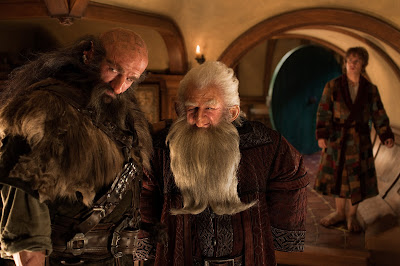 |
| Stott was so good that I almost never laughed at the Cousin It under his nose |
Oddly enough, those two cover most of the acting amongst the thirteen dwarf characters. You can argue that
James Nesbitt had a few solid moments, or that
Aidan Turner stuck out (if only because he looked like the heartthrob of the group), but they didn't really have much to do. The rest of the dwarves made little to no impression at all. A lot of actors from
LotR came back for small parts, and they were all fine.
Elijah Wood,
Ian Holm,
Hugo Weaving,
Cate Blanchett, and
Christopher Lee showed up, said a few lines, and were gone again.
Andy Serkis reprised his role as Gollum and he was excellent. Serkis really does a great job every time he puts on a motion capture suit, and I hope he one day gets some recognition for the pioneering work he's doing (fun fact: Serkis also served as a second unit director on these movies). He doesn't steal the film, like he did in
The Two Towers, but that's mainly due to screen time. Note to Peter Jackson: there's always more room in the script for Gollum.
 |
| He's like Jell-O in that way |
The only other actor worth mentioning is former Doctor Who
Sylvester McCoy, who got to play Radagast, the batty wizard that was apparently named by a twelve year-old in 1992. McCoy did a solid job with a goofy character, almost to the point where I forgot about the fake bird poop on his face.
 |
| Almost |
The special effects were as stellar as you would expect from this series of films and these filmmakers. It kind of sucks that this movie revisits so many things that
we've seen before in Middle-Earth, because it gives a bit of a "been
there, seen that" feel to the film. Even with that in mind, the sets
--- particularly the ancestral dwarf home --- are all awesome. The CGI
was excellent, even in the large battle scenes that clearly didn't have
the actual actors fighting in them. I wasn't a big fan of the makeup on
the dwarves, though. Too many just looked silly, even if they are
faithful to how Tolkien wrote them. It's not a big deal, in the big scheme of things, but it irritated me that there were bad guys who looked dirty and creepy...
...and then there would be good guys who looked like complete cartoon characters.
 |
| This is actually one of the better-looking dwarves |
I'm not entirely sure how I feel about
Peter Jackson's work on
The Hobbit. As far as his co-writing credit goes (the script was basically done by him and his partner, Fran Walsh), I was impressed that
An Unexpected Journey felt like a complete story. Bilbo and Thorin had decently crafted character arcs, there was a natural ending point, and there was no cliffhanger ending. That's tough to do with source material that originally had only 310 pages --- and keep in mind that two more movies are on their way from that same material. I have no idea what the next two films will contain, but I'm alright with the contents of this one. If you're wondering where the hell Jackson and co. found the rest of the material to pad this story enough to get three movies out of it, that was touched on a bit in this interview Peter Jackson had on
The Colbert Report:
As a director, I was a little less pleased with Peter Jackson. The tale was definitely told competently. The movie looked absolutely gorgeous, and the pacing was brisk; while my mind keeps telling me that this story was stretched out, it didn't feel that way when I was watching it. I wasn't a huge fan of the action sequences; without someone awesome to focus on (like Legolas in
LotR), I was faced with a bunch of characters I didn't really care much about in situations that didn't seem all that dire. Admittedly, part of that impression is due to the fact that this movie looks so much like the
Lord of the Rings movies that it suffers when you compare them by scale --- having fifteen good guys fighting a handful of orcs pales in comparison to the odds faced in
LotR. But the problems are not just by comparison. Less than a third of this cast was fleshed out at all, so their survival meant little to me.
 |
| I only cared about the guy who isn't attending a rap-metal show at the Renaissance fair |
That's on Jackson. There is no excuse to have all these characters left undeveloped, especially when there are three movies to fill. Another option would be to imply how unimportant some of them are, but each one has enough quirkiness to make the viewer wonder about them. This movie also suffered a bit from a lack of truly stellar bad guys. The goblin king was kind of gross, but he struck me as more of a bloated tumor than a credible threat.
 |
He has a tumor the size of a grapefruit an obese cave dweller |
The albino orc looked fairly cool, but he didn't get the chance to actually do anything cool. He just posed and growled. He was so underwhelming that the top Google image hits for him are either blurry or behind-the-scenes shots.
 |
| This was the best pic I could find of Azog, the Defiler. I mean "best" in every way possible. |
Sure, Gollum was awesome (again), but he A) wasn't the primary threat B) only threatened Bilbo and C) obviously survived, along with Bilbo, because they are both in
The Lord of the Rings.
My biggest complaint with
The Hobbit: An Unexpected Journey, though, is with its tone. This story is not as epic as
LotR, but it is being presented in the same way. As Stephen Colbert pointed out, Tolkien tried to go back and write an epic version of
The Hobbit, but was later convinced that it was a bad idea. It seems odd that the filmmakers would make the same mistake. There's enough grandiosity in Middle-Earth to make this an epic tale, I suppose, but it just doesn't seem like the right fit.
 |
| It troubles Gandalf, too |
I guess the easiest way to sum this movie up is to say that
An Unexpected Journey is missing a lot of the charm that I expected to find, going into the movie. That doesn't mean that it is a bad movie, by any means. It's just not what I expected or, really, wanted in a film adaptation of
The Hobbit. It is still a good movie and totally worth seeing. There is a lot to like here. In fact, there is just under three hours of movie to like here (and we have six more hours on the way!). It's just not as overwhelmingly, jaw-droppingly fantastic as the
Lord of the Rings movies were. I think that is because this feels like a continuation of those films, instead of a new trilogy with its own identity. Hopefully, the sequels will course-correct that a little.
A quick aside on the format of
The Hobbit: An Unexpected Journey: I have now seen this film in the standard 24 frames per second and in 3D 48 frames per second. The former was a much better experience for me. The 3D was fine when I saw it on opening night, but the action scenes looked terrible. However, my experience doesn't match up with any of the other complaints I've read online regarding the 48 fps presentation. Instead of looking like a video game, or looking "too real," or looking like the ClearMotion option on a Samsung TV, all the action looked like it was sped up. It felt like I was watching something out of the silent movie era, or at least an action scene from an early James Bond movie. My assumption is that someone played the 48 fps version of the movie at 24 fps (because that's how fast-motion scenes are conveyed in those other examples). If you have a better theory, I'd love to hear it.