Showing posts with label Maggie Smith. Show all posts

Friday, January 6, 2012

Gosford Park

Watching The Mirror Crack'd last month reminded me just how much I used to enjoy Agatha Christie novels.  Sure, they're a bit dated, but there is something I find appealing in a whodunnit with a limited number of suspects.  Luckily, there are very few whodunnits made into motion pictures, which means that it is relatively easy to find the most popular and critically-acclaimed entries in the genre.  According to a two-minute long internet search I conducted, the only famous whodunnits of this century are Gosford Park and Identity; I sure as hell wasn't going to subject myself to Identity again (John Cusack, please make better movies!), so I opted to watch Gosford Park.

The premise for Gosford Park is pretty straightforward, although the relationships between the characters are anything but.  Sir William McCordle (Michael Gambon) and Lady Sylvia McCordle (Kristin Scott Thomas) are entertaining for the weekend.  Their extended family and their servants all descend on Gosford Park for a few days of prim-and-proper 1930s British etiquette and dinners.  The servants defer to the needs of their masters, and the masters defer to Sir William, who has more than a few family members dependent on his generosity for their income.  Sir William, though, has had enough with generosity and plans to cut off a few needy family members.  The lives of the wealthy are not just their own, though; many among the help have intimate (read: sexy) knowledge of the masters.  With all the secret sexiness and financial desperation in the air, it is not a huge surprise that Sir William is found stabbed at his desk, at a time when almost anyone could have slipped away and done the deed.  It is a surprise when it is revealed that the stab was not the cause of death; someone else had killed Sir William, before he could be murdered by someone else.
Lower left: the look of a man who finds out there is a line to murder him

The cast of Gosford Park is large and ridiculously noteworthy; the ensemble is so large, in fact, that it is difficult to gauge the acting quality for most of the cast.
It is, almost but not at all literally, a cast of thousands
For the upper class characters, Michael Gambon stands out as the patriarch/victim; I became familiar with Gambon through Harry Potter, so I enjoy it when he plays characters with a bastard streak in them.  Kristin Scott Thomas was solid as your typical woman-married-to-a-wealthy-man-much-older-than-her, although I thought she was at her best when she was dealing with Ryan Phillipe.  Maggie Smith was fun as a crotchety old witch.  Camila Rutherford got to look dazed and confused.  I don't think I've ever seen Geraldine Somerville in a role outside of Harry Potter's mother, so that was mildly interesting.  Charles Dance didn't make much of an impression on me.  Tom Hollander was kind of wimpy in his role, but it was better than the pompous one he played in Pirates of the Caribbean.  Jeremy Northam, who is rarely in anything I want to watch, was surprisingly likable and actually sang quite well in this movie.  Bob Balaban (along with Maggie Smith) quietly delivered most of the film's humor.
Hilarity!
While not quite upper class, comedian Stephen Fry makes a short appearance as a humorously inept (but surprisingly plausible) police inspector.  The help were, surprisingly, given (by my estimates, anyway) a little more time to shine.  Helen Mirren had the meatiest role and was predictably excellent.  Emily Watson was also very good as the character that shows the point-of-view character, meekly played by Kelly Macdonald, how things work at formal functions.  This was a good film for long-established Brits; I thought Derek Jacobi had one of the better sub-sub-plots, and Alan Bates was solid as the head butler.  Richard E. Grant provided some very low-key humor, which suited his snooty character just fine.  Ryan Phillipe got to play a character with a twist, which he managed to not completely screw up.  Clive Owen rounded out the underlings by being rude and mysterious whenever he wasn't undressing me with his eyes.

There is just a crap ton of actors in this movie, and a surprising few made a lasting impression on me.  I haven't seen many of Robert Altman's films (please don't recommend The Player to me, it makes my eyes roll more than a teenage girl talking to her mother), but I know he likes to play with large, well-known casts.  I thought that worked in his favor in Gosford Park.  Really, the biggest problem with movie mysteries is that the audience knows that certain actors are destined to have important roles because they are well-known.  Having such a big cast, filled with recognizable actors makes both the victim and killer a lot more surprising.  As far as the standard pillars I judge directors by (cinematography, editing, cohesive storytelling, and actor-handling), Altman is fine, although nothing fantastic.  Instead, he focused on adding layers of nuance to this film.  Yes, it's a murder mystery, but it is also as much about the British class system as my favorite Pulp album.  And that class commentary invites a lot of moments for subtle humor, although I wouldn't qualify this as a comedy.  Still, Altman takes a pretty simple idea and makes it enjoyably complex.
But not enjoyable for everyone

For such a clever work of direction, I was not terribly impressed with the story.  Altman and Balaban come up with the general story, but I found it surprisingly predictable.  Normally, I would be disappointed by that --- I immediately called Ryan Phillipe's secret and figured out Clive Owen's rather quickly --- but there was thankfully an extra twist to keep things interesting.  Still, I was hoping for this movie to take the mystery part a little more seriously.  If it feels like Altman is just using the mystery plot as an excuse to delve into the cultural politics of the British class system pre-World War II, that's because he is.  I really don't mind the subterfuge, but I wish I had gone in knowing that, because I was looking forward to the whodunnit.

I think I appreciate Gosford Park for what it is, but it didn't blow me away.  I didn't see any stellar performances or find myself shocked or appalled by any of the characters.  The plot was decent, but not great.  The commentary, while occasionally funny, was not as sharp as I would have expected, especially given current views on servitude, homosexuality, empowerment, and romance.
1930s view: Scandalous!  2012 view: Where'd his fist go?
What Gosford Park provides is a solid mystery with a good cast, some good performances, and enough light humor to keep for being too depressing.  Given the number of Oscars it got nominated for (it won for its screenplay, which I didn't love!), I was hoping for more.  Maybe this is one of those movies you enjoy more after the initial viewing; having the suspense of the plot out of the way could conceivably make some of the especially subtle humor stand out more, I suppose.  If you have some thoughts on the matter, please leave a comment.  As a first-time viewer, I thought this was pretty good, but not great.

And here's my favorite song about class warfare, from Pulp's Different Class:

Sunday, July 17, 2011

Harry Potter and the Deathly Hallows: Part 2

For franchises that have built up an enormous audience, filming sequels back-to-back seems like a smart move to save on production costs and make multiple movies at once, which are virtually guaranteed to be cash cows.  Critters 3 and Critters 4 are probably the best examples of this, but what about the sequels to Back to the Future, The Matrix, and Pirates of the Caribbean?  They range from fine (but nowhere near as good as the original) to implausibly disappointing to damn near unwatchable --- in that order.  Sure, they made money, but --- aside from the huge gambles that were the Kill Bill and Lord of the Rings productions --- this method usually winds up disappointing fans.  Harry Potter and the Deathly Hallows: Part 1 did a good job of setting the stage, but it felt incomplete...because it was.  Will that mean that Harry Potter and the Deathly Hallows: Part 2 will suffer the same fate, or will it manage to do what so many series finales fail to accomplish --- end with a bang?

Where were we?  Oh, yes.  Harry Potter (Daniel Radcliffe) and his wizard buddies are on the run from Mister Frowny Face, AKA Lord Voldemort (Ralph Fiennes), and his Frowny minions.  Voldie has broken his soul into seven parts and hidden the parts all over the globe (or, at least England) in six ordinary objects, with Part 7 being in himself.  Why?  This allows him to survive deadly attacks, as long as part of his soul still exists.  In Part 1, Harry, Hermione (Emma Watson), and Ron (Rupert Grint) had managed to find a way to destroy these soul-holders (that's horcruxes, in wizard-speak) and were left with only three to find and destroy before Voldie could be killed for realz.
"No" means no, Voldemort.  Harry doesn't have to "cross wands" with you.

So...they do that.  They wind up back in Hogwarts wizard school because one of the horcruxes is there; Voldie's people learn about this almost immediately, surround the school, and threaten to kill everyone in the school if they do not hand over Potter.  Since this is a tale of good vs. evil, the Order of the Phoenix (the good guys) show up to protect Harry, Hogwarts, and the students against Voldie and his terrible hordes.  In tough times like these, passions flare, characters die, and special effects take center stage.  You want to see some epic wizard battles?  This is the movie to watch.
I cannot believe that Alice Cooper and John Williams didn't collaborate on a re-recording of "School's Out"

The acting in this final Harry Potter is the best in the series in some ways, and emblematic of its recurring problems in others.  I thought Daniel Radcliffe really stepped up in this movie and held his own in several emotional scenes.  Emma Watson was good as usual, and Rupert Grint --- well, he seemed to have a lot fewer lines.  These three aren't unbelievably fantastic, but they do a great job playing their parts and reacting to their stellar supporting cast.  This film finally gives Ralph Fiennes some screen-time, and he makes the most of it; I won't say this is his best work, but he is both deplorable and pitiable as the mustache-twirling (if he had a nose to hang a 'stache on) villain.  Fans have been waiting for a decade to see Voldemort at his worst, and Fiennes doesn't disappoint.  Similarly, Alan Rickman's Snape character was finally given some emotional depth past his irrational hatred of Harry, and it turned out to be a surprisingly effective scene.

The supporting cast, as always, is distinguished, but doesn't get nearly enough attention to do justice to their talent.  Maggie Smith and the young Bonnie Wright get probably the most attention --- and it is well deserved for Smith --- but Michael Gambon, John Hurt, Jason Isaacs, Jim Broadbent, Gary Oldman, David Thewlis, Emma Thompson, Ciaran Hinds, and Robbie Coltrane have precious little to work with.  I get it, I get it...they're taking character parts to participate in this franchise, but it always makes me sad to see so much talent get stuck in bit parts.  On the bright side, Warwick Davis pulled off a dual-role performance pretty well and Helena Bonham Carter was memorable in her small role, once again.  I was disappointed that Tom Felton's performance took a few steps back, making his character seem like the weenie he was four or five years ago; his part was relatively small in the film, but I would have liked a little less slapstick from him.  Perhaps that disappointment is balanced by the surprisingly effective performances in small parts by Evanna Lynch and Matthew Lewis; both have been in the series for years as minor players, but they impressed me with more visible parts here.  Oh, and as a fan of kinetic 90s British cinema, I was happy to see Kelly Macdonald (Trainspotting) and Nick Moran (Lock, Stock and Two Smoking Barrels) in small roles.
Matthew Lewis had to fight (and, presumably, lose) for his screen time

While this was never going to be a movie about the acting, it sure was nice to see that the cast wasn't Transformers-bad.  But that's just a pleasant bonus.  This is the movie that was finally going to fulfill the promise of an all-out wizard battle, with the forces of good taking on the hordes of evil.  And you know what?  It totally delivered on that promise.  This is, by far, the most action-packed Harry Potter film and, because it is the logical conclusion of a decade-long story, it feels very organic.  Most of the time, when a movie opts for the "all action" route, the story gets left behind in favor of bloody explosions.  The Deathly Hallows: Part 2 keeps a pretty fast pace, kills boatloads of witches and wizards, but still has many touching character moments.  More important than all that, this movie acts as a ridiculously satisfying conclusion to the series; it's easy enough for casual viewers to understand, but most of the spells and characters and magical creatures are taken from the earlier films, treating longtime fans by adding a layer to the film that is not always explained explicitly in the script.

There are doubtlessly many fans of the book that are upset over some of the changes that director David Yates made to the story.  Get over it, nerds (says the pot).  Film and prose are different mediums, and overly reverential adaptations usually lead to lifeless movies (The Watchmen, anyone?).  I liked the changes and omissions in this film; they worked with what had been established in the earlier movies, and that's what counts.  I have my own issues with parts of the film, of course.  I was hoping to see more creative wizard fights, like the Dumbledore vs. Voldemort battle that ended The Order of the Phoenix.  Sure, the battle scenes were hectic and cool, but in a world with so much potential for creativity, I thought I would see more colorful uses of magic.  The more I think about that, the more disappointed I am.  As for the epilogue...I'm not a huge fan, even though I see the storytelling value of coming full-circle; I think a few more minutes of Harry pondering Snape's motives would have made that final scene truly powerful, but it's still pretty decent, even if it's not my cup of tea.  I'm also not sure how well the two parts of this story will stand up on their own as time goes on; I just re-watched Part 1 this week, so the story was fresh in my mind, but will I eventually go back and watch Part 2 on its own?  I have no idea.
Squiggly lights?  What happened to fire demons, dude?


That is just me nitpicking, though.  Harry Potter and the Deathly Hallows: Part 2 manages to do an astounding number of things right.  For starters, it's the shortest film in the series, and it spends precious little time with Harry and his friends safe from harm; this is definitely the most exciting movie in the series.  The acting is all good, and there are a number of tear-jerking moments, which is something you rarely see in a film with so much action.  The destruction of Hogwarts was pretty awesome and the characters all looked like they had been fighting in rubble for days.  This film should go down as one of the best final chapters of any franchise.  It was violent, cute, and cathartic in a major way.  Congrats, HP crew.  This is how you tell a satisfying ending.

Friday, July 8, 2011

Harry Potter and the Goblet of Fire

It's almost time for the final chapter of the Harry Potter series to hit theaters, so it's time for me to re-familiarize myself with the last few films (and review them) before the final wizarding battle.  Harry Potter and the Goblet of Fire is the fourth film in the series, and in many ways is the turning point in the seven- (or eight-, if you count the Parts 1 and 2 of the final movie separately) part tale.  The kids are starting to look like teenagers (because they were actually becoming teens), we finally get some face time with the (to this point) mysterious villain of the series, Lord Voldemort, and the children are finally old enough to be legitimately accountable for their acting skills.  This is also the first movie that was forced to make drastic changes between the novel and the screenplay, since the book was over 700 pages and the movies from the 300 page novels clocked in at over two hours each.  The Goblet of Fire is my personal favorite book in the series, but that doesn't always translate into liking the screen version, does it?

Like the past few movies, The Goblet of Fire focuses on an entire year of schooling at Hogwarts, and the trials and tribulations that young Harry Potter (Daniel Radcliffe) and his friends Hermione (Emma Watson) and Ron (Rupert Grint) go through in their fourth year.  This year offers something unusual, though.  In an ongoing effort to make the wizarding world a friendlier place, the legendary Triwizard Tournament is set to be held at Hogwarts; the chosen champions from three schools will compete in a series of tests, with the winner gaining fame for him or herself and honor for their school.  That means that a sizable group of students from the vaguely French Beauxbatons Academy of Magic and the vaguely Eastern European Durmstrang Institute will be staying at Hogwarts this year.  This shouldn't directly affect Harry, since he is under the age restriction to compete, but his name is selected --- along with champions from Beauxbatons, Durmstrang, and Hogwarts.  It's called Triwizard for a reason; this fourth selection is a bad omen, because someone very sneaky and powerful had to be responsible for it.  But why would someone want to arrange for Harry to compete in the Tournament?  Perhaps because it is extremely dangerous.  Perhaps there is another reason.  Nevertheless, Harry has to worry about this on top of all his normal studies.  This year is actually worse for him than usual, because his selection makes him notorious within the school and with his friends as a glory hog; add that to Harry's first real attempts to date a girl, and you have the recipe for an awkward year.
Speaking of awkward...nice suit.

Once again, the acting in this Harry Potter is a marked improvement over its predecessors.  Daniel Radcliffe finally seems to be getting the hang of things and does a good job of playing an awkward teenager.  Emma Watson is given a more complex part this time, and she nails it; her scenes at the dance were great.  Rupert Grint finally seems to be stepping up to the challenge, too, although his improvements are primarily in his comedic timing.  There are a few noteworthy additions to the cast at large in this film, with the most obvious being Brendan Gleeson as Mad-Eye Moody.  Like the past few guest-starring Hogwarts professors, Gleeson is given a lot to work with, and he clearly has a good time as the eccentric and war-scarred professor.  Ralph Fiennes makes his Potter debut as Lord Voldemort, and he does a good job of being EEE-veel; I'm still not a fan of his noseless character design, but it is taken from the books, so...whatever.  This is also the first time we see Miranda Richardson as the tabloid-writing Rita Skeeter; she is fine, but her parts in the films never approaches her presence in the novels.  David Tennant has a small but important role as a fidgety over-actor.  Two of the other Triwizard competitors have popped up in other films; Clemence Poesy has had a few small American movie roles, and Robert Pattinson has been in...something...I forget what.  Neither is very impressive here, but most supporting child actors aren't.
Foreground: a vampire and a wizard.  Background: ethnic diversity.

The rest of the supporting cast is still around, and as solid as ever.  The teaching staff of Hogwarts is great, as usual, even with limited screen time.  Michael Gambon, Maggie Smith, Robbie Coltrane, and Warwick Davis are all good, but I really enjoyed some of Alan Rickman's subtle choices, especially how he chooses to reprimand students.  Gary Oldman makes a cameo in a pretty cool special effects scene, but he doesn't get to add much to the overall story.  Similarly, I thought Timothy Spall, Jason Isaacs, and Tom Felton were fine in their returning parts, but none really had much to do in this movie (except Felton, who isn't much of an actor yet).  One of the more welcome expansions to an existing role was that of the Weasley twins, played by Oliver and James Phelps; they had been around in the past few movies, but they played a larger part here, and their mutually shared dialogue was endearing.
I think Oliver's the one that blow dries his hair.

This movie was directed my Mike Newell, andI think he did an impressive job editing this movie down to a digestible length.  The pace is pretty quick and it centers on the Triwizard Tournament, at the expense of the typical glimpses into everyday life at Hogwarts.  I liked that choice, as it kept things fresh and made this a very different film than the previous three.  This movie had the best performances from the cast to date; whether that was through his work or because the cast was getting old enough to sharpen their acting chops, I don't know.  This film has a more washed-out look to it, which mirrors the more serious tone that it would take.  Overall, I think he did an admirable job maintaining the spirit of the book while cutting substantial amounts from the film.

This movie marks a lot of firsts for the Harry Potter series.  This is the first time that the kids looked like normal students; they wore street clothes, grew ugly shaggy haircuts, and wore their school uniforms as sloppily as possible.  Incidentally, this movie has my favorite hairstyle for Harry; before this, it was just a mop top, after this it's very neat, but this is the unruly mess I pictured from the books.  This is also the first time that romance reared its head in the Harry Potter series, and it was handled surprisingly well.  This is also the first movie to skip the wizard game of quidditch (yes, it's mentioned, but we don't watch a match); that was always a "wizards have fun" part of the earlier films, but skipping that aids the more serious tone of this movie.  Most importantly, though, this is the first film in the series that makes good on the ever-lingering threat of Lord Voldemort.  Finally, we get to see bad wizards doing bad things, and we even get a wizard duel.  It was all pretty sweet, I have to admit.  I should also point out that one of my favorite pop stars, Jarvis Cocker of Pulp, was the lead singer in the Weird Sisters, the wizard rock band that played the Hogwarts dance; fans of Pulp and Radiohead might recognize some of the other band members.  Let it be known, even wizards like to rock.
Jarvis needs to know if you can dance like a hippogriff

As the complete lack of criticism above might indicate, I really liked this movie.  It is definitely my favorite Harry Potter chapter to this point.  A lot of it was done in pretty simple ways; it builds upon the foundations laid in the earlier films.  It's San Antonio Spurs-basic competence, but it works.  Is this a deep movie?  Not particularly.  Will it bring in new viewers into the series?  Probably not.  It is a treat for those that have followed the series and grown up with it.  The Harry Potter franchise has always stood out for making the right decisions on how to adapt its stories, and this was the film that showed that it was possible to adapt a huge book into a regularly-sized film.  This was also the last film that the cast was contractually obligated to make; this could have been the last in the series, or the precursor to an abrupt shift.  Instead, it took the serious tone that The Prisoner of Azkaban hinted at and ran, making this appealing to both the magic-loving innocent in us all and the dark part of us that wants to see bad wizards doing bad things.  Definitely the strongest entry in the series up to this point, and a promising look at things to come.

Oh, I thought up one criticism.  Wizard sports have to be the worst spectator sports ever invented.  All three Triwizard tests had the audience staring at nothing for most of the matches (an empty arena, the surface of a lake, and at the edge of a hedge maze).  Don't even get me started on quidditch.  Wizards need to take a page from muggle sports and build a damn jumbo-tron.

...And, because I love Jarvis Cocker so damn much, I have to include this interview with him.  At the time, he hadn't released any new music in about four years, so it was refreshing to see and hear from him again.  Man, I'm such an Anglophile sometimes.

Thursday, September 2, 2010

Harry Potter and the Chamber of Secrets

"Second verse / Same as the first / A little bit louder / And a little bit worse!"  Those lyrics belong to any number of children's songs, none of which I can recall right now, and I felt them oddly appropriate for the second installment in the Harry Potter franchise.  Harry Potter and the Chamber of Secrets follows Harry (Daniel Radcliffe), Hermione (Emma Watson), and that ginger kid (Rupert Grint) as they try to uncover the annual Bad Thing that is plaguing Hogwarts School of Witchcraft and Wizardry this year.

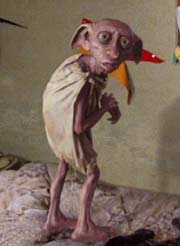
It begins with a house elf, Dobby (CGI voiced by Toby Jones), trying to prevent Harry from going back to school.  Dobby's master is planning some mean stuff and Dobby wants to help Harry Potter; the only problem is that house elves cannot say bad things about their owners, so he cannot give Harry an explicit warning.  Thanks, Dobby, you're worthless.  And you remind me of Fergie.  Harry is eventually reunited with his friends and returns to school.  However, someone is doing weird stuff at Hogwarts.  Messages are being written on the walls with blood, claiming that the heir of Slytherin has returned and opened the Chamber of Secrets.  If that makes no sense to you, I suggest you read the book because I don't want to get into the history of Hogwarts right now.  Along with the messages on the wall, students, pets and ghosts are being found petrified, with no clues as to what could be the culprit.  I guess it's up to Harry and friends to solve the mystery of the haunted amusement park!  I mean, discover the Chamber of Secrets and the, um, secrets it holds.

So what does Harry Potter 2.0 have to offer?  Well, it gives the villainous Malfoy family more screen time.  Draco (Tom Felton) and his father, Lucius (Jasoc Isaacs), are suitably insufferable, and both are welcome foils to the do-gooding Potter crew.  Lucius, in particular, is nice and evil.  We meet the evil Voldemort again and learn some of his history.  We get to see more of Ginny Weasley (Bonnie Wright), who will be important in later movies; Wright's performance isn't great, but it's difficult to be hard on a ten year-old.  Well, it's really not, but it feels mean.  This film also introduces the Whomping Willow and polyjuice potion, both of which will be used in later movies.  And that's about it.  Huh.  I guess this movie just sets up later installments more than anything else.

Chris Columbus directs this movie, as he did the first, and the results are basically the same.  He succeeds with the film's biggest obstacle: child actors.  The kids have gotten a little better at acting, although Emma Watson is still clearly the best out of the bunch.  The supporting cast is again stellar, with Alan Rickman, Maggie Smith, Richard Harris and Robbie Coltrane all maintaining the same high quality they did the last time out.  The addition of Kenneth Branagh as an egotistical teacher was a wonderful idea, and he is perfect in the part.  The special effects look better this time around and the little details that were not captured in the first film are done right in this one.  Honestly, since this story is so similar to the first movie, it feels like they just smoothed out the rough edges and did the same thing as last time, but better.

That is the big problem, of course.  The Chamber of Secrets is handicapped by its similarity to The Sorcerer's Stone.  I think it is obvious that this is the better film; the acting is better, the threat is more frightening, the special effects are better, and we're not wasting time with an origin story.  However, the plot structure (Harry sees a problem, Harry gets educated on wizarding stuff, Harry fights Voldemort) is annoyingly similar to the first movie.  This is also true of the book, but I actually like the movie better because you can see the young cast's growth as actors.  Is it fair to criticize a movie for being similar to its prequel, when the source material has the same problem?  Yes, it is.  Nevertheless, this movie does a great job at capturing the wonder and possibility of a magical world, and doing so in a way that will appeal to children.  If the story was a little better (read: less similar to Volume 1), this would be a clear classic.  As it stands, though, it is still in good company.

Friday, April 2, 2010

Harry Potter and the Sorcerer's Stone

This could have been an awful movie, you know.  It requires several child actors to carry the dramatic load at an age when only prodigies are good actors.  Not everyone is a Culkin, you know.  It's based on a successful book series, but it deals heavily in imagination; the proverbial magic could have been lost in translation (see: Dungeons and Dragons).  The adult actors could have been miscast, or even incompetent.  Not all adults share the screen well with children, like Michael Madsen in the Free Willy movies.  The studio could scrimp on the budget and get laughable special effects, ruining an otherwise plausible film idea.  X-Men Origins: Wolverine springs to mind as an example, although the effects weren't the only problems there. 

This film manages to sidestep these issues and successfully launch the most successful film franchise ever.  This is even more impressive when you consider a) there are more Star Wars movies than Harry Potters (so far) and b) the cast has remained almost unchanged throughout.

Do we really need to recap the origin story for Harry Potter?  In England, apparently there are a lot of wizards and witches, living fairly normal lives (if more magical than ours), working and going to school and the like.  Now, if that seems unlikely to you, consider this: there must be a reason people live on an island that isn't tropical, right?  Alright, then.  Just as there are normal, pleasant wizards, there are criminal wizards.  The biggest baddie of the all (think Adolf Stalin with a Merlin cap) was Lord Voldemort.  In his ongoing attempt to subdue all opposition to his terror, Voldemort attacked and killed the parents of the infant Harry Potter.  However, when Voldemort tried to kill the baby --- what's the emoticon for magical post-birth baby murder?  Oh, yeah... : ( --- something strange happened; Voldemort was mortally wounded and Harry survived with only a lightning-shaped scar on his forehead to show for it.  Harry was raised by non-magical relatives until his eleventh birthday, when the world of magic was revealed to him for the first time and he enrolled in Hogwart's School of Witchcraft and Wizardry.

This, the first in the Harry Potter series, focuses on (appropriately enough) his first year at Hogwart's wizarding school.  Since it takes place over a whole school year, there is a main plot and then a lot of time spent with Harry encountering magical stuff for the first time.  The main plot deals with Harry and his friends, Ron and Hermoine, trying to figure out what mysterious item is being protected within Hogwarts and who is after it.  Well, it turns out that the item is the Philosopher's Stone, which can create an elixir that prolongs life.  Who would want a thing like that?  If you guessed Mr. Frowny Emoticon Face, you'd be right.  Once they figure that out, Harry and his friends try to prevent Voldemort from taking the Philosopher's Stone.

A lot of this movie is spent showing the viewer how different and wondrous the wizarding world is.  There are hundreds of minor examples of magical use throughout, from paintings with animate subjects to broom riding.  Overall, they did a good job.  The special effects take charge here and, while they pale in comparison to the effects in later sequels, they generally look pretty nice.  There are a few poorly designed moments here and there, but nothing major.  Sure, the Quidditch field looks like it is at least sixty miles away from the nearest building, but nitpicking the realism of a movie starring wizards is silly.

The casting in this film is fantastic.  The supporting cast of Richard Harris, Maggie Smith, Robbie Coltrane, Warwick Davis, John Hurt, John Cleese, Alan Rickman, and David Bradley could not be much better.  The actors suit the characters from the book and, while this isn't Superman-level supporting star power, it's pretty close.  The established actors all perform well and the children...well, they're kids.  Daniel Radcliffe and Rupert Grint (Harry and Ron Weasley, respectively) did a good job of looking surprised, I guess.  They're kids and they weren't Jake Lloyd-terrible, so there's no harm done.  However, Emma Watson, as Hermione Granger, actually had flashes of good acting sprinkled throughout her performance.  Regardless, all three are visual matches to the book's characters, and that's usually good enough to recommend a child actor.

While the casting was fantastic, the writing and directing was only okay.  Yes, they stuck to the book's script almost verbatim, but that's a problem in and of itself.  Instead of taking liberties with some of the small details and focusing on more interesting visual magics, the movie misses some potentially awesome moments.  As far as the acting goes, Chris Columbus did a good job with the supporting cast and a very respectable one with the main kids.  He skimped a little when it came to the minor child characters.  I find it odd that commonplace things like magically appearing food, or paintings with animated subjects would hold much fascination for students that grew up around magic.  They should not have gasped, ooh-ed or ahh-ed.  Admittedly, those are minor complaints for minor problems in an otherwise fun family movie.