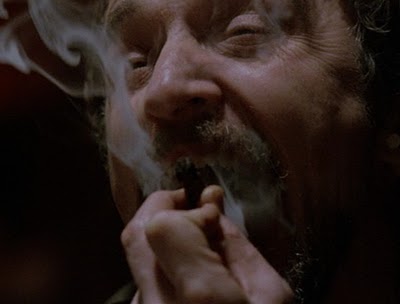
Showing posts with label Michael Wincott. Show all posts

Monday, November 19, 2012

The Crow

Here's a little background on me.  I've always been excited for Christmas.  It is the one day all year I will wake up at an ungodly hour without setting an alarm because, apparently, I am seven years old.  When I was old enough for my parents to yell at when I woke them up at 4:30AM on Christmas morning, I had a choice to make.  I could either be an adult and sleep in until a reasonable hour, or I could find something to keep me occupied until dawn.  And so I began my tradition of watching movies in the pre-dawn hours of Christmas morning.  The first entry in this series was The Crow.  I was unfortunate enough to be a teenager when The Crow came out, which means that I have seen no fewer than 6000 people dressed up as The Crow for Halloween.  This movie has always had a weird appeal.  There are all sorts of people who will dress up as The Crow for Halloween: dudes who like action movies, guys who want an excuse to show off their abs, Goth kids, poor people who happen to own a black shirt and black jeans, bondage enthusiasts, people who love to pout, etc.
Yeah, like that, but less awesome.  And with more practical pants.
Anyway, back to Christmas.  I was lucky enough to have very permissive parents who realized that I was not going to kill people because of the music, video games, or movies I absorbed.  However, my mom happened to walk into the room as the climactic scene was finishing and she saw this:
Bizarrely, her reaction was not "That's totally bitchin', son!"
Yes, a guy impaled on a gargoyle, which is funneling his blood out of its mouth.  Merry Christmas.  I hadn't watched The Crow in many years, so I was wondering how well it held up.  The answer?  About as well as can be expected.

The Crow is the story of Eric Draven (Brandon Lee).  Eric and his fiancĂ©, Shelly, were brutally murdered on October 30th, the day before their wedding.  Why?  Because October 30th is Devil's Night in Detroit, and Detroit is run by complete scumbags (NOTE: that probably means that The Crow takes place before Robocop and is, therefore, a prequel).  A year later, Eric crawls out of his grave because...um...magic?  For whatever reason, a crow tapped on his grave and Eric woke up.  Not surprisingly, he was traumatized by memories of his death and the rape and murder of his soon-to-be-wife.  Quite a bit more surprising, though, was Eric's new-found ability to heal from any wound --- oh, and the fact that his body apparently healed from the sharp fall that killed him while he was rotting in the grave.  Like anyone else who has risen from the dead, Eric preached to others decided to share his experience with the people who killed him.  And by "share his experience," I of course mean "murder the hell out of."  But before he can wreak his terrible vengeance, he needs to put on makeup.  To...er...protect his identity...or something.
That's a sad clown
Once he put on his face, Eric --- now The Crow --- hunted down each of the men responsible for his and Shelly's deaths.  As he works his way up the criminal food chain, The Crow's murderous ways have an unexpected effect on a young girl and a disillusioned cop; he gives them hope...which probably means they're pretty messed up in the head.

The Crow was undoubtedly Brandon Lee's best movie before his untimely death during filming.  However, his career up to this point was highlighted by his prominent chin and that time he complimented Dolph Lundgren's penis in Showdown in Little Tokyo.  Was Lee any good?  He turns in a solid action performance, but his acting is hit and miss.  He is suitably cool when playing the invulnerable Crow, but is wretched when trying to convey any emotions; when he is moaning for Shelly, Lee sounded like a drunk with a mouth full of marbles.  What really makes The Crow work is not Brandon Lee, but the surprisingly solid supporting cast of villains.  Michael Wincott played the unfortunately named Top Dollar, the lead baddie, and he was a lot of fun to watch.  Wincott has a fantastic villain voice, and it absolutely fits the ridiculous level of evil this character requires. 
Long hair and no tie?  This Top Dollar fellow is quite the rebel!
His right hand man was none other than Tony Todd, who simply is incapable of playing a nice guy.  You know you've got a solid bad guy cast when the Candyman is a henchman.  There are a few other minor bad guys, but the most important one is David Patrick Kelly, who managed to rock a Caesar cut and a ponytail at the same time.  Kelly is one of my all-time favorite baddies, and he has some choice moments here.  My favorite is when he orders an underling to grab some cigarettes and "road beers" because he's so evil that he makes drunk driving a priority.  A close second is his "Fire it up!" chant with his gang members.  It is totally intimidating and not at all comedic.
And it definitely doesn't look like a terrible Boy Band dance
The last of the noteworthy baddies is Bai Ling, who was suitably creepy as a weird witch-like lady.  She didn't act great, but Ling's natural smile looks genuinely frightening, so she came across pretty well in her small role.  Ernie Hudson got to swear and point out how ridiculous the rest of the cast was acting.  Rochelle Davis played little Sarah, and she was pretty bad.  On the plus side, she had a terrible and very 1990s haircut that you don't see too often in films.  This was also in that brief period where Anna Levine got to play almost every trashy whore character that Juliette Lewis turned down.  Levine has a tragic quality to her, and I thought she was surprisingly good in a role that wasn't very well-written.

The Crow was directed by Alex Proyas, and was his first widely-released film. If absolutely nothing else, he took a story that could have been laughably cheesy and added enough edge to it to make it pretty cool.  Proyas wasn't too impressive from a technical standpoint, but he played it pretty smart.  Why mess with fancy angles or try to milk a great dramatic performance from this cast, when it is far easier to go for spectacle and overlook its inherent stupidity?  My favorite instance of that comes from this scene:
Heroes/antiheroes leaving a calling card is a long-honored comic book tradition, so it's not shocking that The Crow decides to let the police know that he is the one, um, murdering scumbags.  The effect that this scene has on Ernie Hudson's character is to make him roll with it; if a victim wants to kill the city's biggest scumbags that the law can't seem to prosecute, he's willing to light a cigarette and enjoy the show.  But think about this scene for a moment.  This isn't Spider-Man leaving a purse snatcher somewhere for a beat cop to find and arrest.  This is someone who is murdering people who, in a strictly legal point of view, are innocent.  From that perspective, The Crow is a lot closer to a serial killer than a hero.
"Ha!  Logic!"
Of course, nobody watching the movie actually comes to that conclusion but me.  And no, I don't really give a rat's ass that the bad guys are being killed.  That's all good clean fun in my mind.  What I would like to know is how The Crow managed to pour the gasoline so precisely to make his flame art.  The city always looks wet, he operates at night, and I don't see any streetlights in the area.  Is that a superpower from beyond the grave?  Sure, why not?

Most of the time, movies with antiheroes rely on the main character to draw the audience in.  What's the difference between the murderous Punisher (1989) and the murderous Punisher (2004)?  Thomas Jane is actually sympathetic and Dolph Lundgren deserves everything he gets because he's a godless Communist (that is a continuation of the Ivan Drago story, right?).  The Crow doesn't work that way.  Brandon Lee is just too much of a ham to be truly appealing.  What makes his work look good is how evil the bad guys are by comparison.  When your villains are crazy bastards who live to rape and murder, you don't really need an awesome hero, as long as the bad guys pay.
Although, let's be honest.  How long were these jerks going to live, anyway?
That's really what separates The Crow from the rest of its comic book movie ilk.  This is a whole lot less about the protagonist avenging a single crime and more about the need for bad people to die horribly.  And that's okay.  This is a ridiculous story that gets juuust the right amount of edgy attitude without going overboard, and The Crow winds up being a lot of fun to watch.  That is a delicate balance, though, so it isn't terribly surprising that the sequels didn't quite hit the mark.
"If you mention the sequels again, I will stab your face in!"

So, yeah.  The Crow is not a legitimately great movie, even with action movie standards.  It is, however, a unique blend of violence, melodrama, and villainy that somehow manages to take itself seriously.  That is what makes this movie work; if the characters were winking at the camera or camping it up, The Crow would be unbearable to watch.  And yet...it's actually still pretty cool.

The Crow soundtrack was also a pretty good sampling of moody, mid-90s "alternative" rock.  Nine Inch Nails and Stone Temple Pilots got most of the attention with their contributions, but my favorite track also happens to be the unofficial theme song to the film.

Wednesday, December 14, 2011

Dead Man

For many years, if you asked me who my favorite actor was, I would immediately answer "Johnny Depp."  To date, I have seen 37 of his 42 films, and I have enjoyed most of them.  With the success of the Pirates of the Caribbean franchise, though, I have felt that Depp's roles have been significantly tamer than the glorious weirdness that marked his career from 1990-1998.  Just as I was starting to question whether or not Depp was still my favorite, I noticed that Dead Man was LAMB's Movie of the Month.  That was a good enough reason for me to revisit this film for the first time in fifteen years.

Dead Man is the story of Bill Blake (Johnny Depp), an accountant from Cleveland who has gone West to get over heartbreak and seize a business opportunity.  It turns out that the West he winds up in is significantly further West than he probably had anticipated; his train started with men in suits and well-dressed women, but as the miles wore on, the train car became populated with gruff drunkards with wild hair, animal skins, and lots and lots of guns. 
Blake's stop is at the very end of the line, in a town called Machine.  After taking in the sights (a horse pissing in the street, Gibby Haynes receiving oral sex in an alley, etc.), he heads to work.  Unfortunately, it took Blake too long to make the trip; since he received the letter guaranteeing his employment in Machine, another man has been hired for the post.  Blake tries to protest, but it does little good against his rough would-be employer, John Dickinson (Robert Mitchum).
You're not going to beat two barrels of Mitchum


Without enough money to return home, Blake is at a loss.  He manages to postpone making any real decisions when he befriends (in the Biblical sense) Thel (Mili Avital).  In their post-coital bliss, Thel's ex-boyfriend, Charlie Dickinson (Gabriel Byrne) walks in; he shoots at Blake, the bullet goes through Thel and lodges in Blake's chest, and Blake shoots Charlie in the neck.  Gravely wounded, Blake manages to grab his belongings, steals a horse, and wakes up lost in the woods with a fat Indian poking his wound with a knife. 
Not the ideal wake-up call
It's not as bad as you might think.  Well, maybe it is.  The Indian, Nobody (Gary Farmer) was trying to dig out the bullet (which was a pleasant surprise for Bill), but it is too close to his heart (which is bad news for Bill).  Blake is essentially living on borrowed time.  Meanwhile, John Dickinson hires a trio of murderous thugs to bring Blake back, alive or (preferably) dead and has wanted posters put up all around, offering a large cash reward.  What is an accountant to do in the wild, with every armed man in the West looking to kill him for money?  What do you do when you are a [clever use of the movie title]?
You cry lighting?

Dead Man was written and directed by Jim Jarmusch, and is the only film I have seen of his to date.  I was a little surprised by that, so if you have any Jarmusch recommendations, please leave me a comment.  If there is only one thing you can say about Dead Man, it is that it is definitely stylized.  The entire film is in black-and-white.  The passage of time is shown only through scenes fading to black, sometimes after only a few moments.  It has a very atypical score for a Western; Neil Young provides a sparse soundtrack, consisting almost entirely of harsh and abrupt electric guitar riffs.  This is not the Wild West from classic Hollywood Westerns, where you go West to find freedom and start anew.  Jarmusch's West is surreal and nightmarish.  I loved the direction in this film, and I thought the actors were all handled quite well.  As for the writing...well, I'll come back to that later.

The acting in Dead Man is good, although most of the surprisingly deep supporting cast is limited to shallow bit parts.  Johnny Depp is good as the perpetually out-of-his-depth Blake; what I liked best about his portrayal was just how much calmer and worldly Blake got as he approached death.  Gary Farmer was also very enjoyable as Blake's companion, Nobody.  The last film I watched that had a prominent Native American role in it was Windtalkers, so it was nice to see an ethnic character that wasn't a stereotype.  Lance Henriksen was good as a truly nasty killer, but he was overshadowed by Michael Wincott's gravel-voiced (and often surprisingly funny) chatterbox; Eugene Byrd was fine as the third hired killer, but he definitely had the least developed character in the bunch. 
If nothing else, Westerns typically deliver mean-looking bad guys
Robert Mitchum was pretty awesome as an elderly bad-ass in his few moments onscreen.  I also enjoyed Billy Bob Thornton, Jared Harris, and Iggy Pop as a bizarre trio of fur-traders.
Depp's paper rose is discussed in detail here.  Thankfully, Pop's dress and bonnet are not
The rest of the noteworthy cast (including Crispin Glover, John Hurt, Gabriel Byrne, and Alfred Molina) are certainly adequate, but their appearances generate more of a "is that who I think it is?" reaction than a "what a great performance!"

Dead Man is a dark, trippy, surreal and surprisingly funny Western.  It is sometimes referred to as an Acid Western, following the example of non-traditional Westerns from the 60s and 70s and turning the sense of dread from films like Ride in the Whirlwind into an extended nightmare.  The dialogue is crisp and clever, and the fact that the various Native Americans languages were not subtitled or translated only emphasized Blake's outsider status.  The first time I saw this movie, I was oblivious to William Blake, but now that I'm somewhat familiar with his work, I found Nobody's references and plan far more amusing and less random.  As much as I enjoyed most of Jarmusch's writing in Dead Man, I have one major complaint.  The story just seems to go on and on.  Don't get me wrong --- I enjoyed the film and the two hour running time wasn't excessive.  The story just didn't have much structure.  Blake heads West, gets shot and then another hour and a half go by.  As an exercise in style and fun writing, Dead Man is great, but it is lacking a story that makes you care.  Still, good performances, enjoyable writing and interesting direction makes this better than most movies, even if it is imperfect.

Monday, August 22, 2011

Strange Days

Science fiction movies often walk a dangerously thin line.  On the one hand, they need to be different enough from the modern day to make things interesting, but if you make things too different, you risk alienating your audience (unless you have a huge budget for cool special effects).  One solution that often works well is to set your film in the near future, so you can make some improvements, but not have to change the entire world; it's economical and takes a whole lot less pre-production to imagine a not-too-future world.  When I say that this method "works well," I mean that it succeeds upon the film's immediate release.  Movies like this can seem awfully quaint after the modern day passes what was once the near future.  Case in point: Strange Days.

In the last few days of 1999, Lenny Nero (Ralph Fiennes) has gotten himself into a lot of trouble.  For starters, he is a former Los Angeles police officer who has become a sleazy dealer of illegal technology.  You see, in 1999 Los Angeles, there are Superconducting Quantum Interference Devices (SQUIDs), which are cyberpunk tools for recording a person's point of view --- through their eyes, with their emotions and physical sensations --- and Lenny sells the recordings.  Of course, this was over a decade ago, so you probably remember all this.  SQUIDs are stylish, too, often taking on the appearance of obvious wigs.
Either a SQUID or somebody scalped a robot
It's not make explicitly clear why the practice is illegal, but I suppose a demand for "high-risk" memories of criminal acts could be a bad thing.  Anyway, Lenny is a fast-talking sleazebag with a heart of gold.  He spends his non-dealing time pining for his lost love, Faith (Juliette Lewis), and reliving his own SQUID-recorded memories of her.  Not surprisingly, his highlights usually include her in tight clothing or clothing-optional moments.  When I say that Faith is "lost," I don't mean dead; she just left him for the evil and gravelly-voiced record producer, Philo (Michael Wincott).  Philo is a rich jerk with psychotic tendencies and a habit for being over-possessive.  Faith wants to be a rock star, with all the egocentric behavior that implies.
"What a catch."  Apply the statement to either or both.
Man, science fiction movies require a lot of exposition.  Anyway, Lenny winds up at the center of a storm of evil-doing.  Someone is giving him SQUID tapes showing the anonymous user raping, murdering, and --- most disturbing to Lenny --- breaking into Lenny's apartment while he slept.  For one reason or another, Lenny concludes that this killer is going to go after Faith soon.  But who could the killer be?  Could it possibly be the two LAPD officers that are trying to kill Lenny?  Or are they a symptom of a deeper conspiracy?  Dum-da-DUUUUMMMMM?!?


For being a weird sci-fi movie, there sure are a lot of quality actors in Strange Days.  Ralph Fiennes turns in an interesting lead performance; he plays Lenny as a broken man, only a shadow of what he had been.  And yet, he is still capable enough to unravel a few mysteries and avoid getting killed on several occasions.  The cool thing about Fiennes is that his performance would have made Lenny's failure just as believable as his success would --- Lenny is not your typical movie hero, because he actually needs his friends.  Those friends turn in surprising performances, too.  Angela Bassett gets to play a tough, no-nonsense cabbie that also happens to be pining away for Lenny while he bitches and moans about Faith.  I don't know if we needed the romantic angle, but it was more depth than I expected from her buddy role.  The other buddy is Tom Sizemore as a sleazy private detective; while I normally enjoy mid-90s Sizemore, his ridiculous hairpiece was too distracting for me.
...or maybe I got lost in his dreamy eyes.
Vincent D'Onofrio and William Fichtner played corrupt cops (In Los Angeles?  In the 90s?  Suspend that disbelief!), but they weren't great at it.  Fichtner was fine, but D'Onofrio overacted in this one-dimensional role, somehow equating shouting and sweating with complexity.
And from this seed, Law & Order: Criminal Intent would sprout.
Glenn Plummer's character was a blend of Chuck D and Malcom X, so it should be no surprise that he didn't aim for quiet complexity in his limited screen time.  Career character actor Richard Edson (the parking garage valet in Ferris Bueller) had a bit part, too, and was only marginally more casual.  Michael Wincott once again played an evil character with an evil voice, and he is a pretty solid villain.  Juliette Lewis spent most of the film flaunting her body with either limited or tight-fitting clothing; that's fine I guess, but I've always been kind of weirded out by her.  This is in that time period when she somehow got every "crazy chick" role Hollywood had to offer, and she's as rude and obnoxious as ever.  My biggest problem with her part in this movie is that Lenny can't get over their break-up.
Who could ever get over this?

While I wouldn't say that any of the acting is all that good, I think the cast played up to the storyline pretty well and fit the general tone of the movie.  I had some major problems with the direction, though.  This was Kathryn Bigelow's follow-up to the successful and ridiculous bromance that was Point Break, and Strange Days definitely exhibits more confidence as a director than that film.  Unfortunately, I believe that confidence was largely misplaced.  Bigelow has trouble with the point-of-view camera work necessary to convey the experience of a SQUID recording; the sex scenes, in particular, felt like the cameraman was under strict orders to not follow a natural line of sight.  The pacing of the film is erratic, and the tone suffers from a number of action scenes that have no falling action; that's fine in a tightly-wound and taught thriller, but those words do not describe this film, if only because it takes a while to progress anywhere with this story.  And it is a long while, clocking in at almost two-and-a-half hours.  I understand that James Cameron co-wrote the movie, but he is certainly no genius when it comes to the written word; some more editing would have been nice.

There are also a few stupid ideas in this fabricated future.  That's to be expected from a lot of futuristic sci-fi movies, but these weren't errors in judging how we use technology, they are just poor choices.  I liked that most of the characters in Strange Days dressed more or less like normal people (it was set only five years in the future, after all), but the exceptions to that rule looked idiotic.  For instance, I don't care how eccentric the bad guy is, he's not going to hire a dread-locked albino woman wearing a bondage-themed outfit as a bodyguard, especially as a bodyguard who is sometimes called upon to assault and/or kill someone.  Flashy bodyguards with a license to kill tend to stick out in people's memories.  And why do only people in the future dress that stupidly?
Wasn't she in the Matrix sequel?
It also bothered me that this film deals with cyberpunk ideas, including having bionic parts put in your noggin, but we never see anything too bio-technical.  We get the stupid SQUID hair nets --- which are suspiciously bulky, considering they are recording and reading brain waves that include vision, emotion, and physical sensation --- but we never get to see a bionic eye?  Lame.

I would also like to ask what the deal is with characters who presume that their enemy has drowned.  I don't know how many times I have seen a movie where a car goes into the water --- the bad guys may shoot at the underwater car, or they might not --- and the villains wait to confirm that the good guys are dead...but give up a few moments before the hero resurfaces.  What is the big hurry?  Are these bad guys late for an evil henchmen dinner party?  If there's "no way anyone could have survived that," then why not wait a few more minutes until a body floats up?  That happens pretty frequently in action scenes, but I thought Vincent D'Onofrio's impatience in this movie was especially bad.

Despite its shortcomings, Strange Days is a decently effective science fiction adventure.  The story might have a few too many twists and turns to be truly effective, and the "future" is kind of quaint now, but it is a pretty well-realized future, and that deserves some respect.  I thought the relationships between the various characters was pleasantly atypical; while the plot may have been almost stock for suspense/thrillers at times, the characters didn't ever comfortably fit into that mold.  I would give this movie a higher rating, if not for one glaring flaw: there is absolutely no mention of Prince in this film.  That's right, a movie that climaxes on New Year's Eve, 1999, and was released in 1995 (the height of Prince's "The Artist Former Known As" fame) did not have anyone partying to Prince's "1999."  Talk about science fiction.
"I've got a lion in my pocket, and baby he's ready to roar!"