Let me start by professing my cultural ignorance when it comes to musicals. My top three musicals are
South Park: Bigger, Longer and Uncut,
Willy Wonka and the Chocolate Factory, and
How the Grinch Stole Christmas. My least favorite musicals are
Seven Brides For Seven Brothers,
Chicago and
Rent. Suffice to say, if you are a fan of movie musicals, then my opinion may mean nothing to you. I normally wouldn't go out of my way to watch this movie, but
Les Mis is apparently the most successful musical of all time and I knew nothing about it. Musicals may not be my cup of tea, but that sort of gap in my knowledge is inexcusable. And who knows? Maybe I'll be one of the millions who love
Les Misérables.
Les Misérables is the first musical adaptation of Victor Hugo's novel to reach the big screen, although there have been a few dramatic big screen adaptations already. In other words, if you don't know the story by now, SPOILER ALERT. The story begins in 19th century France with Jean Valjean (
Hugh Jackman), a convict whose crime was stealing bread for a starving child. After serving a mere nineteen years for his crime, Valjean is paroled by Javert (
Russell Crowe), the French equivalent of Boss Godfrey. Valjean quickly realizes that there are not many opportunities out there for someone who's spent more of his adult life in prison than free, so he chooses to skip bail and start a new life with a new name. Years later, Valjean is living under an assumed name and is living the good life; he is a factory owner and the mayor of a town.
 |
| I wonder if he ran on a "tough on crime" platform? |
In his factory, one of his workers, Fantine (
Anne Hathaway), is fired. Why? As far as I can tell, it is because A) she won't sleep with the foreman and B) she has a child, to whom she sends a sizable chunk of her paycheck. Neither reason would pass muster nowadays, so I'm not exactly sure why being a parent mattered. Whatever the reason, Fantine is fired and quickly starts selling parts of her body for cash; her hair and teeth are the first to go, but it isn't long before she is a bald, toothless prostitute.
 |
| Why so glum? Now you don't have to brush your hair or teeth! |
The next thing you know, Fantine is dying. Jean "I'm totally not Jean Valjean" Valjean and Javert discover her, and Valjean takes her to the hospital and promises to take care of her daughter Cosette if worse comes to worse. In a movie called "The Miserable," I wonder how likely that outcome is? Simultaneously, Valjean learns that someone (specifically, not Hugh Jackman) has been arrested and is sentenced to die for being Jean Valjean. Because he's a master of planning ahead, Valjean reveals himself to the court and basically says "Yeah, yeah, I'll serve my sentence," and then tells the dying Fantine that he'll be the father to her child. Those two don't go hand in hand, so when Javert shows up to arrest him, Valjean fights and escapes, finds the child, and takes her with him to live a new life under yet another identity.
 |
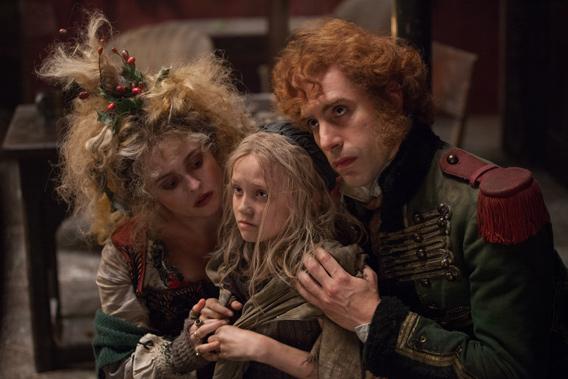
| You know a kid's got a tough life when this guy is the less creepy option |
We then jump forward in time again, until Cosette (
Amanda Seyfried) is an eligible young lady. Unfortunately, she falls in love with a French radical in the 1830s. While her love seems doomed, Javert is seen sniffing around their neighborhood for Valjean once more. Toss in some an unrequited love, a dirty kid, and some comic relief, and this decades-long plot is ready to come to a head. And if you want to know the effect of open sewage on gunshot wounds, this movie might not be the most scientifically accurate.
 |
| Little known fact: Valjean dips everyone he carries in open sewage. It's a fetish. |
Here's a factoid that everyone who talks about this production of
Les Misérables cannot help mentioning: the cast sang each take live, with only piano accompaniment. Most musicals record their soundtrack several weeks ahead of time and later mime their performances for the movie cameras. In other words, the actors of
Les Mis had a better opportunity for onscreen chemistry because they had the freedom to change things up from take to take. Did they make the most of it? Well, I have to admit that the emoting in this film is pretty good.
Hugh Jackman did a reasonably fine job in the acting department; his character goes through the most changes and Jackman doesn't ever seem silly in the process.
Russell Crowe played "stern" capably, although I would argue that this is one of his more wooden performances, overall.
Anne Hathaway was a scene-stealer with limited screen time, even though I really didn't like her character at all. Who sells their teeth before their flesh, anyway? And why does anyone want to buy her teeth? Sure, Hathaway seems to have roughly five rows in her mouth, but that's just weird. I'm not a huge
Amanda Seyfried fan, but she played her (to be fair, totally bland) role well. I don't know what it is about
Eddie Redmayne, but his face genuinely bothers me in this movie; I think it has something to do with his awful brushed-forward/There's-Something-About-Mary-gel-scene haircut. He's okay as a youngster rebelling and falling in love. The more I see of
Sacha Baron Cohen, the less impressed I am by him. He's not bad or annoying in this movie, but he doesn't seem to have the ability to play anything resembling human. I liked
Helena Bonham Carter well enough, though, and the two paired up decently well. I was impressed by
Samantha Barks, even though her part was fairly small.
 |
| ...and, apparently, underclothed |
But
Les Misérables is a musical! What about the singing? I would have to say that the best singers in the cast were the supporting women. Hathaway and Barks were pretty impressive, and Seyfried was pretty good except for too much vibrato in her falsetto. I didn't care for Hugh Jackman's songs. He's a bit too "musical theater" for my tastes. And yes, I know that this film is probably the best place for someone with a musical theater background, but that doesn't change how much I liked him. I was surprised to hear how strong Crowe's voice was, until I remembered he had a finger-quotes
rock band. Bonham-Carter and Baron Cohen were comedy relief, so their voices were intentionally at odds with everything around them; I wasn't a big fan, but they served their purpose.
 |
| Their purpose: to look like a Christmas hangover |
Tom Hooper chose
Les Mis as his directorial follow up to
The King's Speech. He could have gone for another British period piece, but he chose to bring a musical that is
entirely singing to the big screen instead. This is only the second film of his I've seen, but I'm going to go ahead and say that Hooper is a pretty damned good director. The choice to not pre-record the vocals was interesting, and I think he got some of the best acting-while-singing I've ever seen. The camerawork was very good and the set designs were impressive. Since the film jumps around so much in time, there were a lot of different sets, and each one looked great.
 |
| I'm pretty sure this building was only in about 15 seconds of film |
From what I can tell, Hooper did an admirable job bringing this huge musical to the big screen. Too bad I didn't like it. Despite that, the final scene still hit me like a ton of bricks, out of absolutely nowhere, which just goes to show how effective Hooper is at working his script.
So, I didn't like
Les Misérables. The directing was good, the acting was fine, and I liked some of the singing (just not particularly the two male leads). What's my problem, then? If I had to narrow it down to one reason, it would have to be the songs. I didn't really like any of them. There were a few snippets, here and there, that I enjoyed --- Anne Hathaway's signature song, and the beginning to the love song of Cosette and Marius --- but they served as segues to larger medleys that I didn't care for. My overwhelming impression of the songs in this musical was "Shouldn't these rhyme more?" My imagination tried to help fix the songs, too, by pairing any line ending with "gone" or "on" with "like Jean Valjean." Not surprisingly, it didn't help. It also doesn't help that the entire film is sung, so I could not truly enjoy the downtime between medleys, either.
I also had some major problems with the story. Ignoring Javert's insatiable bloodlust for Valjean --- which seems more than a little out of proportion, especially given all the other criminals Javert had met that were worse --- still leaves me with points that I just couldn't comprehend. Fantine's storyline confused the hell out of me. I think she was fired from her crap job because she had a child; this somehow turns into accusations of prostitution, which still should be nobody's business but hers and the police; once she's out on the street, Fantine almost immediately contracts a fatal dose of prostitution. I think that's the gist of her story, but the logic behind it escapes me. Almost as bad was the little revolutionary street rat,
Aladdin Gavroche. That little shit caused more trouble than anyone else in the movie (with the possible exception of that loaf of bread Valjean stole before the first scene). This film would have 70% fewer casualties if he hadn't essentially shamed the rebels into fighting to the death. I also don't understand Javert's motivation when he pinned a medal on Gavroche's corpse; for someone who viewed crime as black and white, that felt very uncharacteristic.
 |
| For the record, cute girls in newsboy clothes are hot, while revolutionary boys with girl hair are little shits |
Obviously, I am only speaking for myself. Countless people have seen and heard this musical and love it to shreds; if there is going to be a movie that satisfies that audience, this is it. I can appreciate the work that went into this production, and the craftsmanship of Tom Hooper and the cast is undeniable. It just didn't tickle my fancy. If you're into musicals, you'll probably dig this one. If not, then this won't change your mind. If you're somewhere in-between, I think the artistry will win you over. But for me, it falls into the realm of barely worth watching.
Why didn't I like the songs? I think I just have a problem with people singing different songs at each other: