Showing posts with label Jeff Goldblum. Show all posts

Tuesday, July 12, 2011

Morning Glory (2010)

I don't know if "interesting" is how I would describe this.
I'm not a big fan of romantic comedies and, by "not a big fan," I mean that I would destroy them all, if only they hadn't hidden parts of their soul in a bunch of horcruxes.  Sorry, I've been re-watching wizard movies to amp up for the new Harry Potter this weekend.  Anyway, I dislike most comedies and hate most romantic comedies.  Morning Glory dips its toe in both waters, which sounds like a recipe for Brian-hatred.

Before I go on, I would like to point out that this movie appears to be the second film in recent years to reference the band Oasis.  Ryan Reynolds made Definitely, Maybe in 2008 (the band's 1994 debut had that title) and the early promotional posters for Morning Glory looked like this:
Oasis's second album is also called (What's the Story?) Morning Glory.  None of this is important, of course.  I just wanted to point out a small pattern before some moron decides to derail their career with a pompous, coked-out movie called Be Here Now.
Just because we can hear you doesn't mean we're listening.


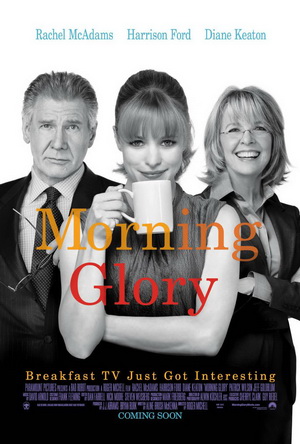
Anyhoo, Morning Glory is about plucky morning news producer Becky Fuller (Rachel McAdams).  Becky lives and breathes for her job, but she is fired from her gig at a local station for unclear, corporate-related reasons.  She bounces back, though, by being hired by a network morning news show, DayBreak, that airs nationally.  That would be the best rebound in history, if DayBreak wasn't the consistent and definite last-place show in its time slot.  What's a plucky young businesswoman to do?  First, she weathers a harsh whirlwind of pre-preemptive criticism from one DayBreak co-host, Colleen (Diane Keaton).  Then she fires the other co-host (Ty Burrell) for work ethic and creepy sexual fetish-related reasons.  That leaves Becky with a last-place show that is short a co-host.  As luck would have it, the station has legendary news correspondent Mike Pomeroy (Harrison Ford) under contract, but no projects for him to do.  What luck!  As perfect as it would be to have Mike Pomeroy --- THE Mike Pomeroy, Mr. Serious Newscaster --- trade vacuous small talk with Joey Lawrence or whoever the hell else usually pops up on these programs, it turns out that Mike doesn't want to do anything except "real" news.  The animosity between Becky and Mike only gets worse when she starts having the cast do stunts, like broadcast the weather while on board a roller coaster.  Do you smell a conflict?  I smell a recipe for guffaws!
If not guffaws, then maybe a few senior moments?

The cast in Morning Glory is surprisingly (to me, anyway) solid.  Rachel McAdams is good as the hard-working and earnest lead.  I wouldn't say that she has great comic chops, but she is certainly likable --- and that's before she prances around in her panties.
Apparently, this is from a Morning Glory photo shoot.
Her romantic lead in the film is thankfully not Harrison Ford.  Instead, the part is played by Patrick Wilson, who always strikes me as a charisma-free version of Josh Lucas; he's fine here, but his character is almost comically understanding of Becky's work obsession for a character that is supposedly looking for a serious girlfriend.  Harrison Ford is the co-lead in the film, and he gets to frown and speak in a gravelly tone of voice.  I didn't particularly like his performance here --- I dislike when Ford tries to be gruff --- but it fit the character.  I didn't find him particularly funny, though.  Diane Keaton was underused for someone with her comedic film experience.
...but she did get to live out her lifelong dream on the set.
The rest of the supporting cast was all fine, but nobody really stood out, aside from Ty Burrell's ridiculous (and short) performance.  Jeff Goldblum did a good Jeff Goldblum impression as Becky's boss, John Pankow revealed what happened to his character from The Secret of My Success, and perennial TV and movie weenie Matt Malloy played a fairly weenie-ish weatherman. 

I didn't particularly like this movie, but it certainly wasn't the fault of the actors.  I just didn't like the story.  It felt obvious in parts and emotionally manipulative in others.  When Harrison Ford's character does something that seems odd and not at all mean, you can bet that the act will be revealed to have a deeper meaning at a crucial moment in the plot.  I normally wouldn't mind that too much, but this film is not terribly comedic, romantic, or insightful into the morning TV business.  It has moments where the movie could have focused on any one of those subjects, but it never really commits to any.  It also bothered me that Ford's character is spot-on when he accuses Becky of being a workaholic with no friends and daddy issues.  I don't think any of those problems are completely solved by the film's resolution, and that bugged me.  I blame director Roger Michell for making a movie that has some interesting plot ideas, but doesn't really take a stand.

Then again, it is entirely possible that this is just not my kind of movie.  My wife liked it and I didn't grit my teeth through it, so there should be something to say for that.  I don't think I would watch it again, but I didn't need to drown my memory in whiskey after seeing this, either.  Overall, I think this is a pleasantly inoffensive movie that disappointed me with a lackluster plot and a solid, if misused, cast.

Thursday, June 2, 2011

The Lost World: Jurassic Park

Everyone is pretty familiar with this common complaint when a book is adapted into a movie: "The book is so much better!"  That's usually a little unfair to the filmmakers, though; screenwriters are forced to essentially create a snapshot of the book to help it make sense in a film format.  Sometimes, though, the book and the movie are different enough to make you wonder just how much "adapting" is taking place and how much "we're stealing the title of your book" is going on.  The Lost World was the first time Michael Crichton wrote a sequel to any of his novels; he wasn't going to write it, but the massive success of Jurassic Park and pressures from his publishing company and Steven Spielberg convinced him to revisit Dinosaur Island.  The book occasionally took a liberal approach to the events in the first novel (Ian Malcom dies in the first book, but is the main character in the second, for starters), but that is nothing compared to the differences between The Lost World and The Lost World: Jurassic Park.  Like what, you ask?  Aside from changing almost every character in the book and splicing in scenes from the first novel, I don't know...maybe a Tyrannosaurus Rex rampaging through San Diego? 
You mean "car flips over to avoid T-Rex" wasn't in the book?
Personally, I don't care about the liberties filmmakers take with their source material, as long as it makes the movie work.  Film and prose are very different forms of entertainment and art, and if huge changes bother you, then stick to your book.  That said, I think adding a citywide dinosaur rampage is a pretty funny detail to add to any story.

The Lost World: Jurassic Park picks up four years after the events of the first film, which is nice, because four years actually took place between the releases of the two movies.  Dr. Ian Malcom (Jeff Goldblum) is asked by John Hammond (Richard Attenborough) to join an expedition to his secret dinosaur island.  You see, Jurassic Park was located on Isla Nubar, but Hammond's company apparently kept a back-up supply of dinosaurs on the nearby Isla Sorna, just without any of the safeguards and fences that were so effective **cough, cough** in the first film.  Apparently, the dinosaurs were engineered on Isla Sorna and then brought to Isla Nubar when mature, which doesn't at all contradict the egg-hatching scenes in the first movie.  Like any person sane enough to not eat their own feces, Malcom refuses the kind offer to visit more killer lizards.  Well, he refuses until he finds out that his girlfriend, Sarah (Julianne Moore), is already on the island, getting her research on.  This throws Malcom in a tizzy, since he's familiar with all the running and screaming that inevitably accompany 20th-century dinos, and he leaves for Isla Sorna with an engineer (Richard Schiff) and an environmentalist photographer (Vince Vaughn) and, because this is a family movie despite all the death, Malcom's daughter from a failed marriage, Kelly (Vanessa Lee Chester), who stowed away on their boat.  When they arrive on the island, it becomes quickly apparent that this is not just a research mission.  John Hammond's nephew, Peter (Arliss Howard), has taken control of his uncle's company and wants to open a new Jurassic Park in San Diego.  He needs to capture some dinosaurs to make that happen, so he brought a few dozen big game hunters with to facilitate his wishes.  Soon enough, both groups find themselves on the wrong side of an island full of angry dinosaurs and it becomes a battle for survival.  Surprise, surprise.
Do not feed the dinosaurs, stupid.

One of my chief complaints with Spielberg movies is that his more special effects-based efforts skimp on the acting.  This time around, Jeff Goldblum is given the starring role, and this might be the most Goldblum-y part of his career; all the awkward poses and odd vocal cadences that you are familiar with are front and center in this film.  Surprisingly, that's pretty entertaining, when given a chance to shine, like he does in the first act of the movie.  Unfortunately, as the dinosaur attacks become more frequent, his dialogue becomes less frequent, and he just becomes another character running from CGI.  Julianne Moore is a capable actress, but I found her character a little annoying in this movie, and that's ignoring some of the colossally moronic things her character does.  It was nice to see a young Vince Vaughn, because I totally forgot that he used to be handsome, or at least less puffy and seemingly without the hangover scowl he's sported for the last decade.  I didn't particularly care for the eco-terrorist/animal rights aspect of his character, but at least he didn't come across as crazy.  As far as the "bad guys" went, I enjoyed Pete Postlethwaite's gruff safari hunter character.  He wasn't in it for the money, but the challenge, and that makes all the difference in a series that points out the dangers of mixing capitalism and extinct species.

The rest of the supporting cast had substantially less screen time, but should be mentioned anyway.  Richard Attenborough, Richard Schiff, and Arliss Howard are all decent enough.  Nobody does a particularly good job, but they propel the plot forward without offending.  Similarly, the brief cameos from the Jurassic Park kids, Joseph Mazzello and Ariana Richards are surprisingly not annoying.  The ever unlovable Peter Stormare once again plays a bad man in this movie, and he's definitely the most entertaining "villain."  Yes, he's a jerk and deserves whatever he gets, but Stormare is a lot of fun to root against.  Vanessa Lee Chester was far less enjoyable as Malcom's daughter, who is only in the damn movie because she is painfully stupid.  Chester isn't convincing as a daughter in this movie or anything more than a recurring victim.  It doesn't help that her idiotic gymnastic routine is the low point of the movie for me.

As for Spielberg's direction...I've been more impressed.  The man still knows how to frame a shot and build suspense in an action sequence, but this is far from his best effort.  He doesn't get much from his actors this time out and the focus is even more squarely on the dinosaurs than in the previous film.  The special effects look great, that's a hollow accomplishment when there's no depth in your family film.  And, for a "family film," this is a bit gory.  There are a lot of humans dying in this movie, either on screen or implied just off screen.  I get that watching people die by dinosaur is both awesome and inevitable in this movie, but this cast was mostly cannon fodder.  The oddest choice that Spielberg made with The Lost World was the addition of the T-Rex rampaging in San Diego.  It's fun eye candy, sure, but it's also very, very dumb.  And it looks and feels like a completely different (although similarly-themed) film; the cast is narrowed down to three characters, without any explanation, and Malcom has time to shave and shower while he waits for Rexie to arrive?  That just seems unlikely.

Of course, The Lost World: Jurassic Park was never going to be a thinking man's movie.  This is a movie that is supposed to deliver dinosaurs, dinosaurs, and more dinosaurs.  In that aspect, it definitely delivers.  There is a lot more T-Rex action this time around and seeing the little compys and the stegosauruses was pretty cool.  The velociraptors weren't nearly as smart or dangerous in this movie, which was a bit of a let down --- being defeated by a mediocre gymnastics routine will do that --- but that was the only dinosaur-related bummer in the film.  The T-Rex trampling San Diego, while very stupid in terms of plot, is still a fun sequence to watch, if only because it's always fun to see monsters destroying cities.
The T-Rex symbolizes Ken Caminiti's 'roid rage.  Don't do drugs, kids.


While this is most definitely a special effects extravaganza, it still needs to tell a decent story, and that's where The Lost World fails.  It almost feels as if, because the first movie got all the pseudo-science and wonder out of the way, this film was given carte blanche to just have dinosaurs chasing people for two hours.  Instead of a plot with characters that develop, we get Jeff Goldblum delivering Yakov Smirnoff-ish lines, like "Wild goose chase?  This is the only place where the geese chase you!"  On the whole, the dialogue in this movie is terrible, especially when Malcom is talking to his girlfriend or daughter.  Does any teenage girl ever ask her absentee dad to ground her?  I won't say "never," but it's damned unlikely.  And as amusing as I find Goldblum's peculiar vocal tics, the script sometimes has him hamming it up as a lesser Jerry Seinfeld, asking "what is with...?"

Worse than the dialogue is the ridiculously convoluted plot.  Here is a scene where an experienced wildlife photographer and an experienced behavioral paleontologist take a wounded baby Tyrannosaur to fix its leg:
Stupid.
You would think that anyone experienced with wildlife in general and with predators specifically would be a little more careful about kidnapping a baby predator without accounting for mommy and daddy predator.  Of course, the parents come looking for the baby, smelling it with their sensitive noses, and they react violently to protect the child.  Oddly enough, those behaviors are exactly how Julianne Moore's character predicted they would react --- and she still took the baby!  Well, maybe she just couldn't leave an animal in pain, even if it is a genetically engineered abomination of nature that should be extinct, anyway.  That doesn't explain how she and Pete Postlethwaite's hunter character both ignore the fact that her shirt was covered in baby T-Rex blood that wouldn't dry in the humid weather.  This is just after she gets done explaining that the Rex has fantastic olfactory senses, is obsessed with protecting its young, and has increased its patrolling area to wherever its baby has been.  And then everyone acts surprised when the T-Rex comes looking for the bloody shirt.

As much as I enjoy Spielberg as a director, The Lost World: Jurassic Park is too big of a mess to just turn off my brain and enjoy.  I didn't care about any characters, the plot was frequently insultingly stupid, and the dinosaurs didn't bring anything new to the movie this time.  It might have three times the action of the original, but it has an eighth of the story.
Thursday, August 19, 2010

Independence Day

There are movies, and then there are films.  The difference can be subtle.  Sometimes, all it takes to move from traditional popcorn fodder to artistic statement is a single performance.  Other times, it requires a hefty dose of Jeff Goldblum and exploding the living hell out of America's landmarks.  Roland Emmerich has never directed a subtle movie (aside from Godzilla (1998) of course), so guess which route he took?

Independence Day answers the question of whether humanity is the only intelligent life in the universe.  The answer is "No, and where do you get off calling humanity 'intelligent'?"  So, yes, Elliot, there are aliens, and of course the aliens want to kill us.  Do you blame them?  Look how well we take care of things; America is now surrounded by the Atlantic Ocean, the Pacific Ocean, and the Gulf of Inkwell.  Actually, this movie takes a much more intimate look at how Earthlings (by which, I of course mean Americans) might handle a hostile alien invasion.  Maybe, if all of America were wusses like Arizona, we would just pass a ridiculous law or two.  Luckily, the other forty-eight states (I'll be dead and buried before I recognize Mizzoura) play for keeps.  When aliens come into our atmosphere and blow all the major cities in the world to hell, that just makes us mad.  Well, it makes us panic and despair first, but after our greatest president gives a speech to a bunch of semi-professional pilots, we are ready to kick butts and mispronounce names.  All we need is a hero and a nerd to lead us to victory.  As far as heroes go, it's hard to top mid-90's Will Smith.  The man has charm, talent, and is fun to watch.  As far as nerds go, Anthony Edwards must have been busy.  Still, Jeff Goldblum is a respectable substitute.  Like many mid-90's movies, it turns out that the cure to everything is computer knowledge, so getting a cable repairman/Mensa member to go into space and launch a computer virus into the alien spaceship network sounds waaaaay too easy.  And it is.  But this isn't a movie that ever tried to be smart, so just be happy it's loud and dumb and never gets pretentious.

Is there more to the movie than that?  Of course there is.  This is a big, blockbuster film, so it has an enormous supporting cast.  In the apolitcal and non-military side of things, we have Judd Hirsch playing the broadest Jewish stereotype I have ever seen outside of Seinfeld.  It works, if only because Hirsch is funny, but damn, he is kind of offensive.  Harvey Fierstein plays an obviously heterosexual man at the cable company and Randy Quaid is a drunk pilot (with something to prove to the aliens) with James Duval as his frustrated son.  Randy is drunk in this movie, which is what I expect from all of his roles, but Duval manages to exude frustration, tenderness, and the slightest hint of acting talent in his supporting role (which is surprising, since he stars in my Most Hated Movie, The Doom Generation).

Interesting side note...I am reasonably sure that Randy Quaid wasn't even cast in this film.  He just showed up, drunk as a Senator, and wouldn't leave.  He had some story about being abducted by aliens, and the filmmakers decided "Why not?"  The rest is history.  "Uh, Brian, if that's the case, why isn't his character named Randy?"  Because he was drunk for a solid week.  He might not respond to the name Russell at first, but it only takes four or five tries to convince him of his new identity.

And then there's Jeff Goldblum as a genius/cable repairman.  He has always had a unique speech cadence, but this is the movie that makes it his calling card.  Like Christopher Walken before him, Goldblum is able to channel awkwardness in such an unexpected way that the rest of the cast simply has to bow down before him. This is also the movie script that took his vocal mannerisms and gave him a script just as ludicrous.  Whenever he has an epiphany, he speaks his train of thought out loud and it is beyond believable.  But that's how this movie works.  It takes a decent idea, makes it overblown to the point of being absolutely terrible, and keeps going until it becomes ironic.  This is the epitome of so-bad-it's-good movie making, and Goldblum's character is the best illustration of this.

The President of the United States is Bill Pullman, with a First Lady (Mary McDonnell) that seems to want him to learn to lie better than he does.  Hmm.  He has a capable adviser and a former wife of Goldblum on his staff, Margaret Colin.  Robert Loggia also serves as a military advisor, as does Adam Baldwin (to a lesser extent), but they basically just grimace and shoot things in the movie.  Will Smith is a fighter pilot with Vivica A. Fox as his stripper girlfriend.  He is buddies with another pilot, Harry Connick, Jr., who is less talented (as a pilot) and used as alien cannon-fodder/don't-ask-don't-tell jokes.  Brent Spiner also makes an appearance as a scientist that is clearly not as intelligent as Goldblum's cable repairman.  How embarrassing.

This is not a smart movie.  It is big, loud, and stupid.  The characters are shallow, the dialogue is full of cliche one-liners ("Now that's what I call a close encounter").  You don't care when somebody dies in the movie; this is basically a disaster flick, so that stuff happens sometimes.  This movie is all about the spectacle.  Want to blow up the White House?  Done.  You want Will Smith to punch out an alien?  No problem.  How about an embattled president giving the best damn speech any president has ever given, where he calls for international cooperation in front of an exclusively American audience?  We can make that happen.

I will give Roland Emmerich credit where it's due --- this is a big movie, filled with big moments.  The fact that those moments are effective (or, at least, cool looking) shows the success of this movie.  Emmerich's other films are just as stupid as this, but they lose momentum by the final act.  The pacing in Independence Day is pretty good, with a nice build-up and then waves of action from there on out.  The acting and script are definitely second to the big dumb stuff, but that's okay.  Sometimes, details like characterization get in the way and force movies to spend less time on blowing up the White House.  And we wouldn't want that, would we?

In a way, the silly things are what makes this such an enjoyable movie for me.  It's easy to go back to the special effects blockbusters of years past and be unimpressed; the effects are dated, the characters are cliche, and the personal style of the cast is questionable, at best.  Independence Day still stands up because it is not so serious.  The fact that the dialogue and plot are bad enough for even dramatic characters to be kind of funny defies the odds and enhances that attitude.  This may be a disaster movie, but it's a fun movie, too.  Is this an artistic film?  God, no.  It is the kind of big, dumb action movie that Hollywood loves to make, but rarely completely succeeds with.  And if that doesn't make you feel patriotic, I don't know what will.

Monday, August 16, 2010

The Big Chill

Have you ever watched a TV show or movie that your parents used to swear was great, but when you watched it, it seemed...quaint?  It happens with me all the time, partially because I'm a little snotty, and partially because my dad still laughs out loud at Barney Fife.  It's not a bad thing, but it just goes to show how certain things age differently than others.  It also serves as an example to generational gaps.  I understand that; I still look back fondly at Homer Simpson falling down Springfield Gorge, but objectively, that Simpsons episode is pretty old and not very funny.  It just holds nostalgic value for me that my children will never understand.

Keep that in mind as I take a look at The Big Chill.

Alex (an uncredited --- because they left his face on the cutting room floor --- Kevin Costner) commits suicide.  His college buddies from the '60s show up for his funeral and get to catching up.  They include a married couple, Harold (Kevin Kline) and Sarah (Glenn Close); a successful Magnum, PI-style television actor, Sam (Tom Berenger); an unhappy public defender, Meg (Mary Kay Place); a professional drug-dealing Vietnam veteran and former radio shrink, Nick (William Hurt); a "journalist" for People magazine, Michael (Jeff Goldblum); and a housewife that regrets marrying a "safe" husband, Karen (JoBeth Williams).  They are joined by Alex's much, much younger (and very flexible) girlfriend/amateur space cadet, Chloe (Meg Tilly).  This group (minus Chloe) went to a Division I college and more than half of them got rich.

And yet, none of them are truly happy.  Sadly, the lovely Motown soundtrack does not include a track of the smallest violin in the world playing a sad song, just for them.  Sarah once had an affair with Alex, and her relationship with Harold never had the same level of trust again; this is compounded by their decision to help financially support Alex in the months preceding his suicide.  Sam feels cheapened by his lame acting gig and wants, more than anything else, to fulfill his long desire to be with Karen.  Karen feels trapped by her boring husband and kids.  Michael is unfulfilled, writing journalistic tripe for a magazine you read in the bathroom or at the doctor's office.  Meg wants a baby, but has no suitors and her biological clock is ticking away.  Nick felt like a fraud as a radio host and balances that with his lack of self worth as a drug dealer.  Oh, and he apparently has erectile dysfunction as a side effect of going to Vietnam.  Or he has a war wound in his crotch.  Or he has a terrible STD from Vietnam.  Whatever.  The big guy has a problem with his little guy.  Chloe is just bizarre and seems attracted by damaged men.  By the time the weekend ends, all of these problems are addressed and (more or less) solved.

I think my favorite thing about this movie is the script.  It is clever and witty, and it leaves out a lot.  That might sound like a drawback, but there is a lot of great dialogue, and real conversations do not spell everything out for onlookers.  There are dozens of funny one-liners, but the script is deeper than that, forcing the viewer to come to their own conclusions about how each character feels about the rest.  As the least sexually-successful member of the group, Michael has a lot of great lines that work, regardless of context, and Jeff Goldblum delivers these lines with panache.  There is a lot of sarcasm in the script, and everyone gets a turn eventually, but I think Goldblum's lines make him the most memorable supporting character.

The acting and direction (by Lawrence Kasdan) are both pretty good, too.  Kevin Kline and William Hurt are usually pretty dependable, and they both are given some solid dialogue, so it's a win-win with them.  Jeff Goldblum is sarcastic, witty, and nobody has sex with him, which is probably as it should be.  Meg Tilly was surprisingly wonderful as the spacey young member of the group; she is alternately distant and intimate, random and on-the-nose, throughout her performance, and I imagine that is hard to pull off.  The rest of the cast (Bernenger, Place, and Williams) are decent, but nothing special.  There was one character that I outright disliked.  Glenn Close's character struck me as particularly disturbing and unrealistic.  I know Close can act, but her emotions in this movie are so unpredictable and inconsistent that I just can't deal with her.

It's not all her fault, though.  The plot for this movie is absolutely ludicrous.  I know coming-of-age stories with ensemble casts usually have a suspicious number of characters come to important conclusions by the end of the film, but this is ridiculous.  Everyone in the principal cast has a life-changing weekend?  What is this, The Breakfast Club?  I don't appreciate some of the plot devices, either.  Why would anyone sit in front of a video camera and be bluntly honest and emotional if they were planning on watching the video in front of their friends?  That is beyond awkward.  I think my biggest problem with the plot deals with Glenn Close's character.  ***SPOILER ALERT*** So Meg wants a kid, but can't find a daddy.  She asks around, and Sam won't do it, Nick can't do it, and she doesn't want Michael, so Sarah suggests her husband?  I'm sorry, but that makes no sense to me.  One the one hand, I would feel uncomfortable (at best) if Glenn Close encouraged me to cheat on her.  She is Ms. Fatal Attractions, you know.  On the other hand, where do you go after that?  How does sympathy sleeping with a friend not attract jealousy and discontent within a marriage?  It's one thing to be married to a crazy woman, but to have her allow you to cheat...well, it may seem like a blessing, but I see a death-by-butcher-knife in your future, my friend.  

If this was almost any other movie, I would give it a few stars for the clever dialogue and dock it points for the ridiculous story and predictable plot.  As it happens, though, my parents were pretty big fans of this film when I was growing up and, while the film doesn't carry as much weight for me as it did them, my early exposure left a soft spot in my heart for it.  Despite the clumsiness of the dance scenes, the implausibility of most of the romances, and almost everything relating to William Hurt's character, I am going to give this movie the benefit of the doubt.  That said, I cannot forgive the egomaniacal self-centeredness of the Baby Boomers, no matter how handsomely it is disguised.  As such, I give this tribute to rich people schtupping each other...

Monday, June 28, 2010

The Thomas Crown Affair (1968)

Who doesn't love a good heist movie?  It's one of the rare occasions where you are actually supposed to root for the bad guy.  The thieves are always charming and clever, and usually are irresistible to the opposite sex.  What's not to like?  Unfortunately, these generalizations only hold up when the movie's heist is clever.  When heist movies get too gritty or too plausible (I'm pretty sure even I can rob a bank as effectively as they did in Dog Day Afternoon), it is usually because the actual heist was done in a thuggish manner.  The Thomas Crown Affair is an odd movie because it aims for the whimsical charm of the best heist movies, but the heist itself is actually pretty boring.

The film begins with a series of split-screen shots of men in suits doing things at approximately the same time in about the same location.  One frame follows a man making a phone call at a pay phone, another frame follows another man as he walks to his designated spot, another frame follows a third man, etc.  The split-screens show five men (including Jack Weston and a young Yaphet Kotto) calling in to a central contact and eventually each man shows up at a bank.  They each do their part and rob the bank.  Sure, limiting the amount of knowledge each criminal had of the crime is smart from a planning perspective, but the heist itself is basically just a stickup.  When it is all over, the proceeds are left in a cemetery trash can, where they are picked up by the mastermind, Thomas Crown (Steve McQueen).  He goes home and laughs out loud.  I'm pretty sure that there is an entire script page devoted to him laughing to himself.  Of course, no crime goes uninvestigated.  Well, bank robberies don't, anyway.  There is a detective attached to the case, but he is inconsequential to this story.  Instead, Vicki Anderson (Faye Dunaway), an investigator for the bank's insurance company, is Crown's main antagonist.  Although "antagonist" is a strong term for a character that is essentially a love interest with an edge.  Crown is a wealthy businessman that has no need (well, little need) for the $2 million-plus that he helped steal.  He spends his time desperately seeking diversions, whether they are with polo ponies, dune buggies, glider planes, or beautiful women.  Vicki decides that he is the perfect candidate for masterminding a bank robbery through what I can only describe as a series of Jeff Goldblum-esque intuitive leaps.  She never second guesses herself and decides to meet Crown socially.  Despite the fact that Vicki openly admits to Crown that she is investigating him for the robbery, the two begin a passionate affair.  The bulk of the film centers on how they metaphorically circle and seduce each other, with the theft acting as the elephant in the room.  The two clearly care for each other, but Crown can never feel safe with Vicki, unless she gives him some sort of proof that she is not after the stolen money, since she get's a percentage of anything recovered.  All he needs is a plan...

Obviously, from this synopsis, The Thomas Crown Affair is not your typical heist movie.  The focus is on the tension between the two leads, playing characters that obviously cannot trust each other but are just as obviously attracted to each other.  It's an interesting concept for a film; rarely does a movie begin with such an elaborately shot sequence and have that event play a secondary role in the plot.  The tension is definitely present on-screen.  Dunaway and McQueen are attractive, charismatic actors at their physical peak, and director Norman Jewison spends a lot of time having the camera focus on their chemistry.

While the filmmaker's intent is clear, that does not mean that this movie succeeded in its goal.  In highlighting the sexual tension between the two leads, this film goes to sometimes ridiculous lengths.  One of the more famous scenes from this film is the scene where they play chess, using the chess pieces as sexual metaphors.  Not subtle metaphors, mind you.  To give you an example, there is a point where Dunaway is literally stroking the bishop.  I have a hard time believing that McQueen could have seen that and not giggled, just a little bit.  This scene gives way to a sequence of the two kissing heavily and...other leisure activities.  From a technical perspective, these scenes are very well done.  They are just a soundtrack change away from fitting in an Austin Powers movie, though.  We're talking some seriously heavy-handed stuff here.  I get it.  They're horny.  Let's move on, already.

The soundtrack is a bizarre product of the times.  There are extended periods that are absolutely silent, and these do a good job ratcheting up the tension.  But then the music kicks in.  I've never been a big fan of the Oscar-winning theme to this movie, "The Windmills of Your Mind," but it just feels grossly inappropriate whenever it pops up in this film.  The cadence is odd and the music does not match the tone of the rest of the score.  Yes, I'm sure it sounded better in the 60s, but that doesn't mean it has to feel anachronistic now.

The biggest problem I have with this film is the crime.  I was a little disappointed when I realized that the heist was not the focus of this film, but I got over that pretty quickly.  I find it a little difficult to sympathize with a character that organizes an armed bank robbery out of boredom, though.  Doesn't that kind of make him the anti-Batman?  The guy didn't even participate in the robbery, so the adrenaline rush excuse doesn't even work in this case.  Boo hoo, you're rich and bored.  Give me your money, or pay bums to fight, or torture tourists a la Hostel.  I don't care what you do, just don't demand my sympathy.  You know what happened when I complained to my parents about being bored?  I was given chores.  Suck it, Crown.

The thing that surprised me most about this movie was how completely unnecessary the split-screen theft scenes were.  I like artsy cinematography, but it needs to serve a purpose.  This just overcomplicated a fairly straightforward crime.  I think that is representative of the movie as a whole.  There is a lot of stylish cinematography and a lot of chemistry between Dunaway and McQueen, but it doesn't really serve a purpose.  With different lead actors, this movie would be a godawful mess of pretentious art without the acting chops to back it up.