Showing posts with label Alan Rickman. Show all posts

Sunday, July 17, 2011

Harry Potter and the Deathly Hallows: Part 2

For franchises that have built up an enormous audience, filming sequels back-to-back seems like a smart move to save on production costs and make multiple movies at once, which are virtually guaranteed to be cash cows.  Critters 3 and Critters 4 are probably the best examples of this, but what about the sequels to Back to the Future, The Matrix, and Pirates of the Caribbean?  They range from fine (but nowhere near as good as the original) to implausibly disappointing to damn near unwatchable --- in that order.  Sure, they made money, but --- aside from the huge gambles that were the Kill Bill and Lord of the Rings productions --- this method usually winds up disappointing fans.  Harry Potter and the Deathly Hallows: Part 1 did a good job of setting the stage, but it felt incomplete...because it was.  Will that mean that Harry Potter and the Deathly Hallows: Part 2 will suffer the same fate, or will it manage to do what so many series finales fail to accomplish --- end with a bang?

Where were we?  Oh, yes.  Harry Potter (Daniel Radcliffe) and his wizard buddies are on the run from Mister Frowny Face, AKA Lord Voldemort (Ralph Fiennes), and his Frowny minions.  Voldie has broken his soul into seven parts and hidden the parts all over the globe (or, at least England) in six ordinary objects, with Part 7 being in himself.  Why?  This allows him to survive deadly attacks, as long as part of his soul still exists.  In Part 1, Harry, Hermione (Emma Watson), and Ron (Rupert Grint) had managed to find a way to destroy these soul-holders (that's horcruxes, in wizard-speak) and were left with only three to find and destroy before Voldie could be killed for realz.
"No" means no, Voldemort.  Harry doesn't have to "cross wands" with you.

So...they do that.  They wind up back in Hogwarts wizard school because one of the horcruxes is there; Voldie's people learn about this almost immediately, surround the school, and threaten to kill everyone in the school if they do not hand over Potter.  Since this is a tale of good vs. evil, the Order of the Phoenix (the good guys) show up to protect Harry, Hogwarts, and the students against Voldie and his terrible hordes.  In tough times like these, passions flare, characters die, and special effects take center stage.  You want to see some epic wizard battles?  This is the movie to watch.
I cannot believe that Alice Cooper and John Williams didn't collaborate on a re-recording of "School's Out"

The acting in this final Harry Potter is the best in the series in some ways, and emblematic of its recurring problems in others.  I thought Daniel Radcliffe really stepped up in this movie and held his own in several emotional scenes.  Emma Watson was good as usual, and Rupert Grint --- well, he seemed to have a lot fewer lines.  These three aren't unbelievably fantastic, but they do a great job playing their parts and reacting to their stellar supporting cast.  This film finally gives Ralph Fiennes some screen-time, and he makes the most of it; I won't say this is his best work, but he is both deplorable and pitiable as the mustache-twirling (if he had a nose to hang a 'stache on) villain.  Fans have been waiting for a decade to see Voldemort at his worst, and Fiennes doesn't disappoint.  Similarly, Alan Rickman's Snape character was finally given some emotional depth past his irrational hatred of Harry, and it turned out to be a surprisingly effective scene.

The supporting cast, as always, is distinguished, but doesn't get nearly enough attention to do justice to their talent.  Maggie Smith and the young Bonnie Wright get probably the most attention --- and it is well deserved for Smith --- but Michael Gambon, John Hurt, Jason Isaacs, Jim Broadbent, Gary Oldman, David Thewlis, Emma Thompson, Ciaran Hinds, and Robbie Coltrane have precious little to work with.  I get it, I get it...they're taking character parts to participate in this franchise, but it always makes me sad to see so much talent get stuck in bit parts.  On the bright side, Warwick Davis pulled off a dual-role performance pretty well and Helena Bonham Carter was memorable in her small role, once again.  I was disappointed that Tom Felton's performance took a few steps back, making his character seem like the weenie he was four or five years ago; his part was relatively small in the film, but I would have liked a little less slapstick from him.  Perhaps that disappointment is balanced by the surprisingly effective performances in small parts by Evanna Lynch and Matthew Lewis; both have been in the series for years as minor players, but they impressed me with more visible parts here.  Oh, and as a fan of kinetic 90s British cinema, I was happy to see Kelly Macdonald (Trainspotting) and Nick Moran (Lock, Stock and Two Smoking Barrels) in small roles.
Matthew Lewis had to fight (and, presumably, lose) for his screen time

While this was never going to be a movie about the acting, it sure was nice to see that the cast wasn't Transformers-bad.  But that's just a pleasant bonus.  This is the movie that was finally going to fulfill the promise of an all-out wizard battle, with the forces of good taking on the hordes of evil.  And you know what?  It totally delivered on that promise.  This is, by far, the most action-packed Harry Potter film and, because it is the logical conclusion of a decade-long story, it feels very organic.  Most of the time, when a movie opts for the "all action" route, the story gets left behind in favor of bloody explosions.  The Deathly Hallows: Part 2 keeps a pretty fast pace, kills boatloads of witches and wizards, but still has many touching character moments.  More important than all that, this movie acts as a ridiculously satisfying conclusion to the series; it's easy enough for casual viewers to understand, but most of the spells and characters and magical creatures are taken from the earlier films, treating longtime fans by adding a layer to the film that is not always explained explicitly in the script.

There are doubtlessly many fans of the book that are upset over some of the changes that director David Yates made to the story.  Get over it, nerds (says the pot).  Film and prose are different mediums, and overly reverential adaptations usually lead to lifeless movies (The Watchmen, anyone?).  I liked the changes and omissions in this film; they worked with what had been established in the earlier movies, and that's what counts.  I have my own issues with parts of the film, of course.  I was hoping to see more creative wizard fights, like the Dumbledore vs. Voldemort battle that ended The Order of the Phoenix.  Sure, the battle scenes were hectic and cool, but in a world with so much potential for creativity, I thought I would see more colorful uses of magic.  The more I think about that, the more disappointed I am.  As for the epilogue...I'm not a huge fan, even though I see the storytelling value of coming full-circle; I think a few more minutes of Harry pondering Snape's motives would have made that final scene truly powerful, but it's still pretty decent, even if it's not my cup of tea.  I'm also not sure how well the two parts of this story will stand up on their own as time goes on; I just re-watched Part 1 this week, so the story was fresh in my mind, but will I eventually go back and watch Part 2 on its own?  I have no idea.
Squiggly lights?  What happened to fire demons, dude?


That is just me nitpicking, though.  Harry Potter and the Deathly Hallows: Part 2 manages to do an astounding number of things right.  For starters, it's the shortest film in the series, and it spends precious little time with Harry and his friends safe from harm; this is definitely the most exciting movie in the series.  The acting is all good, and there are a number of tear-jerking moments, which is something you rarely see in a film with so much action.  The destruction of Hogwarts was pretty awesome and the characters all looked like they had been fighting in rubble for days.  This film should go down as one of the best final chapters of any franchise.  It was violent, cute, and cathartic in a major way.  Congrats, HP crew.  This is how you tell a satisfying ending.

Friday, July 15, 2011

Harry Potter and the Half-Blood Prince

As I type this, my wife is counting down the minutes until we catch the final Harry Potter later tonight.  To prepare for the last installment, we re-watched (and I reviewed) the most recent entries in the series, including this film, Harry Potter and the Half-Blood Prince.  Sadly, even with me paying close attention, I was unable to find any Prince in this film.
Half-Blood, Half-Funk, and All-Awesome.  And weird.

So, what happens in the sixth Harry Potter film?  Well, after Harry (Daniel Radcliffe) was vindicated at the end of Harry Potter and the Order of the Phoenix, the wizarding world now accepts that the evil wizard Lord Voldemort is alive and well.  While the good guys are presumably hunting down the baddies, Harry and his friends return to Hogwarts school for another year that will inevitably feature Lord Voldemort trying to kill Harry, once again.  Or...maybe not...?  This time around, it seems that LoVo (as the tabloids call him, probably) has given Draco Malfoy (Tom Felton) an important task; Draco has always been Potter's schoolmate nemesis, but this is the first time he is actually given the opportunity to be EEE-veel.
You can't wash off jerk, Draco
While Draco attempts to perform his nastiness (that somehow involves a cabinet), Harry is busy helping Professor Dumbledore (Michael Gambon) learn about Lord Voldemort.  You see, LoVo is a powerful dark wizard, but even he should have died at least a few times already in this film series; it is up to Harry to gather the secret to LoVo's resilience.  While the two major plots develop, we get the usual look at magical school life, only this time with some teenage romances. 
Snogging: apparently British slang for sniffing each other

One of the reasons I enjoy The Half-Blood Prince is that it mixes things up a bit.  Instead of waiting a whole movie to see exactly how LoVo is going to attack Harry (and fail...again), both sides take the offensive.  Harry and Dumbledore are searching for knowledge, which will indicate a weakness in LoVo's proverbial armor.   We finally get to see a student do something that isn't good when Draco helps LoVo and his cronies, the Death Eaters.  We even get to see Professor Snape (Alan Rickman) acting as a double-agent for Dumbledore when he pretends to be a Death Eater --- or maybe he's a triple-agent that's pretending to be pretending!  Whatever the case, this is a much needed development for Snape in this series, because he has been the Harry Potter equivalent of Red Herring from A Pup Named Scooby-Doo for far too long.
Possibly not a screen-shot

The acting improvements in the series continue in The Half-Blood Prince.  Daniel Radcliffe adds a bit of subtlety to his performance this time around and his "magically lucky" scene performances are pretty amusing, even if he appears to just be really, really high.  Emma Watson continues to be the best young actor in the cast; I thought she did a good job with her romantic subplot.  Rupert Grint continues to be an ugly red head, but he appears to be more than willing to look silly on camera and his comic performances continue to improve here.  He's still not much of a dramatic actor, but that may just be because I hate looking at his face.
L-R: Daniel, Emma, Ugly, Tom, Alan
Tom Felton was pretty good as the nasty Draco, but his ineffective hoodlum role from the earlier movies contrasts sharply with his brooding/sulking in this film; I will admit that the face-stomping he delivers toward the start of the movie is the coolest thing Draco ever did.  Bonnie Wright emerged as Harry's love interest in this movie; she has had small parts in each of the other films, but this was her biggest role to date.  She was pretty decent with the adolescent awkwardness, but even her newly expanded role didn't give her much to do.

The adult cast is its solid self again.  Both Michael Gambon and Alan Rickman's characters get much more screen time in this film than ever before, and each one has a few very nice moments on screen.  The requisite new cast member is Jim Broadbent, who is always a treat to watch.  His character is a little weaselly, but Broadbent does a good job exuding a blend of ego and cowardice.  Helena Bonham Carter returns as the crazed villain, Bellatrix, and she cackles her way through the movie.  Ralph Fiennes, as the evil Lord Voldemort...is actually not in this movie at all.  Huh.  I had to double-check his IMDb page to verify that, but it's true.  The rest of the adult cast --- Maggie Smith, Robbie Coltrane, Julie Walters, David Thewlis, Warwick Davis, etc. --- are solid supporting actors, even if they only get a few minutes on camera.
"Give me an L...!"

There's nothing wrong with the look and feel of this movie, either.  David Yates directed another solid movie with excellent pacing, a nice balance of comedy and drama, and a great instinct on what subplots from the novel to not include in the film.  There are a few moments where I wondered why the wizards didn't have a magical work-around in a particular situation, but I generally liked what he did and the performances he got from the cast.
Wizards haven't figured out an umbrella spell yet?

I have to admit that I am not the biggest fan of this story, though.  Yes, it has a pretty sweet Empire Strikes Back ending, but it's not enough.  There isn't nearly enough build-up with the mystery of who the Half-Blood Prince was, so when his identity is revealed, there is no pay off.  It felt like the movie hadn't even mentioned the sub-titular character for about an hour when he steps forward and identifies himself; that's nice, buddy, but the movie stopped caring about your code-name a while ago.  The biggest flaw in the story (which caused my wife to hate this movie when we first watched it) involves the use to Draco's evil cabinet.  SPOILER ALERT: Using the cabinet to bring Death Eaters into Hogwarts is a pretty cool idea.  What do they do when they arrive, after two hours of waiting to see what they will do?  They heckle Draco, watch Dumbledore die, and break some dinnerware.  And that's it.  The most bloodthirsty, murdering witches and wizards on the planet have full reign of a school full of frightened children and only a handful of teachers --- most of whom are elderly --- and they leave them all unscathed.  They don't even try to wreck the school.  This is by far the most unnecessary subplot in the Harry Potter series, and the long build-up for it just makes it more frustrating.  I understand that Yates didn't want to include the wizard fights that are featured at the end of this book, since the final movie will have plenty o' wizard fights, but that's still pretty lame.  I was also less than thrilled that we were being subjected to the ridiculously scored wizard sport, quidditch, again.  On the bright side, it played a relatively small part of the film.  I'm still not certain why Ron is the only player I can recall in the series that wears an old-timey football helmet to play.
Ron waits for the short wizard-bus


Even with plot flaws, The Half-Blood Prince is still a pretty entertaining movie.  I think it has some of the best acting in the series, as well as some of the cooler visuals.  I was disappointed by the story, though, which downgrades it from "awesome" to "still pretty good."

Thursday, July 14, 2011

Harry Potter and the Order of the Phoenix

You know, for being a normal (albeit magical) kid, Harry Potter sure does get into a lot of trouble.  Every school year, there is some deadly threat that rears its ugly head, and it always seems to target Harry.  Up until this point in the series, that felt like an abstract coincidence.  Harry Potter and the Order of the Phoenix, the fifth film in the series, changes up the formula a bit; this isn't about the dreaded Lord Voldemort trying to return in some overcomplicated fashion; he's back, and he has a mad-on for killing Harry.
Advertisement for Wizard Gap

The story picks up a few months after the end of Harry Potter and the Goblet of Fire.  Harry (Daniel Radcliffe) finds himself returning to school under more scrutiny than ever before; since he was the only living witness to Lord Voldemort's (Ralph Fiennes) return and was then immediately sent on summer vacation in the muggle world, a lot of people are doubting his claim.  The wizard government and newspapers have taken the stance that Harry is a spotlight-loving glory hound, content to lie and frighten the masses for attention.  This is mirrored in the student population at Hogwarts, too.  Before, Harry was a kid with a burden; now, he's a teenager that is actually being conspired against.  Cue some teenage angst.

Harry and his friends (that believe Lord Voldemort is back) want to learn more about protecting themselves from evil wizards, but the Ministry of Magic sends a new teacher to Hogwarts, Dolores Umbridge (Imelda Staunton), to prevent that from happening.  She starts off small, by assuming the teaching role of the Defense Against the Dark Arts classes and forbidding magic in the classroom, and works her way up; as the story progresses, she gains more and more power, forbidding more and more things, until the wizard school is a joyless, um, normal private school.  But Harry knows that he needs to learn more magic to fight Voldemort and his evil wizard posse.  He would like to join the official anti-Voldemort club, the Order of the Phoenix, like his godfather Sirius Black (Gary Oldman) and his idol, Professor Dumbledore (Michael Gambon), but he is told that he is too young.  How can Harry and his friends learn to protect themselves if the nasty Umbridge won't allow them?  If Harry is at school, and that school is Voldemort-proof, how does the bad guy plan on getting to Harry?  And what is up with the creepy waking dreams Harry keeps having about Voldemort?  As luck would have it, this film tries to answer those questions.
Seduction of the Innocent?

As per usual in the Harry Potter series, the main child actors are getting better.  This was definitely the most varied performance by Daniel Radcliffe to date, and he managed to come across as a hell of a lot more likable than his character did in the book.  Rupert Grint keeps getting uglier as he grows up, but he's less melodramatic this time around, so it seems that he's getting better at acting.  Emma Watson turns in another quality performance, although this part is probably her weakest in the series.  The returning adult cast is of the same quality as they always are; none have particularly large roles, but they're all solid.  That means that Robbie Coltrane, Brendan Gleeson, Jason Isaacs, Maggie Smith, David Thewlis, and Emma Thompson all played their parts well enough.  Michael Gambon and Alan Rickman had slightly more important roles in this film, and I enjoyed the charm and spite that they respectively brought to their parts.  This film also gave us a longer look at Ralph Fiennes as Voldemort, and he definitely enjoys playing the bad guy here.
Finally!  A Harry Potter spin-off!

The new cast members were great, but that's kind of typical for the series.  Helena Bonham Carter looked the part of a half-crazed evil witch, and I loved her childish taunting.  Her character design was pretty awesome and, despite the relatively short amount of time she is onscreen, she is quite memorable. 
This is what Tim Burton wakes up to.
Imelda Staunton was also excellent in her part.  When I heard that she was cast in this role, I assumed that she would be great, because she plays subdued but evil characters quite well.  I was right.  She hits every insincere line perfectly, forcing the audience to hate her abuses of authority at least as much as the Potter bunch do, if not more. 
The Devil Wears Pink

This is the first Harry Potter that was directed by David Yates, who only had television credits before this.  I have to say, this is a very impressive directorial film debut.  Yates doesn't do a whole lot that is too fancy with the camera or special effects (although I do like the subtle reddening of Harry's scar when he thinks of Voldemort), but he manages to get very good performances from the entire cast and made a compelling, two-and-a-quarter-hour movie from an 870-page book.  Bravo, good sir!  What impresses me most about this film is that it is based on my least favorite book in the series; the book has Harry acting like a pissy teenager (which he is) that bitches and moans for 800 pages.  Yates let the frustration and anger of Harry show, but he did it in a way that kept Harry as a likable character and didn't make me want to slap the magic out of him.
Magic-slapped!

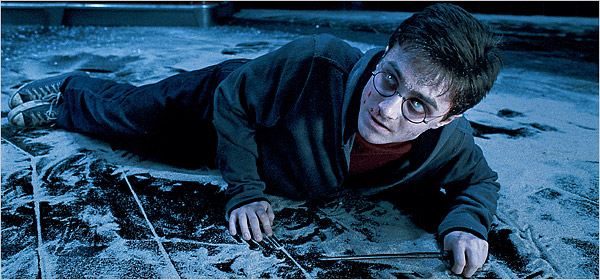
For me, this is one of the best Harry Potters in the entire series.  The acting just keeps getting better, the big-picture storyline finally starts to heat up, and we get to see just how cool adult wizards are.  I like the tone of the movie, I like the washed out colors in it, and I really enjoyed the Voldemort vs. Dumbledore fight.
Wizard fight!
This feels like a step away from the childish wonder that anchored the first half of the film series; there is an important character death, there is no quidditch, and Harry's love life seems hopeless.  Instead, this is a movie that focuses on small victories in the lives of its characters, and it shows just how well Harry and his classmates stack up against real witches and wizards.  It might not be as much fun as some of the other films, but it does a good job balancing the comedic and dramatic.  If I had to pick one Harry Potter movie to get someone interested in the series, I would probably choose The Order of the Phoenix for its balance of character development, cool special effects, and tangible threats.
 

Friday, July 8, 2011

Harry Potter and the Goblet of Fire

It's almost time for the final chapter of the Harry Potter series to hit theaters, so it's time for me to re-familiarize myself with the last few films (and review them) before the final wizarding battle.  Harry Potter and the Goblet of Fire is the fourth film in the series, and in many ways is the turning point in the seven- (or eight-, if you count the Parts 1 and 2 of the final movie separately) part tale.  The kids are starting to look like teenagers (because they were actually becoming teens), we finally get some face time with the (to this point) mysterious villain of the series, Lord Voldemort, and the children are finally old enough to be legitimately accountable for their acting skills.  This is also the first movie that was forced to make drastic changes between the novel and the screenplay, since the book was over 700 pages and the movies from the 300 page novels clocked in at over two hours each.  The Goblet of Fire is my personal favorite book in the series, but that doesn't always translate into liking the screen version, does it?

Like the past few movies, The Goblet of Fire focuses on an entire year of schooling at Hogwarts, and the trials and tribulations that young Harry Potter (Daniel Radcliffe) and his friends Hermione (Emma Watson) and Ron (Rupert Grint) go through in their fourth year.  This year offers something unusual, though.  In an ongoing effort to make the wizarding world a friendlier place, the legendary Triwizard Tournament is set to be held at Hogwarts; the chosen champions from three schools will compete in a series of tests, with the winner gaining fame for him or herself and honor for their school.  That means that a sizable group of students from the vaguely French Beauxbatons Academy of Magic and the vaguely Eastern European Durmstrang Institute will be staying at Hogwarts this year.  This shouldn't directly affect Harry, since he is under the age restriction to compete, but his name is selected --- along with champions from Beauxbatons, Durmstrang, and Hogwarts.  It's called Triwizard for a reason; this fourth selection is a bad omen, because someone very sneaky and powerful had to be responsible for it.  But why would someone want to arrange for Harry to compete in the Tournament?  Perhaps because it is extremely dangerous.  Perhaps there is another reason.  Nevertheless, Harry has to worry about this on top of all his normal studies.  This year is actually worse for him than usual, because his selection makes him notorious within the school and with his friends as a glory hog; add that to Harry's first real attempts to date a girl, and you have the recipe for an awkward year.
Speaking of awkward...nice suit.

Once again, the acting in this Harry Potter is a marked improvement over its predecessors.  Daniel Radcliffe finally seems to be getting the hang of things and does a good job of playing an awkward teenager.  Emma Watson is given a more complex part this time, and she nails it; her scenes at the dance were great.  Rupert Grint finally seems to be stepping up to the challenge, too, although his improvements are primarily in his comedic timing.  There are a few noteworthy additions to the cast at large in this film, with the most obvious being Brendan Gleeson as Mad-Eye Moody.  Like the past few guest-starring Hogwarts professors, Gleeson is given a lot to work with, and he clearly has a good time as the eccentric and war-scarred professor.  Ralph Fiennes makes his Potter debut as Lord Voldemort, and he does a good job of being EEE-veel; I'm still not a fan of his noseless character design, but it is taken from the books, so...whatever.  This is also the first time we see Miranda Richardson as the tabloid-writing Rita Skeeter; she is fine, but her parts in the films never approaches her presence in the novels.  David Tennant has a small but important role as a fidgety over-actor.  Two of the other Triwizard competitors have popped up in other films; Clemence Poesy has had a few small American movie roles, and Robert Pattinson has been in...something...I forget what.  Neither is very impressive here, but most supporting child actors aren't.
Foreground: a vampire and a wizard.  Background: ethnic diversity.

The rest of the supporting cast is still around, and as solid as ever.  The teaching staff of Hogwarts is great, as usual, even with limited screen time.  Michael Gambon, Maggie Smith, Robbie Coltrane, and Warwick Davis are all good, but I really enjoyed some of Alan Rickman's subtle choices, especially how he chooses to reprimand students.  Gary Oldman makes a cameo in a pretty cool special effects scene, but he doesn't get to add much to the overall story.  Similarly, I thought Timothy Spall, Jason Isaacs, and Tom Felton were fine in their returning parts, but none really had much to do in this movie (except Felton, who isn't much of an actor yet).  One of the more welcome expansions to an existing role was that of the Weasley twins, played by Oliver and James Phelps; they had been around in the past few movies, but they played a larger part here, and their mutually shared dialogue was endearing.
I think Oliver's the one that blow dries his hair.

This movie was directed my Mike Newell, andI think he did an impressive job editing this movie down to a digestible length.  The pace is pretty quick and it centers on the Triwizard Tournament, at the expense of the typical glimpses into everyday life at Hogwarts.  I liked that choice, as it kept things fresh and made this a very different film than the previous three.  This movie had the best performances from the cast to date; whether that was through his work or because the cast was getting old enough to sharpen their acting chops, I don't know.  This film has a more washed-out look to it, which mirrors the more serious tone that it would take.  Overall, I think he did an admirable job maintaining the spirit of the book while cutting substantial amounts from the film.

This movie marks a lot of firsts for the Harry Potter series.  This is the first time that the kids looked like normal students; they wore street clothes, grew ugly shaggy haircuts, and wore their school uniforms as sloppily as possible.  Incidentally, this movie has my favorite hairstyle for Harry; before this, it was just a mop top, after this it's very neat, but this is the unruly mess I pictured from the books.  This is also the first time that romance reared its head in the Harry Potter series, and it was handled surprisingly well.  This is also the first movie to skip the wizard game of quidditch (yes, it's mentioned, but we don't watch a match); that was always a "wizards have fun" part of the earlier films, but skipping that aids the more serious tone of this movie.  Most importantly, though, this is the first film in the series that makes good on the ever-lingering threat of Lord Voldemort.  Finally, we get to see bad wizards doing bad things, and we even get a wizard duel.  It was all pretty sweet, I have to admit.  I should also point out that one of my favorite pop stars, Jarvis Cocker of Pulp, was the lead singer in the Weird Sisters, the wizard rock band that played the Hogwarts dance; fans of Pulp and Radiohead might recognize some of the other band members.  Let it be known, even wizards like to rock.
Jarvis needs to know if you can dance like a hippogriff

As the complete lack of criticism above might indicate, I really liked this movie.  It is definitely my favorite Harry Potter chapter to this point.  A lot of it was done in pretty simple ways; it builds upon the foundations laid in the earlier films.  It's San Antonio Spurs-basic competence, but it works.  Is this a deep movie?  Not particularly.  Will it bring in new viewers into the series?  Probably not.  It is a treat for those that have followed the series and grown up with it.  The Harry Potter franchise has always stood out for making the right decisions on how to adapt its stories, and this was the film that showed that it was possible to adapt a huge book into a regularly-sized film.  This was also the last film that the cast was contractually obligated to make; this could have been the last in the series, or the precursor to an abrupt shift.  Instead, it took the serious tone that The Prisoner of Azkaban hinted at and ran, making this appealing to both the magic-loving innocent in us all and the dark part of us that wants to see bad wizards doing bad things.  Definitely the strongest entry in the series up to this point, and a promising look at things to come.

Oh, I thought up one criticism.  Wizard sports have to be the worst spectator sports ever invented.  All three Triwizard tests had the audience staring at nothing for most of the matches (an empty arena, the surface of a lake, and at the edge of a hedge maze).  Don't even get me started on quidditch.  Wizards need to take a page from muggle sports and build a damn jumbo-tron.

...And, because I love Jarvis Cocker so damn much, I have to include this interview with him.  At the time, he hadn't released any new music in about four years, so it was refreshing to see and hear from him again.  Man, I'm such an Anglophile sometimes.

Monday, January 24, 2011

Die Hard

It's hard to believe now, but Bruce Willis in an action movie was considered a risky move before Die Hard.  Sure, he had proven himself as a comedic actor on television, but he also promoted wine coolers.


Looking back, it's hard to believe that anyone wanted to see him blow stuff up.  But it was the 80s, and all sorts of questionable choices were being made --- making John Ritter Ted Danson Bruce Willis into an action star probably made perfect sense to a coked-out film executive.

Thank goodness it worked out.  Die Hard (German for "The Hard") is, without a doubt, one of the top action films of all time.  There are a number of small mistakes throughout the film, but nobody ever notices them until they have watched the movie for the twentieth time.  That's better than quality.  That is the all too rare ability to suspend not disbelief, but criticism.  Die Hard is so awesome, it's mistakes make it all the more lovable.

New York detective John McClane (Bruce Willis) is in Los Angeles to visit his estranged wife, Holly (Bonnie Bedelia), and kids for Christmas.  Before heading home, John heads to her workplace, the Nakatomi Plaza skyscraper, because...um...I guess he loves his estranged wife much more than his young children.  Maybe they're just awful little people.  Don't judge him.  As soon as John is in the building, European terrorists take everyone hostage; since Holly's company was the last group in the building, the thirtysomething employees make up all the hostages.  With his police training and the good luck of being near an emergency stairwell when the hubub began, John manages to escape to an unoccupied floor.  Now, it's John McClane, unarmed and (for some reason) without shoes, against a dozen terrorists with automatic weapons.  I almost feel sorry for the bad guys.

What makes Die Hard completely rad?  The actors, for starters.  Bruce Willis got to shoot a bunch of bad guys and make witty retorts like, "Now I know what a TV dinner feels like!"  Take that, lonely man nutrition!  As John McClane, Willis is extremely likable; he's not perfect --- he can't help getting into stupid fights with his wife --- but he knows how to get things done.  Of course, a hero is only as good as his villain (if you need proof, check out Die Hard 2), and this movie has a doozy.  Alan Rickman plays Hans Gruber, leader of the bad guys.  Whereas McClane is a blue-collar guy to the bone, Gruber is very fancy; he has extensive business knowledge, buys his suits from Savile Row, and he is a teacher at Hogwart's School of Witchcraft and Wizardry.  Right there you have a slobs vs. snobs match-up for the ages.  Gruber adds charm, wit, and ruthlessness on top of those attributes to make him one of my favorite movie villains of all time.  Also impressive is former Soviet ballet dancer Alexander Godunov, as the hot-blooded revenge-fueled villain.
He's like a bare-chested Mona Lisa.  No matter where you move, his eyes follow you.
Sadly, this would be Godunov's last decent film role before his death; it's a shame, because he played a very convincing crazy.  Sure, there are other supporting actors, like Reginald VelJohnson as McClane's contact with the LAPD, or Bonnie Bedelia, that do a decent enough job, but the rest of the cast is just bit parts.  They are stellar bit parts, though, and they make the film so much more enjoyable with their brief appearances.  Who can forget Lakers fan/computer expert Theo (Clarence Gilyard), the only villain that doesn't die?  Or Paul Gleason, taking a break off from playing a high school principal to be the absolute worst Deputy Police Chief ever?  William Atherton was, once again (remember him in Ghostbusters?), a pitch-perfect jerk as the story-hungry reporter.  And then there is stereotypical 80s businessman, Ellis (Hart Bochner):
Hans...!  Bubby...!  I eventually went on to direct PCU!.
Heck, even the bit-bit players were awesome in this movie.  You have FBI agents Johnson and Johnson (Grand L. Bush and future Bond villain Robert Davi, respectively); Argyle, the limo driver, was actually the shoplifting kid that Ray Charles shot at in The Blues Brothers; and Mr. Fu Manchu himself, Al Leong as (what else?) a bad guy with no dialogue.
Fu Manchu, ready to dump a load of action scenes all over Hollywood
It is worth noting that neither Huey Lewis nor the News are in Die Hard...that is just a dude who looks like Huey.

In the director's chair, John McTiernan shows a much better touch with the actors than he did in 1987's Predator.  Of course it helps to have actual actors in your cast, instead of just future governors.  Thanks to McTiernan's help, the humor, action, and drama are well-balanced in this movie.  And each of those aspects of the film are pretty great.  It's not just the dialogue, either; Willis and Rickman show a lot of great nonverbal acting, for both humorous and dramatic purposes.  The action looks really good throughout the film and the story was told in a very clear fashion.  What more could you want?  Well, more professional editing, I suppose.  If you know where to look, you can find Willis' stunt doubles in a few scenes --- they're usually the Bruce Willis-looking guys with the bright white shirts, long after Willis' has been stained with blood and dirt.

That's okay, though.  In my mind, this film can do no wrong.  It's got action, humor, and is just completely awesome.  Do you want to know how awesome Die Hard is?  Here's a list of stupid things in the movie that I don't even care about.
  • Everything 80s: smoking in airports, cocaine use, pregnant women drinking alcohol, form-fitting sweatpants, Huey Lewis look-alikes, and limo drivers drinking hard liquor --- it's all good in the 80s!
  • If Reginal VelJohnson is a "desk jockey," why was he in a patrol car?
  • So, the only people left in the building are the party on the 30th floor, but the doorman makes McClane search for his wife in the computer anyway?  What a jerk.
  • The Deputy Police Chief makes some valid points as to why there is not a hostage situation...until he explains that the dead body that dropped from the upper stories of the building was "probably some stock broker that got depressed."  Oh, well if it's "probably" just that, then we can all go home now, right?
  • John McClane never tracks down the guy with the "make fists with your toes" advice and punches him in the mouth.
  • The closing message of the film is that Reginal VelJohnson killing somebody is a Christmas miracle.  Pity it didn't transfer over to Family Matters.
Here's an interesting factoid: Die Hard, based on the book Nothing Lasts Forever, was actually supposed to be a sequel to the Frank Sinatra film, The Detective.  Can you picture Frankie saying "Yippie ki yay, MF?"  Actually , I can...it would be pretty awesome.  Anyway, without a doubt, Die Hard is one of the quintessential action films, as well as one of the more cheery Christmas movies that you can watch any time of year.

Monday, January 17, 2011

Alice In Wonderland (2010)

Tim Burton is one of my favorite directors, because he makes odd little films that somehow manage to become big hits.  I tend to prefer his more intimate work (Edward Scissorhands, Ed Wood, Big Fish) over his obvious blockbusters (Batman, Planet of the Apes), but I always find his work interesting.  When you add my favorite actor and Burton collaborator, Johnny Depp, to the mix, you definitely have my attention.  Add those two oddballs to the fictional world of Lewis Carroll's Alice in Wonderland, and you have a guaranteed formula for weirdness.

It should be pointed out that, despite the title, this actually isn't an adaptation or re-imagining of the source material, or even of the Disney animated classic.  Instead, it serves as a sequel of sorts.  This time around, Alice (Mia Wasikowska) is a teenager instead of a child.  Like all Wonderland stories, this one begins in the real world.  Alice is attending a party when she fields an unexpected (and unwanted) proposal for marriage; she is at the marrying age for Victorian England, and the match is sensible and proper.  And, in typical Tim Burton style, "sensible and proper" seem positively horrid, with madness being a preferable alternative.  Almost as if she is signaling for a rodeo clown to distract the bull away from her, Alice notices a white rabbit wearing a waistcoat.  Since her options are follow the rabbit or definitively choose a life path, the nineteen year-old Alice opts to follow the rabbit.  From here, things begin to get a little deja vu; Alice visits all the same places and meets all the same characters that she did in the original stories --- she eats stuff and grows/shrinks, she chases the White Rabbit (voiced by Michael Sheen), she goes to the Mad Hatter's (Johnny Depp) tea party, and gets confused by the Cheshire Cat (voiced by Stephen Fry) and the Caterpillar (voiced by Alan Rickman).  Alice seems to be going through these experiences for the first time, but something seems...different about everything.  The only clue we have that this is a new tale is the fact that all the the inhabitants of Underland (not Wonderland) remember an Alice from years ago.  It has even been prophesied that Alice will be the one to kill the Red Queen's (Helena Bonham Carter) fearsome dragon, the Jabberwocky (voiced by Christopher Lee).  Alice is supposed to kill a creature of Wonderland?  Well, that's different.  And, as this film insists, this really isn't Wonderland, but Underland.  What's the difference?  While both are filled with imaginative landscapes and characters, Underland is the nightmarish twin to the world of Wonderland; apparently, things were once shiny and happy, when the White Queen (Anne Hathaway) ruled, but things have gotten darker and more serious under the Red Queen's reign.  But is this Alice the Alice of the prophesy?  Or is this all something else, something darker?

Not too long ago, I read Lewis Carroll's works for the first time.  Frankly, I was underwhelmed.  I will admit to an unusual joy of language present in these stories, and some pretty interesting imagery, but I wasn't impressed on the whole.  In all honesty, I think that these stories are excellent launching points for adventures, but I am happy to see that most adaptations to the stories aren't slavishly devoted to the source material.  Obviously, then, I have no problem with Burton's Underland.  I do have a problem with the title, though.  I've said it before, and I'll say it again, I think that film titles are important indicators of the film's content; if I pop in a DVD titled Bambi, it had better be an animated deer story, and not a live-action bestiality flick.  Titling this Alice in Wonderland seems disingenuous to me, because the films goes to great lengths to differentiate itself from previous movie incarnations and the source material.  Alice in Underland would have been more appropriate, I think, and still drawn the connection to Wonderland.

The first thing that struck me about this film was its appearance.  Visually, this is a fantastic piece of moviemaking.  The environment, even though it is almost a post-apocalyptic version of Wonderland, is still full of color and detail.  The character designs were astounding, so different from the classic versions of the characters, and yet they all had something iconic that made them seem somehow familiar.  The use of CGI in the film was some of the best I have seen utilized in any motion picture.  Obviously, the environment was largely CGI, but most of the characters had something altered in post-production, some in subtle ways; Crispin Glover, who plays the Red Knave, had everything except his head replaced by CGI.  Tim Burton has always been a visual filmmaker, but this was really a step above anything else I've seen of his.

This film was chock full of recognizable actors, each of whom did a good job.  Many of them stuck to the classic interpretation of their characters, but that's not necessarily a bad thing.  Matt Lucas (Tweedledee and Tweedledum), Michael Sheen, Stephen Fry, and Alan Rickman were the principal actors who followed that practice.  There were several bit parts where I recognized the actor, but not the character.  Timothy Spall played a bloodhound, Michael Gough voiced a dodo bird, Crispin Glover was awkward as ever as the Knave, and Imelda Staunton was one of the talking flowers --- none of these were huge roles, but I found it interesting that such small parts were played by actors I have seen in so many other films.

Now let's talk about the departures from the norm.  For starters, Paul Whitehouse's March Hare had a dangerous edge to him that bordered on sociopathic.  While Christopher Lee's lines as the Jabberwocky fell in line with Carroll's poem, I'm not so sure about the use of this character as a fearsome enemy.  Anne Hathaway was okay as the White Queen, showing a few hints at bizarre character traits, but I don't think she had enough screen time to develop her character much.  Helena Bonham Carter had more screen time, but most of it was spent emphasizing how odd her character was and was, I think, supposed to generate more laughs than I gave it.  I felt that Mia Wasikowska did a pretty good job as Alice, making her one of the stronger heroines I've seen in a children's movie; I'm not entirely convinced that her "roll with the weirdness" attitude was the right one for a character entering Underland, but it was a choice and she stuck to it.  And then there's Johnny Depp.  The Mad Hatter isn't a character that is usually given depth, but here he has a back story and plays a critical role in the film.  To do that, Burton and Depp had to change the character significantly, and not just cosmetically (although his CGI/makeup was some of the most interesting in the film); this Hatter seems to have almost a split personality, with the harmless goofball character that is well known and a Scottish (I think) warrior character that is brand new.  I think Depp captured the mercurial nature of his character well, but his character is one of the aspects of this film that I found disappointing.

I have heard that Alice in Wonderland is not so much a children's story, so much as it is an acid trip told in nonsense rhymes.  Yes, this is a story that is typically aimed at children, and yes, this story does has some surreal nightmare qualities to it.  I think that balance lends itself nicely to Tim Burton's guiding hand; much of his work appears dark, but has a childlike quality at its core.  On the surface, this is a can't-miss concept.  In practice, though, all the visual effects in the world can't disguise the fact that the story in Alice in Wonderland is lacking.  There isn't a strong narrative, which shouldn't be a problem, since this is a story that should be about the wonders of this Underland.  But the whole movie builds toward a final battle that fails to do anything imaginative and ends up as a surprisingly dull action sequence.  Because this movie has that climax and they foreshadow it from the beginning, the rest of the story feels like an unstructured jumble that rambles on without much purpose.  Personally, I would have preferred a story where there was more rambling and a less typical climax.

With that story structure in place, though, Alice must be given motivation for trying to thwart the Red Queen's rule.  Since Alice is a stranger, that motivation has to come from the supporting cast, which ends up being the most prominent Underland inhabitant, The Mad Hatter.  I love me some Johnny Depp, and he is occasionally very charming in this role, but the militant edge to his character is left largely unexplained and his shifts into that persona are abrupt and unexplained.  This could have been circumvented if Alice had a personal stake in Underland, but she does not, and remains fairly dispassionate about the bizarre events surrounding her.

This movie just feels like ninety percent of the creative process focused on how the film would look, and maybe ten percent was spent on the story itself.  There are so many pieces of this film that work.  I liked all the voice acting and I didn't see a poor performance in the whole film.  I don't particularly like Depp or Mia Wasikowska's characters, but I think they both played their parts well.  There are all sorts of high concept issues brought up in this film (Colonialism, feminism, etc.), but I was happy to see these topics left without any explicit conclusions.  And let's not forget just how gorgeous this movie is.  Just looking at promotional posters for this movie makes me want to watch it again.  No, that's not right...they make me want my own production stills, framed and mounted on my wall.  I really liked a lot about this movie.  I just didn't like...well, the movie part of it.  With such a surprisingly limp emotional core, I was left unsatisfied with the film and extremely disappointed in Johnny Depp and Tim Burton.  The gorgeous peculiarity that is Alice in Wonderland is certainly worth viewing, but the story is inconsequential at best. 

Tuesday, December 14, 2010

Harry Potter and the Prisoner of Azkaban

Quick, name your favorite third installment of a film franchise.  Yeah...it takes a little bit of thought, doesn't it?  Aside from Die Hard With a Vengeance and Army of Darkness, is there a great third movie in a series?  If you can think of another great #3, leave it in the comments (I can think of two others).  These movies usually end up putting the lid on the franchise coffin, instead of improving upon the established formula.  After two successful (but similar) movies about magical children, Harry Potter and the Prisoner of Azkaban changes the tone a bit and delves into darker territory, with a tale about betrayal and murder.  That sounds about right for a family film, doesn't it?

Like the last two films, Azkaban covers an entire school year for Harry (Daniel Radcliffe) and his friends, Ron (Rupert Grint) and Hermione (Emma Watson).  Also like the last two films, the plot is split between the ongoing struggle between Harry and the forces of evil wizard extraordinaire, Lord Voldemort, and Harry's smaller-scale problems at school.  As Harry prepares to return to Hogwart's wizard boarding school, he notices wanted posters for a man named Sirius Black (Gary Oldman) everywhere he looks.  Black, a disciple of Voldemort, had just broken out of the super-secure wizard gulag, Azkaban; this is a big deal for the wizarding world because Black was the first-ever escapee of the prison and also because his crimes were especially heinous.  Not only did he blow up a fellow wizard, Peter Pettigrew (Timothy Spall), with only a finger escaping total incineration, but Sirius Black was the man who led Voldemort to Harry Potter's parents on the night they were murdered.  Out of prison, it just makes sense that his first move would be to kill Harry for his master.  When Harry learns Black's history, he welcomes the fight and declares his intention to kill Black.  Apparently, having evil wizards try to kill you every year can make thirteen-year-olds get a little aggressive.

The other plot line follows Harry's progressive immersion in the world of magic.  As a side effect of Black's escape, Azkaban guards (called Dementors) arrive, looking for Black.  Dementors are not people, but soul-sucking monsters that find Harry a particularly tasty morsel.  Harry takes lessons on how to deflect these creatures from his new Defense Against the Dark Arts teacher, Remus Lupin (David Thewlis).  Like Harry's last two DADA teachers (villains in the last two films), Lupin has a secret that plays a part in the film's climax.  Also playing a part is the school groundskeeper, Hagrid (Robbie Coltrane), who earned a promotion to teacher.  He introduced a hippogriff (a magical half-horse and half-eagle creature) to some students and, despite it being very friendly to Harry, it injured a student, perennial Potter bully Draco Malfoy (Tom Felton).  As such, the animal receives an execution date.  I wonder...will these seemingly dissimilar plots ever coalesce in time for the film's end?

At the time of its publication, the book, Harry Potter and the Prisoner of Azkaban, was the longest in the series.  Since the last two films went over two hours to cover everything in the books, it became necessary to cut the novel into something more digestible in movie form.  As such, Azkaban is the first Harry Potter film to take liberties with the source text.  That's great news for someone like me, who liked the first two films, but felt that they could have done more to adapt to the film genre.  That means that this film is more plot-driven that the others.  The other big change is Alfonso Cuaron's assumption of the director's role; aside from making a very good cutting of the story (in my opinion) for the screenplay, Cuaron played with the film's color palette, opting for more blues and a general washed-out feel, which I thought matched the story's being-hunted-by-a-murderer plot.  The DVD special features also point out an instance of Cuaron's dealings with his teenage cast; he asked the three main actors to write an essay about their characters, and the responses he got were surprisingly in-line with the work the characters themselves would have done: Watson wrote a fifteen-page paper, Radcliffe wrote a few pages, and Grint didn't do his homework.  Well, I laughed, anyway.

The acting in this film is a marked improvement over The Chamber of Secrets.  Daniel Radcliffe not only looked the part, with the most Harry Potter-ish hair of any of the movies, but his casual acting skills showed a lot of growth.  He doesn't quite nail every emotion (anger seems a little out of his grasp), but it's still a big step.  Emma Watson is, once again, the most natural actor of the three, but this movie gives her less screen time and, thus, less to do.  Rupert Grint manages to make ugly faces whenever he's supposed to be frightened, which is often.  I wasn't terribly impressed with David Thewlis' Lupin, but that has more to do with the CGI used on his character and my own impression of the character from the book than any particular shortcoming in his performance; I thought he would be more...raggedy, I guess.  And I'm still not certain why his CGI-aided moments went with such a lanky character design instead of the more traditional bulk.  Gary Oldman, one of the great actors of the 90s, took this role to make some money, but his performance is still pretty good; I loved the design for his character, from the hair and tattoos to his emaciated body.  Much of Oldman's presence in the film comes from wanted posters, but they are pretty awesome, just the same.  Tom Felton's turn as Draco is far less sinister than in previous movies; here he is used as comic relief instead of a legitimate rival to Harry.  Michael Gambon replaced Richard Harris as Hogwarts headmaster Dumbledore, and his performance had the subtle mischief I felt was lacking in Harris' performances.  Emma Thompson and Timothy Spall make their Potter debuts here in limited performances and cast staples Maggie Smith, Alan Rickman, and Robbie Coltrane all do fine work in their small supporting roles.

Personally, I think this third installment surpasses the first two Harry Potters easily.  The acting is better, the pace of the film is better, and several details are glossed over in favor of a more seamless narrative.  Not only were the individual acting performances better than in previous films, but I think the more casual scenes showing the kids goofing off and having fun felt natural an unforced, which was a huge departure from the I'm-waiting-for-you-to-stop-talking-so-I-can-deliver-my-lines performances from the last film.  This movie also helped build the budding romance between Hermione and Ron a bit, something the other films left on the cutting room floor.

Not every choice was well made, though.  The Jamaican shrunken head in the early stages of the film was just obnoxious, for starters.  There were a few instances where the token black student at Hogwarts makes some reference to Black (as in Sirius) being up to no good, or how he could be anywhere, or whatever --- I'm not a racist, but unintentional racism makes me giggle.  I mean, really?  You couldn't find any other actor to make negative comments about "Black"?  Those aren't major complaints, though.  The one thing holding this movie back is the source material.  There is a plot element that is revealed in the final third of the movie (to be fair, it is foreshadowed) that essentially acts as a deus ex machina.  As such, the final third of the movie can seem somewhat contrived, but that is what the book offered, so I guess the filmmakers were kind of stuck.  Still, even with the contrived ending, this is the best of the bunch so far.

Monday, November 22, 2010

Harry Potter and the Deathly Hallows: Part 1

Does this remind anyone else of Iron Maiden's "Run to the Hills"?
It's been a while since I've read a Harry Potter book. I've read them all, but in the intervening years, many of the plot details have faded from my memory. Maybe that's a good thing; when I'm too familiar with a story, I notice any variations acutely and also know every beat of the plot. For the seventh installment in the franchise, Harry Potter and the Deathly Hallows: Part 1, that was not an issue. I even completely forgot what a Deathly Hallow was, it's been so long. Isn't it a 70s punk band? Does that make this movie like a Scooby-Doo team-up episode (Harry and the Hallows take on Joker and the Penguin!)? Anyway, it was a nice change to know the gist of the story, but not feel the need to nit-pick every little change made. I have to wonder, though, if more familiarity would have actually helped with this film.

I'm going to make some basic assumptions about you, the reader right now. First off, you are familiar with the wizarding world of Harry Potter. You know that Harry Potter (Daniel Radcliffe) is a good wizard, and he must eventually battle the Bowser of the wizarding world, the evil Lord Voldemort (Ralph Fiennes). Harry is accompanied primarily by his friends Hermione Granger (Emma Watson) and Ron Weasley (Rupert Grint), and frequently aided by his school's headmaster (and Voldemort's only magical equal), Professor Dumbledore (Michael Gambon).

Now, here's a quick catch-up on the series. Unfortunately, Dumbledore was killed at the end of the last Harry Potter. Voldemort's bad guys are running the wizarding world through terror and murder, which are admittedly pretty non-magical ways to rule anybody; only Harry and his friends know how to stop Voldemort. Oh...you want to know, too? Well, Voldemort (let's call him Morty for short), in order to gain immortality, split his soul into six parts and hid them inside ordinary items. As long as one of these Horcruxes exists, so does Morty. The good news is that, through the events of earlier movies, two Horcruxes have already been destroyed. The bad news is that the other four could be anything, anywhere, and the longer it takes to find (and figure out how to destroy) these things, the more likely it is that Morty and his minions will kill Harry, removing the last viable threat from Morty's reign of terror.

This movie marks a distinct departure for Harry and his friends. Instead of going to Hogwart's and finishing their last year of wizarding school, they go on the lam. Morty's men are hunting them, and they need to lie low and run when they are found. That means that they stay outside of wizard communities and spend some time in London before ultimately settling on a series of desolate camping grounds scattered throughout England. As it turns out, without Dumbledore's help, these kids are pretty helpless. Like, you know, kids. They know that they need to find Horcruxes, but they only manage to find one for this entire movie. It takes them the entire movie to learn how to destroy it, too. Meanwhile, Morty spends his time searching for a special magic wand, one that will kill Harry. Things begin to fire on all cylinders when Harry and his friends get over their teenage attitudes and work together to solve their problems. Of course, that only gets you so far if you get captured by Morty's people...

The biggest difference between The Deathly Hallows and any of the preceding chapters is the tone. Gone is the sense of wonder at magic. That is replaced by a hopelessness that becomes the defining tone of the film. We're used to seeing Harry and his friends encounter a puzzle and solve it within two hours (even though those two hours encompass their entire school year). Seeing them stuck, with no promising leads, is surprising to see on the big screen; I liked this choice, because it actually makes their tasks seem suitably difficult for a lead-up to the inevitable big wizard fight. However, the movie can drag at points when nothing seems to be happening. It is at these moments, though, where we get to see how well these young actors have developed over the years. Director David Yates leaves a lot of moments as better shown than told, which is especially surprising in a family film (even if it is rated PG-13, this is a movie that young fans will grow into), a genre that usually leaves subtlety locked in the car with the window cracked. His confidence pays off pretty well; Emma Watson is still the class act of the bunch, but Daniel Radcliffe was pretty good and Rupert Grint looks like he might be a pretty good comedic actor at some point, even if he is so very, very ugly. This movie relies more on these three to carry the acting load than any other Potter film, with special effects and the always wonderful adult supporting cast making only occasional appearances.

The film is certainly not without fault. You can justly criticize this movie for having very little happen in its two-plus hours running time; actually, many things happen, but very little to advance the larger plot of Harry vs. Morty. I've also heard people complaining about an abrupt ending. It's not abrupt; the action leading up to the ending is sudden, when compared to the pace of the rest of the film, but the ending makes sense and I was okay with it.

What I didn't like about this film was the fact that it is clearly a set-up film. I actually enjoyed this movie --- it had action, humor, and several sad moments, even if it was slow --- and I think it did a fantastic job setting up The Deathly Hallows: Part 2, especially with the way it built up Bellatrix Lestrange (Helena Bonham Carter) as a prime villain. That doesn't make this a strong movie on its own, though. While I was okay with the ending, it isn't as strong or final as the other Potter endings; it definitely feels like a "switch to disc 2" moment. And that's too bad, because I think that, if they could have found a good stopping point, this could have been the awesome downer movie of the series; they are trying hard to be the wizard version of The Empire Strikes Back, where the heroes have had bad news all day, and are getting ready to attack those stupid Ewoks. It doesn't quite hit the same note of "we've taken their best shots, now it's our turn" feel, though. I also felt that this movie had scenes where you were just attacked by cameo appearances. Of the adults, only Bill Nighy and Ralph Fiennes had decent screen time, with Helena Bonham Carter, Toby Jones (as a voice) and Rhys Ifans also making good with their brief appearances. Alan Rickman, Jason Isaacs, Michael Gambon, Peter Mullan, Robbie Coltrane, Brendan Gleeson, David Thewlis, John Hurt, Imedla Staunton, David O'Hara, and Warwick Davis were all just flashes on the screen. Sadly, most of these (for the most part) very respectable actors were limited to less that four lines and maybe one visible emotion. Even the other child actors, like Tom Felton, Clemence Poesy and Bonnie Wright were barely given any time to much of anything. This barrage of familiar faces and characters was sometimes distracting for me, as I searched my memory to identify certain characters or recall why someone was in the position they were in (I'm still not sure why the Malfoys were on Morty's bad side).

There was a lot that I really enjoyed, though. I really liked Ben Hibbon's dark and visually interesting animated tale that explained just what the hell a Deathly Hallow is. I liked the supporting cast, even when their input was limited. I thought the emotional scenes were handled better than in any previous Harry Potter, and that includes an extended sequence of watching them mourn an ugly CGI character, which could have been hilarious if it was handled poorly. And this movie did what it set out to do (set up the final film), and it did it well. Does this story need to be two movies long? After all, the last three movies were also based on enormous books. I don't know, but I guess we'll see when Part 2 comes out this summer. As it stands right now, though, I expect that this film (both parts together) will prove to be like any classic double album in rock; bloated and long-winded, and certainly with some moments that could have been left out, but it's the White Album, what are you gonna do?