Showing posts with label Jack Lemmon. Show all posts

Friday, May 18, 2012

The Apartment

When I finished watching  Double Indemnity a few months ago, I came to a startling realization: that was the only Billy Wilder movie I had ever seen!  That fact still boggles my mind; with such a prolific director who made so many noteworthy films, how could I have accidentally avoided his body of work?  Well, it's high time I changed that.  I wasn't sure which film I should choose next --- he covered a lot of ground, genre-wise --- so I just went with the film that earned him the most Oscar nominations: The Apartment.

C.C. Baxter (Jack Lemmon) is one of the many faceless worker bees in a New York insurance company.  Baxter is a nice guy, but he's also the type of guy who doesn't stand up for himself or really separate himself from the pack.
Insurance agencies: where unique snowflakes go to melt
The only way Baxter has found to differentiate himself from the masses of other qualified workers has been to offer his apartment as a love nest for his manager.  Well, actually, it's not his manager, it's a manager.  Well, it's not a manager singular, it's three managers.  So Baxter spends his days buried in paperwork, trying to do his job, while balancing the scheduling demands of three men unaccustomed to patience.  A typical day would have Baxter sending his apartment key to a manager (using the company's interdepartmental mail, of course), working late, and then coming home...only to wait some more, because boss man is running behind schedule.  Of course, the managers --- who seem to think his name is "buddy boy" --- aren't going to clean up after themselves or even apologize for their messes; Baxter takes it all in stride, hoping to get glowing references when a promotion opens up.
Above: Baxter and the managers of Total Bastards, Inc.
While the constant activity in his apartment makes his neighbors think Baxter is a Lothario, he actually only has eyes for Ms. Kubelik (Shirley MacLaine), one of the elevator operators in his building.  Promotion day finally arrives for Baxter, but having his own office doesn't mean that he is free of lending his apartment key to his superiors.  And when he begins to lend his home to the director of personnel, Mr. Sheldrake (Fred MacMurray), these "favors" really begin to cause complications for Baxter.

The thing that surprised me most about The Apartment was its subject matter.  For the first half of the film, the idea of serial adulterers is played for laughs; the only consequence shown was Baxter catching cold because he had to wait in the rain while his place was being used as a hanky-panky den.  This was widely released in America in 1960, so I imagined that a Leave it to Beaver nation would get offended by a theme like this; apparently not.  The second half marks an abrupt shift in tone, as one of the consequences of adultery is shown to be suicide, and that also seems like something that wouldn't have played in Peoria, at least not back in the day.
Nowadays, though, we're all like, "Kung fu that bee-yatch"
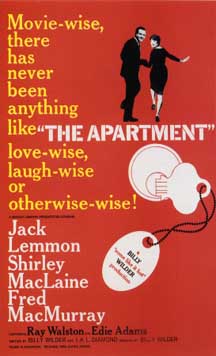
Of course, that shouldn't impact my opinion of the movie, since I don't live in 1960s Middle America, but the tone of The Apartment definitely caught me off guard.  Honestly, with a movie poster like the one at the top of this post, I didn't expect any significant dramatic content at all.  But, you know what they say about expecting: you make an "ex" out of "pec" and "ting."  Side note: "They" are idiots.

I haven't seen very much of Jack Lemmon as a young actor, so it feels strange to admit this, but...I don't think I care for Lemmon as a comic actor in his youth.  I'm not exactly sure why, either.  Sure, he hams it up a bit, but I don't think he's any more guilty than other contemporary actors.  Maybe I just dislike his put-upon everyman character that seems to be a common theme in his early work.  Whatever the case, I didn't like Lemmon in the first half of this movie. 
Hold that thought; I'm not done with you yet
As soon as the suicide attempt happens, though, I thought he was excellent; Lemmon is extremely capable --- great, even --- at balancing humor and drama within the same scene, but when he's left to just comedy, it felt flat to me.  Shirley MacLaine was more consistent and played her character in an interesting way.  How easy would it have been for MacLaine to portray a dumb broad too innocent to know when she is being lied to?  She carried an unusual weariness in her performance that was absolutely perfect for the role. 
"I'm tired of this movie.  If I settle for you, can we cut to the credits?"
Fred MacMurray was good as the selfish boss; MacMurray really was at his best when he played against type like this.  Ray Walston was memorable as one of the many bosses who took advantage of "buddy boy," although it had more to do with his dialogue than his actual performance.  Along the same lines, Joan Shawlee sticks out in my memory as the first illicit girlfriend we see in Baxter's apartment, if only because she wouldn't stop cha-cha-ing.  Jack Kruschen was good as Baxter's doctor neighbor, even if he was a bit of an ethnic stereotype, but what I remember most about his performance was how he repeatedly called Baxter a "good time Charlie" for all the noisy romancing that he hears coming from Baxter's apartment.  I get the gist of that comment, but as far as insults go, I've heard better.
Really, he's more of a Bjorn Boring than anything else

Billy Wilder directed and co-wrote The Apartment, which surprised me.  Maybe I just haven't experienced enough Wilder, but I think it's pretty interesting that he would intentionally set himself up with such a shift in tone.  Does he pull it off?  Well, I didn't enjoy the first half of the movie very much.  It felt like the sort of fluff that Jerry Lewis would star in, and I think that it has aged poorly.  However, I really enjoyed the rest of the film.  Wilder isn't the most dramatic director in regards to his cinematography, but I really liked some of the frame compositions in this film.  I also thought it was an interesting choice to make this a black-and-white film; thanks to the almost bleak hues, it is easy to forget that this movie takes place mostly during the time between Christmas and New Year's Day.  Keeping the film in shades of grey makes the character's loneliness and desperation stand out more, but very subtly. 
Not always subtly, but most of the time
I also liked that, in many ways, the two main characters are so similar --- both are used to being lied to and treated as doormats; the only difference is that Baxter eventually gets the promotion promised him and Ms. Kubelik never becomes Mrs. Sheldrake.

As much as I enjoy the second half of the film --- I won't say it's great, but it is pretty darn good --- I just can't get over how disinterested I was in the first half.  I liked what Wilder was able to do when he mixed the serious and the humorous, and I loved the second-half performances, but when I think of The Apartment, I think of Jack Lemmon whining.  Maybe one day I will come back to this movie and, knowing what's in store, be pleasantly surprised with how the film has grown on me.  For now, though, I have to give it a fairly mediocre rating.
Thursday, November 18, 2010

Grumpy Old Men

The elderly are adorable!  They're not even people, they're like little pets, I want to just pinch their cheeks so badly!  At least, I do when they are foul-mouthed curmudgeons.  Grumpy Old Men is very much a movie about your favorite old person (or, if you're old, your favorite you).  You might see how the story ends a mile off, but it's a fun viewing because it's so pleasantly comfortable.

John Gustafson (Jack Lemmon) and Max Goldman (Walter Matthau) are neighbors and competitors in a never-ending battle of petty jokes and pranks.  Anyone else would admit that they are actually best friends --- they go to all the same places and do all the same things --- but these two have an imaginary grudge from years ago, and "Hello, dickhead" is as friendly as they get.  Actually, these two pay closer attention to each other than ordinary friends do; they either accompany each other around town, or peer through their window shades to see what the other is doing.  That rivalry heats up when a new neighbor moves in across the street.  Ariel (Ann-Margret) is exotic in this small, icebound town; she is not only in their age group and still attractive, she is from California and has all sorts of weird possessions and hobbies.  Ariel introduces herself to the townsfolk by going on an informal date with (seemingly) the town's entire senior citizen class.  That means John and Max are in direct competition for the last hottie either of them will ever have a chance with.  "Hello, dickhead" is starting to sound downright inviting.

The story of Grumpy Old Men is not fantastic or complicated.  It's really nothing special at all, except with the inclusion of ice fishing, something you rarely see in films because it's even more boring than regular fishing.  There are subplots and complications, secrets and reveals, but this story is just an excuse to see two old men insult each other for 100 minutes.

That's not a bad thing, mind you, but its effectiveness definitely depends on the cast.  Jack Lemmon and Walter Matthau are both wonderful in this movie.  Their interactions are so natural and so nuanced, but the insults creative; their chemistry makes it feel like you're not watching a movie, but the dialogue is witty enough to remind you that this had to have been written down at some point.  It feels like director Donald Petrie didn't even have to direct his stars, just let them loose.  The nice thing about this movie is that both Lemmon and Matthau have opportunities to show the depth of their characters, so they're not just insult machines, like the Friar's Club roastmasters.  Most of the noteworthy supporting cast was fine (Kevin Pollack, Daryl Hannah, and Ossie Davis), but their roles had limited impact on the quality of the film as a whole.  Anne-Margret did a pretty good job, although I'm still not sure about some of her character's choices; name one old person that moved from a warm climate to ice fishing territory and didn't have family nearby.  And she dates Matthau?  Isn't he a little out of her league?  Burgess Meredith, in his small supporting role as John's father, is what bumps this movie up from "pleasant" into "funny."  With the rest of the cast, this is an above-average comedy, but Meredith is hilarious and improves the entire movie.

No, Grumpy Old Men is not revolutionary or unexpected.  It's comfortable and engaging and sweet.  And Burgess Meredith is amazing.  In a drama, I would care more about the story, but this is a comedy with three old men saying some pretty funny things that only the elderly can get away with.  It's interesting to think how much less funny this movie would have been with the same cast, only twenty years younger.  This is one of the only Hollywood movies that requires its actors to age gracelessly, and they do it well.

Wednesday, September 29, 2010

The Odd Couple

Films adapted from plays can have difficulties during the creative process.  Unlike adaptations of literature, comic books, comic strips, or legends, plays usually do not suffer from an oversimplification or over-condensation of material; plays typically run about as long as feature films do.  You can usually spot a former play by the sharp dialogue, the absence of complicated action sequences, and the large number of scenes that feature only one or two characters.  Some of my favorite films have been adapted from plays (I love me some Who's Afraid of Virginia Woolf?), but I recognize that some things that work on the stage do not work on film.  For instance, on stage, it is necessary to make broad gestures and speak loudly so the audience can hear and see what is happening; with the intimacy of movie cameras, films can be much more intimate and subtle.  Sometimes, the screenplays for these adaptations take that subtlety into account.  Sometimes, they don't.

The Odd Couple begins with Felix Ungar (Jack Lemmon) renting a room at a sleazy hotel.  He planned to commit suicide by jumping out of his hotel room window because his wife has left him.  It is not Felix's day, though; his window was jammed and he threw his back out, trying to open it.  He even failed to drink the pain away afterward, hurting his neck when downing a shot of liquor.  Felix then hobbled toward a bridge to contemplate suicide again.  I would like to take the time to point out that this is, in fact, a comedy (ranking #17 in AFI's 100 Years...100 Laughs list) that opens with physical humor and the foibles of a suicidal person.  I'm not judging (yet), but I thought I'd throw that idea out there.

Meanwhile, Felix is missed by his buddies at their weekly poker game.  Felix is never late, so the group (including classic character actors John Fiedler and Herb Edelman) is mildly bewildered by his tardiness.  That bewilderment turns to pronounced concern when the host, Oscar  Madison (Walter Matthau), gets a call from his ex-wife, telling him the news of the Ungar's breakup.  Oscar and the boys immediately worry that Felix will attempt suicide; I guess his friends knew him well.  Before anyone can take action, Felix arrives at Oscar's for the poker game.  He eventually breaks down and tells them his troubles, and Oscar decides to offer Felix a room in his eight bedroom (***mouth agape***) New York City apartment (***jaw now on the floor, completely detached from face***) to stay in until he can overcome his suicidal tendencies.  You would think that two poker buddies would get along just fine in an apartment that size; even if somebody's annoying, you can just take up residence in the Northern wing.  Apparently, though, there is a small hitch.  Oscar is a slovenly person, while Felix is an obsessively tidy person.  What kind of crazy hijinks will these kids get into?  Well, if you're not guffawing at the mere thought of such an unlikely pair living together...well, tough --- that's where all of the humor in this movie stems from.

The Odd Couple is a notable comedy or many reasons.  It was nominated for two Oscars (one for writing, the other for editing), which is extremely rare for comedies.  It helps that the screenplay was written by Neil Simon, who wrote the Tony Award-winning play.  Walter Matthau starred in the play as well as the movie; this was his first comedic role in a film.  This was also the first collaboration between Matthau and Jack Lemmon, one of the most famous pairs in film history.  Even without the AFI ranking, this is generally regarded as a comedy classic.

I just wish I liked it more.  I appreciate a lot of the things this film does well, though.  The acting is well-suited for the script.  Matthau is very entertaining and Lemmon plays his part well; together, their banter is a great example of timing and chemistry.  The supporting cast is universally solid or better; I particularly liked Monica Evans and Carole Shelley as the feather-brained Pigeon sisters.  The direction must be pretty good from habitual stage director George Saks; if it wasn't good, then I doubt that Lemmon and Matthau would have worked so well together.

If all that is good, what could I possibly have a problem with?  I'm not sure.  I think it's the script.  I'm pretty familiar with Neil Simon's plays; he writes bickering friends like no other playwright, so this is obviously one of his seminal works.  I just don't like a lot of what he wrote here.  I find Felix's character utterly obnoxious.  I understand that is the point, but this isn't like other movies with buffoonish characters --- I have an active dislike for Felix Ungar.  I think Lemmon played the part perfectly for the way it is written, but his performance comes across as less subtle than a Jerry Lewis comedy and hammier than Christmas dinner.  For the first two-thirds of the movie, I not only completely sympathized with Oscar's character, but I was rooting for another suicide attempt.  I guess my problem is that the script is so one-sided.  You're rooting for Oscar, despite all the good things that Felix does because Felix's character is really, really annoying.  If that was evened out, so that Oscar's slovenly ways could be shown as truly disgusting instead of just messy, I think Felix's character would seem like less of a cartoon character.

Part of my problem might be overexposure.  While this is the first time I watched this film, it has spawned a sequel, two television shows, one animated show, and a female version of the play, all while the original play has been produced and reproduced several times over.  The idea of the tidy Felix and Oscar the slob has become omnipresent in our culture to the point that if you say that a pair is an "odd couple," thoughts immediately jump to these characters.  Then again, maybe I didn't really like this movie because my thoughts on humor are a little odd.

I mentioned that the first two-thirds of the movie were painful for me to watch; I have to admit that I enjoyed the last third.  Starting from approximately the confrontation in Oscar's bedroom (the "F.U." line is fantastic), I really got into the movie.  I liked when the two men were ripping into each other.  I liked the scene with the Pigeon sisters even more, because it highlighted the differences between the two men much better than the obvious gags and overacting from earlier in the film did.  This movie even manages to have a touching ending, which is beyond rare in comedies.  So, despite digging itself into a deep hole, The Odd Couple came back and I actually enjoyed the last bit very much.