I made a deal with my wife this year, in regards to what movies we would see in the theater. You see, we've attended a Best Picture marathon at our local movieplex for the past few years, cramming nine movies into two days, and we've always had a few that we were re-watching. That's fine when you're at home, in the mood for a particular flick. It's draining when you're in hour 8 of a marathon. As such, we made a deal to not see anything in theaters that we thought would be nominated for Best Picture at the Academy Awards. For my wife, that meant putting off a viewing of Argo. For myself, it meant postponing the gory joy of Quentin Tarantino's latest film. It was a mature choice, I suppose, but I was so happy to finally scratch my Django itch this past weekend.
The Django Unchained trailer really covers the basics. Like so many other Tarantino movies --- Kill Bill, especially --- the premise is fairly simple. A bounty hunter in pre-American Civil War times, Dr. King Schultz (Christoph Waltz), enlists a slave, Django (Jamie Foxx) to help him out on a bounty assignment. As it turns out, Django is a natural when it comes to killing people. What a happy coincidence! Working with Schultz allows Django to earn his freedom, but his ultimate goal is to find his wife. He doesn't know who owns her, but Schultz agrees to help his new friend find his lost love. Of course, there are some twists and turns down that road, usually involving racist white people and gore, but that sums things up pretty nicely.
Okay, there are bad black guys, too. It's a complex film.
It's a good thing that I feel silly summarizing the plot in detail, because I have a lot to say about everything else in Django Unchained. While I have some concerns about Tarantino's writing and direction, the man has a knack for getting great work from his actors. I honestly think this is my favorite performance by Jamie Foxx --- of course, if you don't count Ray or Collateral, there's not much competition. He was understated at times, but was able to rise to whatever level of silliness or violence the script demanded.
Violence and a silly suit --- in the same scene! Levels!
His character was a little light on depth, though. That may be because this movie --- which is definitely about Django's journey --- was dominated by Christoph Waltz. Do you remember those awkward, slightly philosophical monologues that Uma Thurman sometimes delivered in Kill Bill? Waltz takes that same sort of material and makes it magical. I don't know if it is his voice or his natural charm, but Waltz is the best thing to happen to Tarantino's movies since Sam Jackson. I was also impressed by Leonardo DiCaprio's heel turn as the primary villain.
He doesn't need the hammer here. With that grin, even flowers would look threatening
I've always liked DiCaprio, but his role selection over the past few years has bored me. Playing a character with no regard for human life was a nice change of pace, and he was convincingly nasty. Samuel L. Jackson was also (unsurprisingly) good as DiCaprio's right-hand slave. Jackson swims through his profanity-laced dialogue, but what makes his performance stand out are the moments that he spends one-on-one with other characters. Look at his face:
That is not the look of a slave. That is the look of an evil bastard who loves to manipulate, and that is why this was a standout role for Jackson. Like most Tarantino movies, the cast is substantially large, but those four are the major players. Kerry Washington was fine as Django's wife, but her role was reactionary, so it was hard to like much about her. Don Johnson had a better part, as one of the many racist white people that needed killing, but it's not like he had to do much in his role. Walton Goggins made a welcome appearance as a henchman. Goggins is quickly becoming one of my favorite villains, thanks to his work in Justified, but his caveman-brow and so-laid-back-it's-sinister Southern drawl make him a scene-stealer regardless of his medium. Here, he played tough very well (as expected) and gave a truly fantastic frightened howl (less expected). I'm not exactly sure why James Remar had a dual role, since his characters were never revealed to be brothers, but it's nice to see him get back to his bad guy roots, instead of all this bland authority figure crap he's been putting out lately. The rest of the cast was essentially a series of cameos. The ones that paid off fairly well were Jonah Hill, M.C. Gainey, and Bruce Dern; none of them did anything special, but they played their familiar parts well enough. The rest were surprisingly brief. Amber Tamblyn looked out a window, Franco Nero was there to pass on the legend (he was the original Django), and Ato Essandoh died poorly.
And then there is the hillbilly family, which consisted of Tom Savini, Robert Carradine, Zoe Bell, and Ted "Jesus Christ Superstar" Neeley, among others. I don't know if they had a line between them. Of course, Quentin Tarantino had to cast himself in a small role. While his Australian accent was horrible, his character's fate was hilarious, so I'm counting this as one of his better bit roles.
Quentin Tarantino wrote and directed Django Unchained, and it is definitely a Quentin Tarantino movie. If you don't already like his fast-talking and (occasionally) brutally gory films, Django will not change your mind. Similarly, if you're already on board with Tarantino, I can't imagine Django disappointing. In terms of dialogue, there are more than enough actors here that are capable of delivering QT's lines well. Pairing Waltz and Jackson in the same film --- even though they didn't interact much --- was a lot of fun to watch, because you can tell that their dialogue was written specifically for them.
"What can I say? I'm his muse."
Tarantino always has a strong vision of what he wants from each scene, and that is true in Django Unchained. The story was nothing special --- it's a Spaghetti Western with racism --- but the script and the performances made it extremely entertaining.
Since this is a Western and a Quentin Tarantino film, I should probably take a moment to address the level of gore and violence in Django Unchained. Simply put, it is awesome and abundant.
...and this is only a small taste of the exploding blood packs in this film
I love the fact that Tarantino is sticking to actual fake blood, instead of adding CGI blood in post-production. QT is currently the leader in fake blood usage in modern films, and the ridiculous excess of it always makes me smile. To put it another way: if you don't like gore, this is not the movie for you.
To put it another way, *slowly licks Leo's hand*
The gunfighting is done well, and there are plenty of shootout scenes --- particularly toward the end. More important than the quantity is the quality. These scenes are violent, and they occasionally have repercussions (although not really). I also have to admit that Foxx and Waltz looked pretty damn cool most of the time, which is about 60% of any good Western.
This still alone is better than American Outlaws
There are three problems I have with Django Unchained. The first is that the movie is too damn long. Tarantino loves to hear himself talk, so I suppose it is no surprise that he can't seem to cut out much from his films. That's not a huge problem, but this story could have been twenty or thirty minutes shorter and still been awesome.
He could have cut the scenes where they shopped for drapes, for example
My next issue was how well Tarantino built up a large cast of villains and then dispatched most of them with little more than an afterthought. The most obvious example of this was the hillbilly family; the cast was noteworthy and Sam Jackson built them up like the damn bogeymen for slaves (which would seem to make them extra-extra-scary), but the payoff never came. You can make the same argument about almost all of the slavers in this film, but that was the instance that bothered me the most. The most irritating aspect of this film is convoluted plan to retrieve Django's wife. The script went to great pains to justify this roundabout attack, but the direct approach ("Hello, can I buy your slave?") seems too reasonable to have been dismissed as something not worth trying.
Are any of those issues critical flaws? Not for me, although the last one still bothers me, even days after watching it. Django Unchained does so many things right that its missteps barely matter. And I haven't even mentioned the amazing soundtrack! Ennio Morricone. Western. 'Nuff said. I went into this with extremely high expectations, and I loved every minute of it. The violence was ample, the dialogue was funny and clever, and the villains (especially Sam Jackson) had depth. It's not perfect, but I find the imperfections pleasantly interesting.
Here's the song from the opening credits, which also happens to have been the song from the original Franco Nero Django:
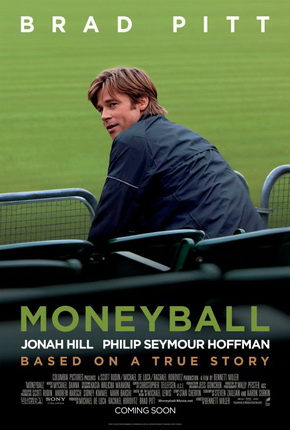
I've always been a big fan of baseball statistics. You know the old saying, "those who can do, those who can't obsessively memorize meaningless numbers." I don't know exactly what it is about baseball stats that has always enthralled me. Sure, there's the feeling of superiority you get when you have trivia answers carved into your mind, but it goes deeper than that. I've always liked looking at numbers because it helps me discover things that I might have never appreciated otherwise. For instance, did you know that former pitcher Bret Saberhagen once finished a season with more wins than walks allowed? That's ridiculous! It's amazing! It's unheard of...unless you do a Google search. Not surprisingly, I have been interested in sabermetrics for a while now and was eager to see Moneyball when I heard that the book was being made into a movie. As exciting as statistical analysis is to me, I recognize that the subject could very well make for a dreadfully dull movie experience for 99% of all people, alive or dead. And yet, Moneyball has been widely acclaimed. How the hell did they pull that off?
In short, the answer to that question is, "By making smart choices." By balancing the information that baseballs fans enjoy with a universally understandable dramatic story, the filmmakers made a surprisingly appealing sports movie that features surprisingly little focus on the games being played.
Let's look at the fan stuff first. When the Oakland Athletics ended their season in the 2001 playoffs, general manager Billy Beane (Brad Pitt) knew that his team, which had played so well that year, was going to be pretty terrible in 2002. The team's three best players were all free agents, and Oakland is a small market team, which meant that the team's best players were definitely going to sign lucrative deals with bigger market teams, like the Boston Red Sox and New York Yankees.
I think I see the cause of Oakland's woe: there's an attendance problem
Beane had three gaping holes to fill in his team, and he did not have the money to sign equally talented players, nor did he have up-and-coming youngsters ready to fill those spots. There was no way on Earth that Beane would be able to build a competitive team, at least not by using conventional baseball logic. Enter Peter Brand (Jonah Hill), a quiet number cruncher with an economics degree. Using sabermetrics, Brand saw potential in players that other teams undervalued. Brand believed that the Athletics could field a competitive team, but they would have to favor players that specialize in some of the less flashy aspects of the game.
Like telephone courtesy
Billy and Peter build a team that can theoretically win, despite loud and frequent criticism from the media, baseball scouts, and even Oakland's own manager, Art Howe (Philip Seymour Hoffman). By following sabermetrics, Billy and Peter were ignoring the way players had been valued for the last hundred years of baseball. If they failed, which pretty much everybody expected, Billy and Peter would be job-hunting before the end of August and the whole sabermetrics thing would be dismissed. However, if they managed to field a winning team made from under-appreciated scraps from around the league, they would change baseball forever. Of course, to do that, they actually have to win...
Pictured above: optimism
That's the somewhat-interesting-if-you're-a-baseball-fan plot. For casual fans or baseball ignoramuses, though, there is still a rich story. This isn't just another story of the unlikely team becoming impossibly successful --- this is the story of a man who has essentially bet his entire livelihood on an untried and ridiculed concept, and how that stress affects his life. This isn't about the 2002 Oakland Athletics. This is about Billy Beane's quest to show value in people thought to be disposable by everyone else and prove that the total can be greater than the perceived sum of its parts.
To pull off that sort of "man against the system" story, though, you need an effective lead actor, since the film will inevitably focus on him. Luckily, Brad Pitt continues his string of interesting roles (which essentially describes his post-Mr. and Mrs. Smith career) in Moneyball. This role could have been horribly overacted, because so much of it involves self-doubt and depression. Pitt conveys most of this through nonverbals --- he seems to favor staring --- which is nice, because he almost never raises his voice, which means there are no Pacino-esque moments. In many ways, Pitt does his best to channel Robert Redford at his smartest and most charming in this role, and he is largely successful. Pitt has better comic timing than Redford though, and a lot of Pitt's recurring mannerisms --- like incessantly eating on-screen --- shine through enough to make this more than simply an homage to Redford.
He can't close his mouth. It's filled with sunflower seeds.
I seriously loved Pitt's performance. It's underplayed, but extremely effective. I also genuinely enjoyed his interactions with Kerris Dorsey, who played his daughter. Speaking of Dorsey, I was surprised to find that I liked her. Most of the time, the child actors who play characters visiting their "weekend parent" tend to annoy me. Dorsey was pretty likable, despite some unfortunate bangs, and surprised with her musical talents, too.
A lot of attention was given to Jonah Hill's first dramatic role, and he's definitely solid in it. He's likable as a fish out of water, but I don't understand the degree of recognition he got for this role. Does he deserve credit for his work here? Absolutely, if only for the wheeling and dealing phone scene. I disagree with his Golden Globe and Oscar nominations, though; he was good, but there were better choices available. Philip Seymour Hoffman didn't add a whole lot to this movie; he certainly wasn't bad, but the role was a lot simpler than he typically plays. Robin Wright doesn't have much screen time, but she doesn't add much anyway, which is about par for the rest of the cast. This movie lives and dies on Brad Pitt's performance.
He pinkie swears it'll be good, though
Moneyball is only the second full-length feature film from Bennett Miller (the other is Capote, which might explain Hoffman's presence), but he has an excellent grasp of the drama in this tale. As I have already mentioned more than once, Moneyball could have --- maybe even should have --- been an awful viewing experience for most people. It takes the slowest American spectator sport and gets rid of the action, focusing on politics and number-crunching instead. And he managed (along with an Aaron Sorkin screenplay co-credit) to make this film feel like a personal journey of a man trying to prove his worth. I also loved how he used Pitt in this movie; he was unafraid of silence on the screen, and that made for some surprisingly touching moments.
The best thing about Moneyball is that the events portrayed here happened recently enough for many audience members to recall the ending. I knew how the A's season ended in 2002, and yet I never felt a sense of dramatic letdown. That's because the drama is in Beane, and not entirely based on the fate of his team. This is just a smartly-written, well-acted, and well-directed picture.
And if you were wondering what the song Billy Beane's daughter was singing was, here's the original version:
Vikings are awesome. Fact. If I had to pick between a viking, pirate or ninja, I would just wait five minutes, because the Viking would undoubtedly cut the other two in half with a battle axe and then fashion a helmet from their skulls. Like I said: awesome. And their religion is just as bad-ass, even from the bits and pieces historians have been able to assemble (Vikings didn't write...unless it was in the blood of their enemies). For instance, their head god, Odin, poked out his own eye to gain godly wisdom and hung himself from a tree for nine days with a spear in his side to learn magic. And then, on his day of rest, he created the ultimate viking, and the man that Biblical Adam is loosely based on, Chuck Norris. And then Odin punched Chuck Norris in the stomach so hard that his testicles popped out of their protective spot inside the pelvis; that is why all men now have their most delicate body part dangling, undefended, in the wind.
What does that have to do with How to Train Your Dragon? It has Vikings in it, duh.
How to Train Your Dragon is loosely based on a series of books on the life and times of a (probably fictional) Viking named Hiccup (voiced by Jay Baruchel). As his name implies, Hiccup is not much of a viking; while the others are brawny and mostly simple, Hiccup is skinny and cerebral. His village, Berk, is frequently attacked and raided for livestock by a variety of dragons. As such, the Vikings of Berk make a big deal about killing dragons. Desperate to prove himself to the town and Stoick (Gerard Butler), the village leader (and Hiccup's dad), Hiccup tries to invent tools that will help him kill a dragon. One night, Hiccup uses one of his inventions to knock down a member of the most feared dragon species of them all, the Night Fury. Nobody believes him, though, so Hiccup tracks the dragon down and finds it helpless, still caught in his net. Now, if Hiccup was a standard Viking, he would have cut out the dragon's heart to prove his victory to others, but Hiccup feels bad and instead releases the creature. Obviously, the dragon kills Hiccup because dragons are evil creatures and the rest of the movie is about Stoick seeking revenge for his lost song --- WHAAA?!? The dragon lets Hiccup live? That flies in the face of everything the Berkians know about dragons! I wonder if the brainy Hiccup will try to learn more about this dragon and somehow find a way to prove himself to his father and the village?
The voice acting is decent all-around, with Jay Baruchel doing double duty as both a character and the narrator. The rest of the cast played exactly who you would expect them to play in a movie. Christopher Mintz-Plasse plays a (Viking) nerd who spouts off Dungeons and Dragons (get it?) -style data (Attack +2, Armor +1, etc.) about every known dragon whenever he opens his mouth. America Ferrera plays the "girls kick ass" love interest and Jonah Hill plays an obnoxious kid that should shut up more often. Gerard Butler plays the rough-and-tumble Viking leader/father and Craig Ferguson voices the one-armed and one-legged dragon-killing instructor for the kids. That's right...the two adults are both Scottish, and none of the children are. Do these Vikings grow into their accents? Is a Scottish burr a reward for reaching manhood? Startlingly, these questions are never addressed in this film. Aside from the peculiarity of the accents, everybody does a decent job. Mintz-Plasse's recurring joke of a character was kind of funny, but the only real standout in the voice-acting department was Craig Ferguson, who was funny and surprised me with how well he handled the more dramatic moments.
This movie was directed and co-written by Chris Sanders and Dean DeBois, both former Disney people whose highest profile work was on Lilo and Stitch and its subsequent direct-to-DVD sequels. As far as the directing goes, they do a pretty good job, I think. There are no outstanding voice performances, but the animation looks great and the story is told well enough. I don't know why they opted to make Scottish Vikings with American children, but I doubt that bugs anyone but me. And anyone viewing the film in Nordic countries.
I liked the movie as entertainment for a child, but it wasn't great, certainly not to the tune of the $500+ million it made in theaters. Yes, it's a cute story and dragons are cool, but the story lacks an emotional punch. This is not too surprising, since Dreamworks Animation usually makes funny but vapid kids movies, but Dragon is a little different. There isn't nearly as much comedy as you might think in this movie, but it doesn't drag despite that lack. The film also deals with several potentially heavy topics; there is a fractured father-son relationship, the notion of being a social outcast, the importance of standing up for personal values, the power of group-think mentalities, the place of animals in our culture (friends vs. pets vs. prey), among other issues. Don't worry, though --- How to Train Your Dragon might bring up these issues, but it doesn't develop any of them. You would think that the emotional core of the film would center around Hiccup and his dragon, but it bounces around to his love interest and one scene with his father. Deep, this isn't. Still, dragons are cool and the movie is about seeing the dragons breathe fire and fly. I don't think this is a bad movie --- kids should certainly enjoy it --- and it is certainly watchable by adults, but it's a little simple for my tastes. And it loses some points for making Vikings with Scotsmerican accents.
There is also an animated short that goes along with the DVD, called The Legend of the Boneknapper Dragon. This follows Hiccup and his friends as they try to help their teacher (Craig Ferguson) find a legendary dragon that nobody but he believes in. The mini-film is mostly just Craig Ferguson telling stories to the kids, with traditional animation helping. I thought this short, while predictable and repetitive, was much more entertaining than the feature film and proves, once again, that Craig Ferguson is a funny guy when he is not reading monologue jokes.