Showing posts with label Helen Mirren. Show all posts

Monday, November 12, 2012

Legend of the Guardians: The Owls of Ga'Hoole

After an entire month of horror movie reviews, what better way to cleanse the palette than an animated feature for children?  I opted to go with a movie that I had always been curious about, but never went to see because...well...I don't have kids, so I can pick and choose my animated movie experiences.  Aside from the fact that the CG animation looks amazing in this trailer, this is also Zack Snyder's first effort at directing an animated movie (although I would argue that Watchmen and 300 come pretty darn close), and I've always liked his visual touch, so hopefully this is pretty awesome.


In a throwback to 80s "children" movies like The Dark Crystal, The Legend of the Guardians: The Owls of Ga'Hoole opens with a kidnapping.  After all, who says that children's movies shouldn't make your children cry?  Soren (voiced by Jim Sturgess) is an owl that was goofing off with his little brother, Kludd (Ryan Kwanten), when Kludd kicks Soren out of the nest, before he could fly.  And, because nature abhors terrible siblings, Kludd also lost his balance and fell to the base of their maghty home tree, with Soren.  Instead of getting eaten by Tasamanian Devils, which was apparently an option, the pair was rescued/kidnapped by a couple of dim-witted adult owls.  These scary-looking creatures take young Soren and Kludd to a distant land, where they are presented with an interesting choice.  They can either follow the racist/speciesist teachings of Nyra (Helen Mirren), queen of the Pure Ones, or they can become mindless slaves.
Alternate title: White (Owl) Power
Kludd opts to follow the obvious villain, while Soren rebels and tries to escape.  The strange thing about the Pure Ones is that they're supposed to be the stuff of legend; Soren and Kludd grew up to takes of them being the villains in a long battle against the heroic Guardians.  If the Pure Ones are real, I wonder if the Guardians could be real, too?
Above: an owl realizing that someone wrote sixteen books about owl racism

Legend of the Guardians: The Owls of Ga'Hoole could not be a modern animated movie without a ridiculously famous cast of voice actors.  The most effective in their roles were probably Helen Mirren and Geoffrey Rush; both have wonderfully emotive voices and did a fine job as important, but ultimately peripheral, characters.  Rush plays a great grouch, so it was nice to see that talent being utilized.  Hugo Weaving had a double role, although his voice talents are not exactly what I would call "audibly versatile."  He fine fine in both parts, but anyone who knows his voice can instantly recognize him in both roles.  Joel Edgerton was pretty good as the head bad guy, but it seems odd in retrospect that he was the cast member chosen for the villain role, and not Weaving or Rush.
Maybe he got the role thanks to his physical presence
Sam Neill was well-cast in a bit part, where his lovely voice was meant to be a contrast to his character's actions, and that was nicely done.  But those are just the most notable supporting voice actors.  Jim Sturgess played the main character, a young and idealistic owl who sometimes gets the benefits of super-slow motion shots.
ACTING!
Sturgess was fine, but this is a pretty generic character and he didn't really add anything special to the part.  An odd thing about this cast (that I just noticed) is that it is predominantly Australian, with a few Brits  sprinkled here and there.  I didn't realize that owls needed to speak the Queen's English.  Ryan Kwanten, Anthony LaPaglia, Richard Roxburgh, Leigh Whannell, David Wenham, Essie Davis, Abbie Cornish, and Angus Sampson, Aussies one and all, had roles of varying importance.  Most of their voices were recognizable, but I guess that's point when you fill your voice cast with actual actors.  None of them were bad, but none were too impressive.  As for the non-Australian supporting cast, I thought Miriam Margolyes was suitably cartoonish as a snake nanny and Emily Barclay was suitably bland as the romantic interest for Jim Sturgess.
Romantic owl eyes are slightly unsettling

What about Zack Snyder's direction?  It's no secret that Snyder likes to aim for "epic" as a director, and he did a solid job framing Legend of the Guardians: The Owls of Ga'Hoole in an epic fashion.  It is interesting watching Snyder's direction in a film where he can get exactly the visuals he wants.  It's not too different from his normal style.  The visuals are stunning.  The slow-motion is prominent and occasionally questionable.
Or, as Snyder likes to call it, "The speed at which all things should happen"
There are large-scale battles, where a small cast of heroes faces down a large number of interchangeable villains.
They're like Storm Troopers that cough up pellets
Snyder tells the story ably enough, but he doesn't get great performances out of his most important characters.  The ideas of love and betrayal have never been prominent in any of Snyder's other films, so seeing him ignore them in a children's story might not be as surprising as it should be.  Legend of the Guardians: The Owls of Ga'Hoole has all the basic elements of an entertaining animated film, but there's no emotional core to it. Part of the problem is with the writing, which spends little time on characterization, but the director should notice a little thing like entirely two-dimensional characters and have it changed.
I'm guessing he focused more on eye reflections than the script

My other problem with Legend of the Guardians is that it feels very, very familiar.  If you're familiar with Star Wars or the Chronicles of Narnia, or just about any other epic tale with children as an intended audience, then you've seen this plot before.  A lot of kid's movies are like that, but this feels like a Frankenstein of epic childhood fiction, with the only new addition being the owls.
This scene actually dubs in dialogue from Attack of the Clones
I take that back.  Making some of the child characters into mindless slaves is somewhat unique, especially in a movie aimed at children.

The moment that crystallized my feelings toward Legend of the Guardians came toward the end.  After growing up with tales of the Guardians of Ga'Hoole, Soren is happy to tell his father that the Guardians are not just legend, but are real.  His father's response was, "You made them real."  At first glance, it looks like the meaningless "kids rawk" fluff that often pops up in animated movies.  But this was so blatantly wrong that my wife got seriously irritated.  She actually raised her voice to ask, "HOW?  They already exist!"  My wife doesn't like every movie, but she doesn't loudly question movies very often.  To put that in perspective, the last time she watched an animated feature and wasn't happy with it was G-Force.  Congrats, Legend of the Guardians, you are in elite company.  Apparently, there was not enough cute to counteract the dull and stupid here.
Sorry kid, not cute enough

Let's be honest, though.  This is a movie for kids, and the standards of entertainment for children are comically low.  Sadly, Legend of the Guardians doesn't quite meet those unimpressive standards.  There are a few moments that truly "wow" the viewer --- yes, they are in slow motion --- but they are not the most important or memorable parts of the plot.
This scene > rain flying
However, thanks to the dull story, these inconsequential scenes are what I remember most about this film.  The story is too dark to be cutesy, but there are characters clearly designed to just be cute.  And yet, the story is not dark enough to be frightening or to make the story less predictable.  Even the primary staple of animated movies, the goofy supporting character, is absent for most of this movie.  Yes, Legend of the Guardians: The Owls of Ga'Hoole looks nice, but it is genuinely uninteresting and charmless.

Friday, January 6, 2012

Gosford Park

Watching The Mirror Crack'd last month reminded me just how much I used to enjoy Agatha Christie novels.  Sure, they're a bit dated, but there is something I find appealing in a whodunnit with a limited number of suspects.  Luckily, there are very few whodunnits made into motion pictures, which means that it is relatively easy to find the most popular and critically-acclaimed entries in the genre.  According to a two-minute long internet search I conducted, the only famous whodunnits of this century are Gosford Park and Identity; I sure as hell wasn't going to subject myself to Identity again (John Cusack, please make better movies!), so I opted to watch Gosford Park.

The premise for Gosford Park is pretty straightforward, although the relationships between the characters are anything but.  Sir William McCordle (Michael Gambon) and Lady Sylvia McCordle (Kristin Scott Thomas) are entertaining for the weekend.  Their extended family and their servants all descend on Gosford Park for a few days of prim-and-proper 1930s British etiquette and dinners.  The servants defer to the needs of their masters, and the masters defer to Sir William, who has more than a few family members dependent on his generosity for their income.  Sir William, though, has had enough with generosity and plans to cut off a few needy family members.  The lives of the wealthy are not just their own, though; many among the help have intimate (read: sexy) knowledge of the masters.  With all the secret sexiness and financial desperation in the air, it is not a huge surprise that Sir William is found stabbed at his desk, at a time when almost anyone could have slipped away and done the deed.  It is a surprise when it is revealed that the stab was not the cause of death; someone else had killed Sir William, before he could be murdered by someone else.
Lower left: the look of a man who finds out there is a line to murder him

The cast of Gosford Park is large and ridiculously noteworthy; the ensemble is so large, in fact, that it is difficult to gauge the acting quality for most of the cast.
It is, almost but not at all literally, a cast of thousands
For the upper class characters, Michael Gambon stands out as the patriarch/victim; I became familiar with Gambon through Harry Potter, so I enjoy it when he plays characters with a bastard streak in them.  Kristin Scott Thomas was solid as your typical woman-married-to-a-wealthy-man-much-older-than-her, although I thought she was at her best when she was dealing with Ryan Phillipe.  Maggie Smith was fun as a crotchety old witch.  Camila Rutherford got to look dazed and confused.  I don't think I've ever seen Geraldine Somerville in a role outside of Harry Potter's mother, so that was mildly interesting.  Charles Dance didn't make much of an impression on me.  Tom Hollander was kind of wimpy in his role, but it was better than the pompous one he played in Pirates of the CaribbeanJeremy Northam, who is rarely in anything I want to watch, was surprisingly likable and actually sang quite well in this movie.  Bob Balaban (along with Maggie Smith) quietly delivered most of the film's humor.
Hilarity!
While not quite upper class, comedian Stephen Fry makes a short appearance as a humorously inept (but surprisingly plausible) police inspector.  The help were, surprisingly, given (by my estimates, anyway) a little more time to shine.  Helen Mirren had the meatiest role and was predictably excellent.  Emily Watson was also very good as the character that shows the point-of-view character, meekly played by Kelly Macdonald, how things work at formal functions.  This was a good film for long-established Brits; I thought Derek Jacobi had one of the better sub-sub-plots, and Alan Bates was solid as the head butler.  Richard E. Grant provided some very low-key humor, which suited his snooty character just fine.  Ryan Phillipe got to play a character with a twist, which he managed to not completely screw up.  Clive Owen rounded out the underlings by being rude and mysterious whenever he wasn't undressing me with his eyes.

There is just a crap ton of actors in this movie, and a surprising few made a lasting impression on me.  I haven't seen many of Robert Altman's films (please don't recommend The Player to me, it makes my eyes roll more than a teenage girl talking to her mother), but I know he likes to play with large, well-known casts.  I thought that worked in his favor in Gosford Park.  Really, the biggest problem with movie mysteries is that the audience knows that certain actors are destined to have important roles because they are well-known.  Having such a big cast, filled with recognizable actors makes both the victim and killer a lot more surprising.  As far as the standard pillars I judge directors by (cinematography, editing, cohesive storytelling, and actor-handling), Altman is fine, although nothing fantastic.  Instead, he focused on adding layers of nuance to this film.  Yes, it's a murder mystery, but it is also as much about the British class system as my favorite Pulp album.  And that class commentary invites a lot of moments for subtle humor, although I wouldn't qualify this as a comedy.  Still, Altman takes a pretty simple idea and makes it enjoyably complex.
But not enjoyable for everyone

For such a clever work of direction, I was not terribly impressed with the story.  Altman and Balaban come up with the general story, but I found it surprisingly predictable.  Normally, I would be disappointed by that --- I immediately called Ryan Phillipe's secret and figured out Clive Owen's rather quickly --- but there was thankfully an extra twist to keep things interesting.  Still, I was hoping for this movie to take the mystery part a little more seriously.  If it feels like Altman is just using the mystery plot as an excuse to delve into the cultural politics of the British class system pre-World War II, that's because he is.  I really don't mind the subterfuge, but I wish I had gone in knowing that, because I was looking forward to the whodunnit.

I think I appreciate Gosford Park for what it is, but it didn't blow me away.  I didn't see any stellar performances or find myself shocked or appalled by any of the characters.  The plot was decent, but not great.  The commentary, while occasionally funny, was not as sharp as I would have expected, especially given current views on servitude, homosexuality, empowerment, and romance.
1930s view: Scandalous!  2012 view: Where'd his fist go?
What Gosford Park provides is a solid mystery with a good cast, some good performances, and enough light humor to keep for being too depressing.  Given the number of Oscars it got nominated for (it won for its screenplay, which I didn't love!), I was hoping for more.  Maybe this is one of those movies you enjoy more after the initial viewing; having the suspense of the plot out of the way could conceivably make some of the especially subtle humor stand out more, I suppose.  If you have some thoughts on the matter, please leave a comment.  As a first-time viewer, I thought this was pretty good, but not great.

And here's my favorite song about class warfare, from Pulp's Different Class:

Wednesday, September 21, 2011

The Cook, the Thief, His Wife & Her Lover

I've never been a big fan of Roger Ebert, but I do "Like" him on Facebook; while I frequently disagree with his opinions, he posts a lot of interesting links to essays and other cool websites.  Another thing Ebert likes to do is call out some of an actor's best work on their birthday; for Helen Mirren, Ebert suggested The Cook, The Thief, His Wife & Her Lover.  I had never heard of the film, but the more movies I see Helen Mirren in, the more I like her, so I gave it a shot.  I'm the sort of person who likes to be surprised by movies, so I usually don't research them before I see them; in the case of The Cook, The Thief, His Wife & Her Lover, I probably would have liked a heads up.  This movie is a little artsy-weird.
How can I say such a thing?

Albert Spica (Michael Gambon) is a British mobster (or a thug with underlings, if you don't like that term) with some unique passions.  He loves money, he loves food, and he loves...well, the third one is better left unsaid for now.  He has plenty of money, so he indulges his second passion by owning a fancy French restaurant, even though he doesn't appear to truly like much French food.  Unlike most fans of fine dining, though, Albert likes to force his opinions and tastes upon everyone else.  The film opens with his head chef, Richard (Richard Bohringer), being publicly humiliated --- stripped naked, beaten, peed on, with excrement smeared on his body and shoved in his mouth --- for contradicting Albert.  Everything that Albert does to "improve" the restaurant is gaudy and classless, and he only appears sophisticated next to his boorish underlings. 
His actions even make that claim questionable at times.  Albert and his posse impose themselves upon the restaurant every night, making it a terrible place to work and/or eat.  Accompanying Albert is his wife, Georgina (Helen Mirren), who is sophisticated and does appreciate French cuisine.  Why is she with such a brute?  Well, it appears that she has given up escaping or changing Albert, and has resigned herself to ignoring her surroundings as much as possible.  One night, though, Georgina makes eye contact with another restaurant patron, Michael (Alan Howard), and something changes.  No words are exchanged at first, but they begin a passionate affair, right there in the restaurant, under Albert's nose.
Passionate affairs apparently aren't always fun or glamorous

The Cook, The Thief, His Wife & Her Lover is a film steeped in directorial intent.  I haven't researched it, so I'm not exactly sure what director Peter Greenaway is commenting on with this movie, but I'll hazard a guess that it has symbolic meanings (and, given the time period and country of origin, probably has something to do with Thatcher).  That's fine and all, but I'm going to concern myself with the film out of the context of the times.  The first thing that struck me about this film is how strange it looks.  The visuals are simply striking.  There are only a few sets in the movie, but they all have their own color scheme and lighting; the restaurant is red, the bathrooms are a spotless white, and the kitchen has kind of a greenish hue.  The sets are enormous; the kitchen looks like a warehouse and the bathrooms are large enough to play soccer in. 
GOOOOOAAAAAAAL!!!
The costumes change as they leave one set for another, too --- and when they don't change, it is supposed to evoke a subtle reaction from the audience.  The film is ripe with symbolism, but of what?  Gluttony?  Passion?  Disgust?  Complete bullshit?  You can make a solid argument for any of these.

I think it is indisputable, though, that Greenaway worked well with his cast.  Michael Gambon --- a classically trained actor, with many Shakespearean credits to his name, along with some Harry Potters --- is thoroughly reprehensible as the boorish Thief of the title.  He's so rude and gross and vulgar that it is easy to forget what a dignified actor he typically is; that's some damn fine acting, right there. 
Bibs: not classy
Helen Mirren was also excellent in a very brave performance; not just any actress would be willing to spend so much time on screen completely nude, especially one that was in her mid-forties at the time.  Her work as the Wife justifies that excess, though.  Her moments on screen with Gambon are filled with self-loathing, but she transforms that into passionate desperation with Alan Howard; she is so convincing in these scenes that her turn toward the end of the film seemed absolutely effortless.  I also liked the vocal style of her shameful monologue to Howard --- it is so hard to speak half-phrases on film naturally, but hers were very believable.  Alan Howard was pretty good as the Lover, providing substance to a role with little dialogue, but I wasn't as impressed with him as I was with Gambon and Mirren. 
***no dialogue***
I was indifferent to Richard Bohringer's Cook.  I'm not quite sure why his character was important enough to be mentioned in the title, but I might have missed something.  Tim Roth is fine as Gambon's most noteworthy henchman, but the character is pretty dumb, so Roth's performance just seemed adequate.  Ciaran Hinds played a supporting character that actually had a bit of a dramatic arc, but he was so far removed from the main plot that it had little impact on the overall story.  There are a few other recognizable faces in the crowd (punk rocker Ian Dury and Harry Potter alum Roger Lloyd-Pack), but they were just role players.

There was a bit of controversy when The Cook, The Thief, His Wife & Her Lover was first released --- the MPAA was going to rate it X, so the filmmakers decided to release it unrated (the modern equivalent would be NC-17), which meant that only adults could see it.  With such an edgy rating, you would think that this film reeked of sexual and violent excess.  It really doesn't.  Yes, there is a decent amount of nudity; Mirren, Howard, and Bohringer all have full-frontal scenes.  These scenes are not meant to be erotic (most of the time), but sad and desperate.  There is violence in the movie, but nothing too gory.
Evil Dead 2 did it so much better
The Cook, The Thief, His Wife & Her Lover received its rating because the sex and the violence had very disturbing, emotional, and frightening undertones.  Oh, and there's some gross fecal content, too.  This is definitely an adult film, but don't mistake that for an exploitative one.

There is a lot of artistic merit in this film, but the big question remains: is it good?  I acknowledge that this film has many technical achievements in film style.  I compliment the main two actors on their excellent performances.  Heck, I even like the surreal settings and soundtrack.  But did I like it?  Not a whole lot, but I think I appreciate it.  The Cook, The Thief, His Wife & Her Lover is a hard film to sit through because it is uncomfortable to watch; if you have a different viewing experience, then I would probably not feel comfortable around you in social situations.  And that's fine (the film being uncomfortable, that is), since that was clearly the filmmaker's intent.  Thankfully, that intent stops before the film becomes unwatchable and/or too pretentious for words.  Still, it's a pretty strange trip, and not a very fun one at that.  I think I would have enjoyed the film more if the bizarrely theatrical sets were less obvious; every time I looked at the classical painting in the restaurant, or the enormous size of the bathrooms, or the hobo town appearance of the kitchen, I found myself distanced from the story, and that's a problem for me.  In strictly technical terms, TCTTHW&HL is an impressive piece of work, but it's a piece of craftsmanship that that won't appeal to many.

Friday, April 22, 2011

The Long Good Friday

I do a lot of reading of lists and things like that to find interesting movies to watch.  I'm not always in the mood for a great movie (or even a good one), but it's nice to have a little insight into titles that I might otherwise ignore.  That's what brought me to the British Film Institute's 100 "Favourite" Brit flicks of the 20th century.  Many of the films I was familiar with, but The Long Good Friday was the first title (coming in at an impressive #21) that I had never even heard of.  So, with Easter right around the corner, I thought this an appropriate time for a viewing.

Harold Shand (Bob Hoskins) is that oh-so-dangerous kind of gangster --- the type that is trying to finally go legit, and therefore has the most to lose.  He has an iron fist on London's organized crime and he has a finger in every dirty little pie (except drugs) in England's greatest city.  Harold has managed to keep the peace between the various criminal groups that he oversees for over a decade, and now (which is in 1979) he is on the cusp of two truly important moves.  He has visiting New York mobsters coming in to possibly give him financing that will allow him to buy up enough (decrepit) London dockyard land and influence enough votes to have London host the 1988 Olympics and build their Olympic town on his land.  The American mobsters get their dirty cash laundered, Harold has a legitimate source of income from the land deals, the city gets a boost of revenue, and all sorts of politicians and policemen get their palms greased.  Best of all, nobody gets killed because it's all mostly legal.  That's better than win-win, it's win-win-win-win-win.  There's just one problem.  On the Good Friday that the American mobsters come to visit, Harold's men start to die in spectacular ways.  His mother's driver is killed by a car bomb, his casino has a bomb in it, two of his best men are found dead; as the day goes on, the bodies and explosions keep piling up.  Who would dare, after a decade of peace, take on the proverbial King Kong of London's criminal underground?  Who could even think of it?  Harold has long since killed his rivals.  Whoever it is, Harold has no problem going to his most savage lengths to find the guilty party.  But what does he do when it is clear that savagery isn't enough?
It's hard to act like a tough thug when you're hanging by a meat hook.

While you might not know the names of the actors in this film, they are all pretty recognizable British actors.  Paul Freeman (Belloq from Raiders of the Lost Ark) has a small, but pivotal, role in the beginning of the movie.  P.H. Moriarty and Alan Ford (the villains from Lock, Stock and Two Smoking Barrels and Snatch, respectively) play some of Harold's thugs; Moriarty was pretty impressive as the knife-loving Razors.  Dexter Fletcher (another Lock, Stock alum) makes an early appearance as an ugly child.  Paul Barber (The Full Monty) gets his hands nailed to a floor to make him tell the truth.  Kevin McNally (Johnny's Depp's drunken buddy in all the Pirates movies) has a bit scene in a bar.  Most of these actors had pretty small roles in the film, but most of them have at least one memorable scene.  Heck, Pierce Brosnan, in his first film role, had a major supporting role as a very hairy-chested assassin. 
James Bond: the bathhouse years.

The film belongs to the lead actors, though.  Bob Hoskins is terrific as the street-level thug trying to be a gentleman, especially as that gentlemanly facade is slowly stripped away and we get to see just how brutal he is.  You don't see a whole lot of physically evocative performances from British films in general, but it was all but unheard of in the late-70s/early-80s; the best British films of the time tended to be epic and theatrically acted.  Seeing Hoskins gnashing his teeth together and seething with violence while wearing a fancy suit was a treat.  This is a performance that pre-dates --- and, in some ways, overshadows --- James Gandolfini's Sopranos role by over two decades.  But what sets this movie apart from other gangster movies, at least in the character department, comes from Helen Mirren's portrayal of Harold's girlfriend.  She could have played the typical gangster moll, but (at her insistence, I've heard) her character is smart, sophisticated, and is definitely the brains behind Harold's brawn.  Can you tell me the last time you saw a gangster movie where the lead female role was equal in power to the male lead?  I can't think of any, but you're welcome to try.  This is the youngest I've ever seen Mirren (she was in her mid-thirties at the time), so I was a little surprised to see her as, well...young and pretty.  While her part was definitely a supporting role, I thought her calm and collected smarts stole the scenes she was in.

I'm not too familiar with John Mackenzie's body of work as a director, but he obviously did a pretty good job with the actors here.  I love that the beginning of the film lays out some problems, but doesn't explain them until much later; this might be confusing at first, but I thought that showing what happened, but not hearing the dialogue in most of the scenes or knowing the context of the actions was an interesting (and ultimately rewarding) choice.  I wish I could say the same for some of Mackenzie's other choices.  Many scenes go on too long, adding little or nothing to the overall story and the score, while modern at the time, sounds positively archaic now.  I liked how he handled the actors and assembled the story, but I have to admit that the movie drags at times.

What sets this movie apart from your typical gangster movie is the problem it poses.  The police aren't getting in Harold's way, because he pays them not to.  Politicians aren't making a stink about it, because Harold pays them not to.  Harold's enemies aren't causing all these problems, because they're all dead.  As the enemy is slowly revealed, things start to make sense, especially once the motives for the attacks become apparent.  What I really liked about this movie was how it found an enemy that could take on mobsters and plausibly win.  The script was handled intelligently and it definitely spoke to some of the reality of 1970s Britain.
I will probably watch this again, and I might appreciate it a little more the next time around.  Even if I don't it's still pretty darn good.

Monday, January 31, 2011

Red (2010)

Apparently, America, we are having trouble saying goodbye to our aging action stars.  If you truly doubt that, please explain the appeal of Rambo or The Expendables.  Don't get me wrong, I miss the days when a hero could stand in one spot and shoot down fifteen thousand ninja-Communist-Nazis, without getting even a flesh wound, and I've enjoyed Stallone's increasingly idiotic movies.  Still, it's kind of strange that we haven't seen anybody (except maybe Jason Statham) truly embrace the stupid action hero role, given how important dumb action movies were in the 80s and 90s.  When you think about it, the success of The Expendables is an amusing insight into just how badly we want these actors to keep killing bad guys.  I don't know how intentional this was, but Red seems to be in on that joke, too.

It's kind of like the song from White Christmas...what do you do with a former CIA black-ops agent when he stops being a CIA black-ops agent?  Well, if you are Frank Moses (Bruce Willis), and you are living an inoffensive existence as a lonely retiree whose only friend is a customer service representative at a bank several states away, the answer is simple: kill him.  For reasons unknown to him, Frank discovers that his status in the intelligence community has been changed from "retired" to RED ("retired, extremely dangerous").  Being RED means that assassination squads infiltrate your home in the middle of the night, looking to terminate with extreme prejudice.  However, the "extremely dangerous" bit is an understatement; Frank quickly kills his attackers and begins a quest to find out who wants to kill him and why.

Along the way, Frank has to pick up that bank representative, Sarah (Mary-Louise Parker).  He realizes that his phone must have been tapped prior to the assassination attempt and that the next logical step for the bad guys would be to kidnap Sarah and use her as leverage against him.  She's not very willing at first, but as more people keep showing up to kill her, Sarah quickly gets on the Frank Moses bandwagon.  Frank can't unravel the plot against him all by his lonesome, though, which means he needs to find help.  Since he's retired, it turns out that his help is also a little past their prime.  Joe (Morgan Freeman), Frank's mentor, is now living in a retirement home and passes the time by ogling his nurse's ass.  Marvin (John Malkovich) is a well-armed conspiracy theorist that is paranoid to the extent of having a decoy house.  Victoria (Helen Mirren) is a prim and proper housewife, formerly the best wetworks specialist in the business.  With a little help from Ivan (Brian Cox), a Russian spy and former adversary, the group sets out to learn the truth.
I so so so wish he yelled "Flava Flaaaaav!" here.

 I was excited to see this movie after seeing the trailers for it.  It didn't look like a great action movie --- it has Morgan Freeman and Helen Mirren, remember? --- but I thought it looked funny.  I was wrong.  It is funny and a good action movie.  This is one of Willis' more wooden roles, but I don't know if I would have bought a black-ops specialist with a talent for wisecracks.  His stoicism was probably for the best.  Morgan Freeman and Helen Mirren clearly had a lot of fun in their roles, with Mirren taking particular relish in being the gun expert.  I go back and forth with my appreciation for John Malkovich, but he plays a pretty amusing paranoid here.  Malkovich was probably my favorite character in the film, but I also really enjoyed Brian Cox.  I think I just like the idea of former arch-enemies getting together and reminiscing about "the good old days," when they used to try to kill each other.  Cox doesn't get nearly enough comic work, in my opinion.  Mary-Louise Parker was also good as the relative newbie to all the danger.  Is it just me, or was Parker neither attractive or talented until she turned 40?  Weird.  I liked seeing Ernest Borgnine again, even if he wasn't threatening to shoot anyone in the face.  The rest of the cast was kind of meh.  James Remar was in the movie for all of two seconds.  Rebecca "Mrs. David Mamet" Pidgeon and her ugly jaw was as awful as she usually is, as was Richard Dreyfuss in his small-but-overacted role.  I'm not exactly sure why Julian McMahon took his small part in the film, but he was definitely many years too young for the character he played.  The bulk of the meh comes from Karl Urban, though.  While I appreciate his dedication to the action movie genre, Urban is best when he speaks little and doesn't develop as a character.  Here, he tries to actually act, with little to show for it.
Though this isn't from Red, Ernest Borgnine is still awesome.

This movie shouldn't be as good as it is.  The screenwriters that adapted this story from the comic book series are the same people who wrote the dreadful Whiteout.  The director, Robert Schwentke, has never shown a talent for either action or comedy, with his only other English films being The Time Traveler's Wife and Flightplan.  Somehow, those films managed to collectively gross over $300 million and still have absolutely zero appeal to me.  Regardless, the script was smart, the actors were directed well, and the action was pretty cool.  I don't think I've ever seen so many bullets fired into one suburban home before, but I liked it.

Probably the thing I appreciated most about this movie was that it didn't keep calling attention to the age of its characters.  Aside from an assassin calling Malkovich "old man," and maybe a similar remark made during a Willis-Urban fight, age was not a joke in this movie.  Thank you, screenwriters.  Instead, the humor was largely contextual and delivery-based.  The main actors were all very good, and only the bad guys weren't funny.  The pace is quick, the action is good, and many things go boom.  This is exactly what From Paris With Love should have been, but was not.  I will go so far as to say that Red is one of the most enjoyable action movies of 2010, and the perfect antidote for anyone who cannot fathom the success of The Expendables.

Monday, August 2, 2010

The Last Station

Biopics can be tough.  Casting an actor to play a real person is always difficult (except for Morgan Freeman playing Nelson Mandela --- that was a no-brainer), but that is rarely the toughest part.  The real crux of a biopic is the story arc.  Just telling the life of a person usually mutes the inherent drama in that life (Public Enemies, anyone?).  In my opinion, the best way to go with these movies is to take a slice from the subject's life and follow one of the many story lines from it.  This notion leads us to The Last Station, which tells the tale of the famous Russian author/philosopher/Count Leo Tolstoy in the last year of his life. 

I entered this picture with only some general knowledge of Tolstoy's work (War and Peace, Anna Karenina, and I knew that he was influential on Ghandi), but even that knowledge was unnecessary.  This movie proved to be very "stupid American" friendly, explaining Tolstoy's life and philosophy simply and effectively.  That might sound like a pretty dry movie, but I found it to be enjoyable, containing a surprising amount of humor.

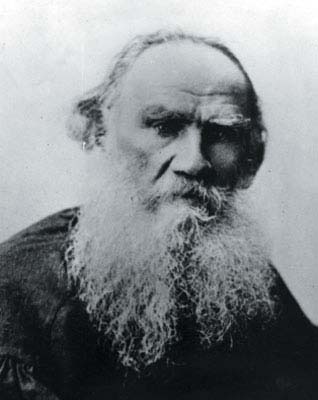
Leo Tolstoy (Christopher Plummer) is an old man with a big beard nearing the end of his life.  In his homeland of Russia, the opening credits tell us that many consider Tolstoy to be nearly a saint, and his religious/philosophical followers have established communes devoted to his principles of chastity, equality, and nonviolence.  The movie follows a young Tolstoian, Valentin (James McAvoy), as he is recruited by the head Tolstoian, Chertkov (Paul Giamatti), to be Tolstoy's new secretary.  Valentin is not just supposed to write about Tolstoy, though.  Chertkov needs Valentin to act as a Tolstoian spy in the Tolstoy home so Chertkov can manipulate Tolstoy against his wife.  Why would someone want to do that?  Well, Chertkov believes in Tolstoy the philosopher less than Tolstoy the man; if Chertkov can convince Tolstoy to actually follow through on some of Tolstoy's philosophical musings, like renouncing his private property, then the Tolstoian movement will have a founder that lived the movement's ideals.  Of course, that means that Tolstoy's wife, the Countess Sofya Tolstoy (Helen Mirren), would get pushed to the side with her more traditional views on family and religion.  Young Valentin is thrust in the middle of this barely civil conflict as the Tolstoians attempt to get Tolstoy to sign a new will that will essentially give away the copyrights to his writings, making them public domain.  Giving away a famous author's copyrights obviously will limit the inheritance of his children, so Sofya is violently opposed.  At times, Tolstoy seems determined to live his last days according to his writings.  At other times, though, he shares his lust for life with Sofya between their shouting matches.

As the main male character, Valentin gets his own plot thread that runs parallel to this conflict.  Valentin is a "good Tolstoian," which means that he adheres to Tolstoy's writings and has remained a virgin.  His beliefs come into question after some time with Tolstoy, who clearly has not been much of a Tolstoian at all; he is a wealthy Count that had several torrid love affairs in his youth, which he remembers fondly.  While staying at the local Tolstoian commune, Valentin meets a young woman, Masha (Kerry Condon), with whom he begins a relationship with.  Eventually, though, he is faced with the decision on whether he should follow Tolstoy or his heart.

One of the more surprising aspects to this movie is the complete lack of Russian accents.  It's not a bad thing, mind you, since bad accents can really hurt a movie (I'm looking at you, K-19: The Widowmaker), but it is kind of strange when the movie is about someone that is so very Russian as Leo Tolstoy.

The biggest surprise for me was the endearing relationship shown between Leo and Sofya Tolstoy in this movie.  I cannot think of another movie that portrays the affection between an old married couple better than this film.  You know those old, bickering couples that argue all the time, but clearly love each other and can't imagine life without the other?  That's what you get here.  The fights are loud and intentionally hurtful.  The love is childlike, and yet knowing.  They share a bedroom scene --- which is not gross, I promise! --- that is absolutely adorable.  Both Helen Mirren and Christopher Plummer received Academy Award nominations for their work, and they were both well deserved.  Mirren, in particular, did a fantastic job.  Plummer's acting was also impressive, but it would be remiss of me not to acknowledge his lovely Tolstoy beard, which made his casting seem perfect.

The rest of the performances are pretty solid.  McAvoy once again plays a nervous young man and that shtick hasn't gotten old yet.  McAvoy's real-life wife, Anne-Marie Duff, turns in a less impressive performance as one of Tolstoy's daughters, but she doesn't do a bad job, per say.  The same can be said for Paul Giamatti and Kerry Condon.  They're not bad, but their roles just aren't very good.  I actually like Giamatti best when he plays finks like this, but there wasn't enough complexity to his character to really satisfy me.  Condon did a fine job with her role, but it was written in a way that made some of her character's choices seem rather abrupt and arbitrary.

The same can be said for the film's focus.  While the relationship between Leo and Sofya was fantastic, the rest of the film was a little limp.  I understand the need for a point-of-view character (in this case, Valentin), and I understand the urge to give him more depth by giving him a sub-plot.  Ultimately, though, that sub-plot needs to be relatively short or serve as an extended parallel to the Tolstoy marriage to truly work.  Here, the Valentin's love story is too long to simply be an aside, but not involved enough to do much for the plot as a whole.  In the end, Valentin professes his love for Masha, but it doesn't feel like the same sort of love we witness between the Tolstoys.  Oddly enough, the praise for the good performances and the criticism for the poor plotting can both be aimed at Michael Hoffman, who directed the film and wrote the screenplay from Jay Parini's novel. 

Overall, this is a surprisingly enjoyable movie with humor sprinkled throughout, but it is carried by the performances of Christopher Plummer and especially Helen Mirren.  The movie itself may not be anything special, but their performances help romanticize the notion of growing old with your special someone, even if they drive you nuts.

Sunday, May 2, 2010

The Hitchhiker's Guide to the Galaxy

I've done a little research and have concluded that there are four types of reactions for those that have seen The Hitchhiker's Guide to the Galaxy:
  • - those that have read author Douglas Adams' work and are relieved by this adaptation of it
  • - those that have read Adams' work and hate what happened between the page and the screen
  • - those that have not read the books and end up being charmed by the whimsical nature of the storytelling
  • - those that have not read the books and see this a a hit-or-miss movie with no story and little character development.
All of these reactions are justified, but they all miss the point.  Like the book that it is based on, this movie is less about plot and more about how the story is told.  The whos, wheres, and whys are largely inconsequential; the emphasis is on the delivery.  And that delivery is excellent.

This is a story about how the world ends.  I'll save you the suspense; aliens blow it up within the first ten minutes of the film to make room for an intergalactic highway.  From there, our everyman point-of-view character, Arthur Dent (Martin Freeman), is taken on a pan-galactic adventure with his best friend, Ford Prefect (Mos Def).  Ford was an undercover alien on Earth, doing research on the planet for his employer, the constantly updated and best-selling book in the universe (literally), The Hitchhiker's Guide to the Galaxy.  Ford uses his hitchhiking skills to save Arthur and himself, and there their adventure begins.  Before the movie ends, we find out the answer to "life, the universe and everything," what the smartest creatures on Earth are, and what it feels like to be a woman.  For those of us that might be curious.  On this adventure, they gain some new companions, including the last human female in the cosmos, Trillian (Zooey Deschanel), a chronically depressed robot (with Alan Rickman providing the voice while Warwick Davis manned the costume), and the President of the Galaxy (Sam Rockwell).

If that all sounds fairly random...well, it is.  The primary plot device for this film is a spaceship that has an "Infinite Improbability Drive," which allows just about anything to happen in this movie.  Randomness might not be great for a coherent plot, but it does help with some fantastic visuals.  This movie doesn't do much with CGI special effects, instead opting for men in rubber suits, and it's a great choice.  All the aliens in this movie look amazing, from the bovine Vogon race to Humma Kavula's (John Malkovich's) spindly lower body.  These special effects choices were made, I think, not to impress you with the action sequences, but to be as funny and weird as the source material demanded.  Could this movie have been made with an animated depressed robot, voiced by Alan Rickman?  Of course.  They could have gone the Scooby Doo route, but it's much funnier to see an actual person wobble around with such a top-heavy costume.  Director Garth Jennings' only previous film work was on music videos, and it shows here.  His concern is clearly on the visuals and the timing of little moments, not on the film as a cohesive whole.  And he does an excellent job with that.  This is one of the most visually exciting movies of the past decade; Hitchhiker's has it all, from aliens and robots, to an entire scene where the characters and setting have been turned into yarn.

The visuals would not hold up nearly as well without impeccable casting.  Choosing Martin Freeman as the everyman character was a good move and Zooey Deschanel does a good job as a woman looking for the extraordinary.  Mos Def does a fantastic job as Ford Prefect, showing a talent for timing an understatement that he hasn't used a lot since (the adorable Be Kind Rewind being the only notable exception).  Sam Rockwell is hilarious as the bombastic airhead, President Zaphod Beeblebrox; I can totally understand his character annoying some viewers, but even his little gestures make me laugh here.  If you're not perfectly entertained by those two interacting, then there's nothing I can do to make this a more pleasurable movie experience for you.  Well, I guess I could point out the always awkward and charming Bill Nighy and his understated performance as a custom-made planet designer.

It is rare for a live action film to have the need for several voice actors, but this is an odd film.  Voice acting is, nowadays at least, a hit or miss field.  Movie studios usually want someone famous to lend their voice, regardless of how expressive that voice may be.  Luckily, this movie has some of the best voice acting you will find in any movie.  Ever.  Alan Rickman as a droll, clinically depressed, super smart robot?  Yes, please!  Helen Mirren as the biggest, smartest, and fastest computer ever created?  Sure, why not?  Thomas Lennon as an inappropriately optimistic computer for a spaceship?  That's an interesting casting choice, but it definitely works here.  Rounding out the voice cast, Stephen Fry does a perfect job as the narrator of the story and the reader of any Hitchhiker's Guide entries.

Douglas Adams wrote the screenplay for this movie, but died before it went into production.  The screenplay does differ significantly in parts from the book, but Adams made radical changes every time the story was adapted to a new medium (it's been on the radio and TV, as well), so that shouldn't be a big deal for rabid fans.  This isn't a movie that is slavishly indebted to the book that it is based upon.  This is a movie (written by the book's author) that understands the need for visuals to match the storytelling of the book.  No, this isn't a great story.  It is a lot of harmless fun, though.