Showing posts with label Lee Pace. Show all posts

Saturday, March 2, 2013

Lincoln

Steven Spielberg and Daniel Day-Lewis working together on a film about one of the greatest Americans that ever lived?  Yeah, that sounds like a prestige picture.  Lincoln boasts not only (arguably) the best director and (unarguably) the best actor working in Hollywood right now, but one of the greatest supporting casts ever assembled for a simple (read: not epic) film.  Of the ten top-billed actors on Lincoln's IMDb page, there are a total of 16 Oscar nominations (with 6 wins) and 28 Golden Globe nominations (with 5 wins); only Bruce McGill has not been nominated for an Oscar or Globe.  If you wanted acting credibility, you got it in spades with Lincoln.  But does the movie live up to its pedigree?

Lincoln is a tad deceiving as a title; this isn't so much a biopic as it is a chronicle of President Abraham Lincoln's (Daniel Day-Lewis) struggle to get the 13th Amendment to the US Constitution passed while simultaneously ending the Civil War, the bloodiest war Earth had seen up to that point.  For those of you who are not history buffs (America, I'm looking at you), the 13th Amendment made slavery illegal in the United States.  Sure, Lincoln had freed all the slaves with his Emancipation Proclamation, but the legal grounds by which he did so were shaky, at best.  Lincoln wanted to ensure that his actions had some sort of long-lasting effect that would not be overturned in a court of appeals.  It's a pretty cool thing to be the guy who freed the slaves, but nobody wants to be the guy who freed the slaves only long enough for them to bleed in battle for him. 
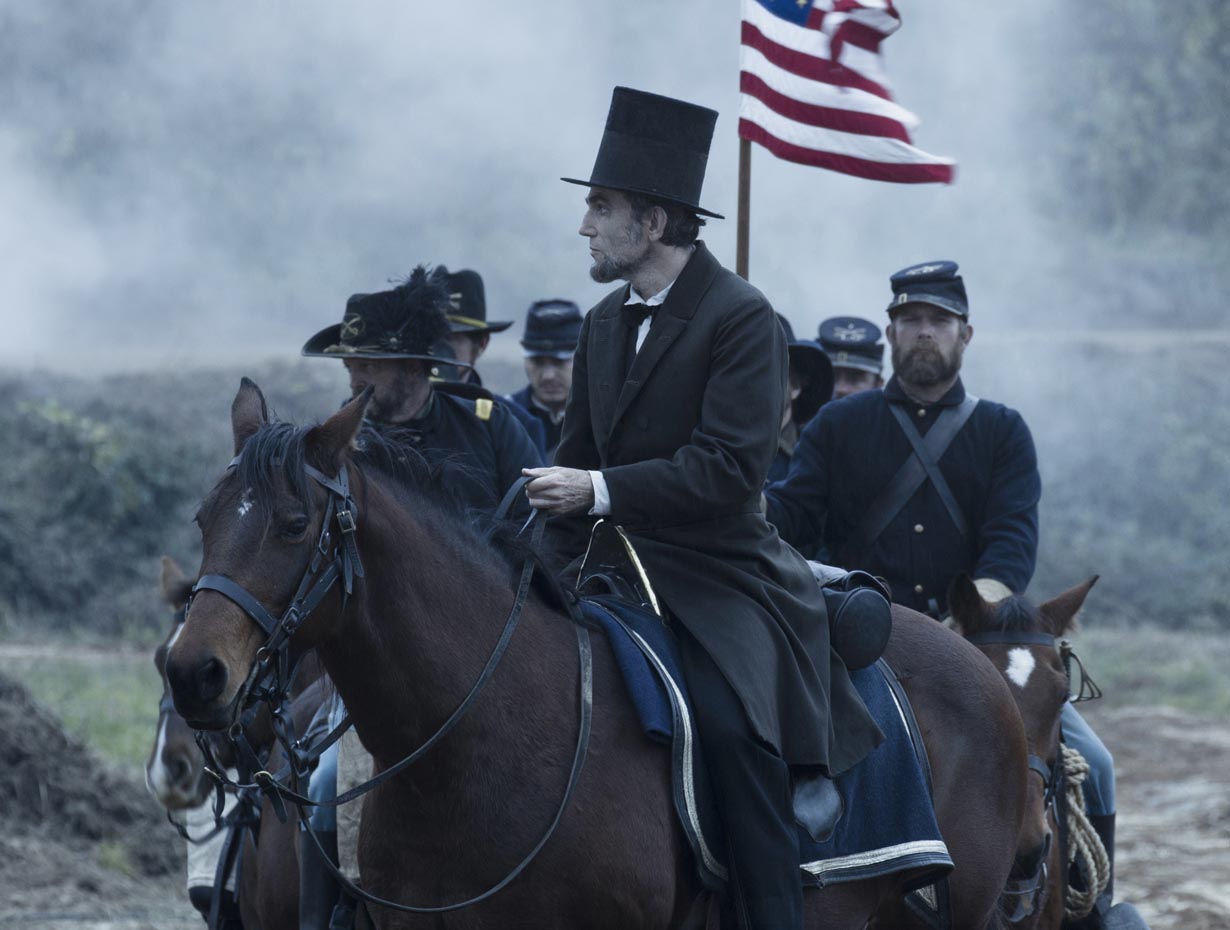
Even a great hat can't distract from that, Mr. President
Unfortunately, his window of opportunity was closing fast.  The Confederacy was weakening.  It was only a matter of time before they were completely defeated.  But once the Confederate states rejoined the Union, the chances of passing an anti-slavery amendment would be nil.  Not only would there be pro-slavery Southerners voting, but much of the support for anti-slavery legislation was garnered from the belief that repealing slavery would end the war faster; with the war over, racism would win the day.  That left Lincoln with one chance.  Assuming everyone in his political party would vote for him (which was a stretch), the 13th Amendment was still a few votes shy of passing --- but there were several men in the opposing party that had lost their elections and were just waiting to be replaced.  If Lincoln's men could convince enough of these lame ducks --- and his own party --- to vote for the amendment, history could be made.  And, as luck would have it, there was one more date available for a Congressional vote before all the peace hits the fan!
"What will it take to get your vote?  A threesome is not off the table."

The acting in Lincoln is, not surprisingly, excellent.  Daniel Day-Lewis is THE thespian stud of our times, and he brought his A-game here.  Day-Lewis went against the traditional interpretation of the character by making him slouch, feel old, and speak with a soft tone, but he also managed to demand all of the attention in every scene he was in.  As luck would have it, that is practically every single scene in the film.  I think some of my favorite moments were the scenes where he relied on nonverbals.  This is a fairly talky character, so having the quiet moments as highlights is just a testament to Day-Lewis' acting prowess.
Example: right here, Lincoln was this close to killing everyone in a 30 foot radius
Leading the exemplary supporting cast was Tommy Lee Jones, who played a perennially cranky character.  Shock!  I love it when Jones gets a role that lends itself to his acerbic delivery, and this is easily one of his best.
Sally Field played Mrs. Mary Todd Lincoln, who is known historically for being a bit crazy.  Field managed that well enough, but I didn't think her role was anything special.
Buck up, Sally.  Sulking is not attractive in any time period.
Despite that, Field did a lot with the part and was surprisingly magnetic onscreen.  David Strathairn was good as the eternally exasperated William "I Heart Alaska" Seward.  He didn't really have much room to grow as a character, but served well as a mouthpiece to the logistics Lincoln was facing.  James Spader, John Hawkes, and Tim Blake Nelson played the three men tasked with drumming up support among the opposition; all three are fine actors, but I would have preferred it if Spader wasn't the one doing most of the work here.
Spader, realizing that this role has nothing to do with deviant sex acts
Hal Holbrook was fine as an obstacle for Lincoln to overcome, although I think this role was a little underdeveloped.  Speaking of which, Joseph Gordon-Levitt was a waste of space as Lincoln's eldest son.  One of these days, JGL will play a big role in a big movie --- it's inevitable, given his talent and the people he works with --- but the whiny, over-privileged son of the president is not that role.
"What if I tried pouting more?"
Rounding out the cast, Lee Pace was solid in the strawman role of "that really racist guy."  This is the first time I have seen Pace play an unlikable character, and he did so reasonably well.

Lincoln was the result of director teaming up with , king of the difficult-subject-screenplay.  With regards to the direction, Spielberg nailed all the technical aspects.  Design, costumes, filling the cast with nary a bad actor, etc. --- Spielberg is too big of a director to accept anything but the best in these regards.  While he has never been the strongest director in terms of cinematography, Spielberg still managed to snag several memorable shots of an American icon.
He also handled the actors quite well.  Having a great cast obviously helps with that, but Day-Lewis, Jones, and Field were all deserving of their award nominations, and Spielberg was ultimately responsible for that. 

I think Kushner did a solid job with the plot and the dialogue.  Both Lincoln and Thaddeus Stevens (Tommy Lee Jones) had some fantastic lines, and transforming this political issue into an interesting story was an impressive feat.  Lincoln is missing something, though.  I want to say that it is something immaterial, like "heart," but I can do better than that.  This is a smart script, no doubt.  It is just not an emotional one.  American culture has reached a point where racism is justly vilified.  It definitely still exists, but racists are generally acknowledged as assholes, as they should be. 
"Amend that.  It should read 'total fucking assholes'"
This might have been a brave film as late as 1975, but in 2012, the subject matter isn't compelling enough on its own.  This needed an emotional anchor to twist the audience's stomach in knots while we waited for the inevitable, and that was lacking.  There were some attempts.  Thaddeus Stevens' change of policy was intriguing, but underdeveloped.  Abraham and Mary Todd shared a scene where they got to bare their souls, but it wasn't nearly enough to warm an otherwise cold story.
"You act like a little culture will kill you!"
The fault is not Kushner's alone, of course.  Lincoln has been Spielberg's baby for years, and he managed to put out a smart, well-acted and -directed film without that crucial element that makes you cry at the end.

I was expecting a lot from Lincoln, and only got most of what I hoped for.  This is technically a better film that Spielberg's last effort, War Horse, but that movie drew me in, despite my objections.  Lincoln is more cerebral, but leaves emotions at the door, and that turned out to ultimately be a mistake.  Even without something tugging at my heartstrings, it is hard to dismiss Daniel Day-Lewis reinventing an American icon.  With all the good and the not-quite-bad, Lincoln gets

Sunday, May 20, 2012

The Resident

I don't often watch Hilary Swank movies.  It's not that I dislike her --- although two Oscars seems a bit much, in my opinion --- it's just that she stars in a lot of crap.  I have similar feelings about Jeffrey Dean Morgan; I like the guy just fine, but he's not in many things I want to watch.  No, what drew me into The Resident was the fact that this was a Hammer Films production featuring Christopher Lee.  Plus, I just reviewed The Apartment, and I found the pairing amusing.  I haven't seen many classic Hammer movies, but I was completely unaware that they had resurrected the brand recently and made a few noteworthy pics (that I haven't seen yet).  Christopher Lee, a two-time Best Actress, a solid character actor, and a classic movie brand --- what could go wrong?
"That depends...how much do you love rape?"

Juliet (Hilary Swank) is a New York City emergency room doctor in need of a new home.  She receives a call from someone, telling her that there is an apartment for rent.  When she arrives, she finds an enormous place in an older building that is nearly perfect: great wood floors, about three acres of floorspace, and a ridiculous view of the city.  The downside is that the train passes pretty close to the building and things have a tendency to vibrate off of shelves.  The price is shockingly cheap (by NYC standards), so Juliet takes the place.
"I like the plastic on the walls.  It makes it easier to clean blood off!"
Her landlord is Max (Jeffrey Dean Morgan), whose only job appears to be renovating the building; Max and his grandfather, August (Christopher Lee), are the building's only other tenants.  Juliet loves her new place, but the creaks and moans of the building play tricks on her, making her think that she is not alone.  Nevertheless, things appear to be getting better for her.  She even randomly encounters Max socially and the two hit it off; in other words, the pair quickly start getting naked together.

Now stop.  Rewind.  The film backs up to give the viewer an alternate point of view on the story thus far.  It turns out that the friendly Max has been stalking Juliet for some time and she played right into his hands.  Remember those moments Juliet thought she wasn't alone?  That's because she wasn't.  Two-way mirrors, peepholes and secret passages abound in her apartment, and you can be sure that behind every creepy noise in the place, Max is hiding and breathing heavily.
Aww!  Look at that puppy dog face!  You are forgiven for everything, Max!
At this point, the film can take a few directions.  The first would be for the pair to start dating and either become a lovely couple, or his creepy nature would turn this into a taut thriller, where Juliet only gradually realizes how dangerous Max is --- and he's sleeping right next to her!  Alternately, Juliet could put a stop to their naked time before the grinding starts and Max could go into full-on horror movie villain mode.  The Resident opts for the second, easier, route.

How's the acting in The Resident?  I suppose that depends on how forgiving you are.  I wouldn't say that Hilary Swank was good, but she played her role capably.  Is it her fault that her character is almost fatally stupid?  I don't think so, but it would have been nice for her paranoid character to call the police, even once.  I will say, however, that I was surprised that she had some brief getting-out-of-the-tub nudity; that's just about the cheapest excuse for nudity you will come across in a film, and I wasn't expecting it from her in a horror flick.  I'm not complaining, I'm just saying.  Jeffrey Dean Morgan was certainly creepy for a good portion of this film, so I guess he was somewhat successful.  Toward the end of the movie, he exchanged creepiness for sub-par horror slasher villainy, and he wasn't very good at that.  I would say that he was solid for the first half of the film, but when the plot returned from its flashback, his performance went downhill quickly.  Christopher Lee felt out of place in this movie, somehow; I like seeing him act, but hearing his strong voice coming out of his frail body made me a little sad.
Little known fact: Christopher Lee is Noah
Lee Pace didn't have much do do.  He played Juliet's unfaithful ex, and his part was fairly unremarkable.  He got beat up like a chump twice and went grocery shopping.
Not necessarily in that order
Aunjanue Ellis is the only supporting character that isn't terribly important in the overall plot.  She urges Juliet to date Max and talks trash about Lee Pace.  On the one hand, I guess her character can be seen as someone encouraging Juliet, but everything she supports (take the apartment, date Max, etc.) is really, really bad advice.

The Resident was Antti Jokinen's first (and so far, only) feature film director credit.  That's probably for the best.  I will give Jokinen some credit; I thought the first thirty minutes were surprisingly solid, although the story felt familiar.  I also like that the "surprise" of Max being a creep was not held back as a major plot twist, because...well, it was pretty damn obvious.  His fancier camera work was handled clumsily, making scenes that should have been ambiguous (is she alone, or isn't she?) pretty cut-and-dried.  I didn't like the choice to rewind the plot to show us how awful Max is, but I suppose it was better than him having a shrine to Juliet in his closet.  My main problem with how Jokinen directed this movie was that he was inconsistent.  I would have been fine with this film if he had maintained the suspense from the first act.  The second act, during the rewind, took all the mystery from the story.  The third act just sucked, as Max went from creepy to evil with less buildup than the 12th kill in a Jason movie.  I don't think Jokinen did a terrible job directing this film, but he certainly didn't make this story better with his direction.
Example: he frequently told his actors to look perturbed, not scared

Unfortunately, Jokinen was also responsible for the major weakness of The Resident: the writing.  He co-wrote this screenplay with a guy who was involved in the third Underworld movie, so the talent pool for this screenplay was not particularly deep.  Still, this story is pure crap.  Ignoring the cliche of the nice guy who is secretly disturbed, there really isn't any other logical suspect when Juliet gets paranoid that she is being watched.  So, that means Juliet is either paranoid or her landlord is spying on her; given the title, that seems like a poorly constructed mystery.  What really pushed this movie over the edge from drudgery to utter crap was how the writers showed that Max was disturbed.  Max's primary way to get close to Juliet was by drugging her and touching her while she was asleep.  Licking her hands was creepy enough, but raping her while she was unconscious was more gross than shocking.
That's so...erotic?
If you're going to make rape a plot point, that should not be the effect.  I also did not need to see multiple scenes where Max masturbated while in Juliet's apartment.  They throw in some stuff where Christopher Lee implies that Max's parents were disturbed, too, but it doesn't go anywhere.  I think they overplayed their hand with Max, making his transition from peeper to murderer/rapist too abrupt.
It's surprisingly well-lit when Max chooses to creep
I would have been much happier if Max was just creepy and maybe building up toward rape, when he panics and kills someone and, from there, we see him get more desperate and his actions more drastic.  There's just no build to this plot whatsoever.  Instead of being suspenseful or scary, it is boring, over-familiar and uncomfortable.  I should be rooting for either the killer or the heroine here, but neither is particularly likable.  I had difficulty understanding why I wasn't sympathetic toward Juliet for a little while.  Then, I realized that she was an idiot.  She oversleeps after her evening wine bottle was drugged; instead of drinking less, she blames it on her apartment.  Yes, that makes perfect sense.  On the bright side, the movie did end with a nail gun-related death, so there's that.