Showing posts with label Steven Spielberg. Show all posts

Saturday, March 2, 2013

Lincoln

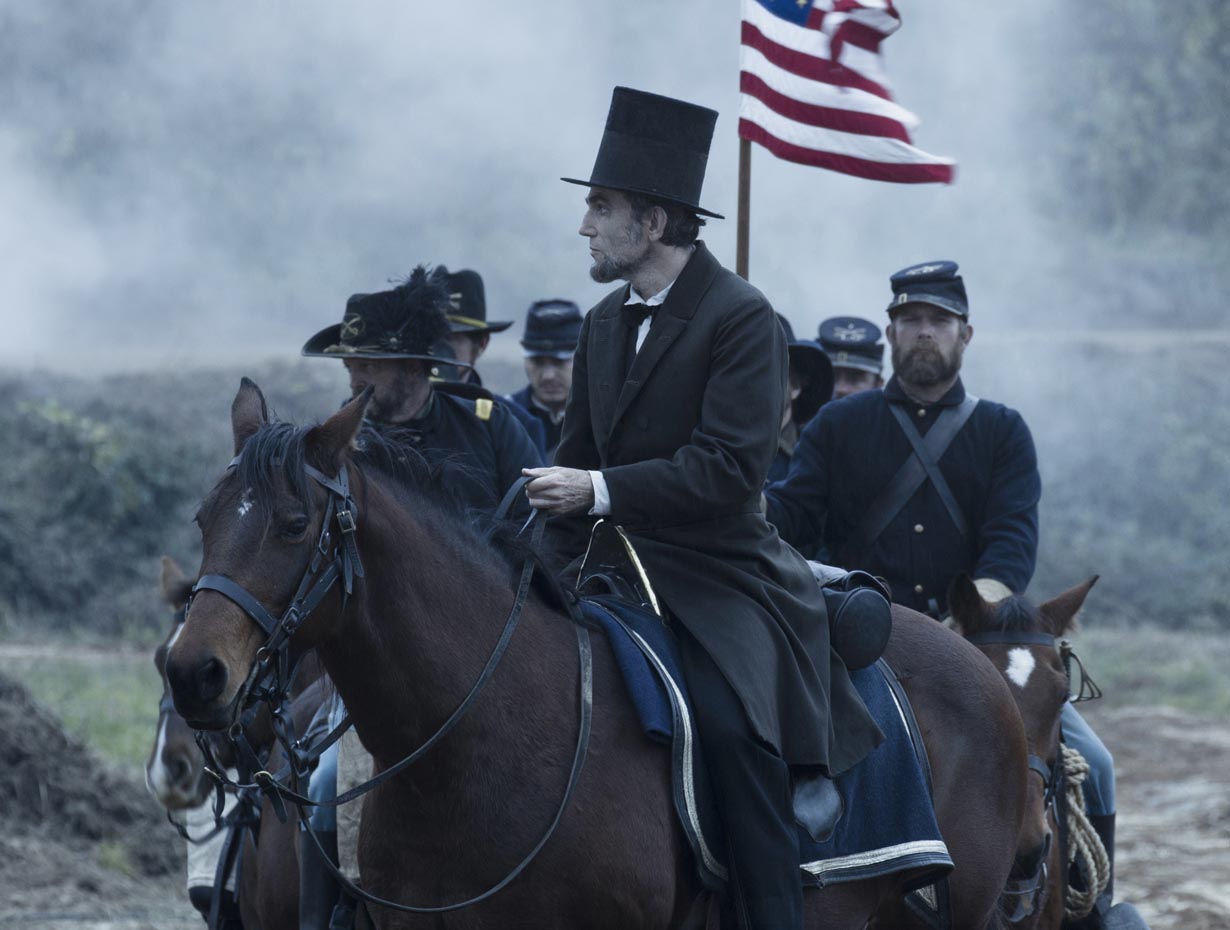
Steven Spielberg and Daniel Day-Lewis working together on a film about one of the greatest Americans that ever lived?  Yeah, that sounds like a prestige picture.  Lincoln boasts not only (arguably) the best director and (unarguably) the best actor working in Hollywood right now, but one of the greatest supporting casts ever assembled for a simple (read: not epic) film.  Of the ten top-billed actors on Lincoln's IMDb page, there are a total of 16 Oscar nominations (with 6 wins) and 28 Golden Globe nominations (with 5 wins); only Bruce McGill has not been nominated for an Oscar or Globe.  If you wanted acting credibility, you got it in spades with Lincoln.  But does the movie live up to its pedigree?

Lincoln is a tad deceiving as a title; this isn't so much a biopic as it is a chronicle of President Abraham Lincoln's (Daniel Day-Lewis) struggle to get the 13th Amendment to the US Constitution passed while simultaneously ending the Civil War, the bloodiest war Earth had seen up to that point.  For those of you who are not history buffs (America, I'm looking at you), the 13th Amendment made slavery illegal in the United States.  Sure, Lincoln had freed all the slaves with his Emancipation Proclamation, but the legal grounds by which he did so were shaky, at best.  Lincoln wanted to ensure that his actions had some sort of long-lasting effect that would not be overturned in a court of appeals.  It's a pretty cool thing to be the guy who freed the slaves, but nobody wants to be the guy who freed the slaves only long enough for them to bleed in battle for him. 
Even a great hat can't distract from that, Mr. President
Unfortunately, his window of opportunity was closing fast.  The Confederacy was weakening.  It was only a matter of time before they were completely defeated.  But once the Confederate states rejoined the Union, the chances of passing an anti-slavery amendment would be nil.  Not only would there be pro-slavery Southerners voting, but much of the support for anti-slavery legislation was garnered from the belief that repealing slavery would end the war faster; with the war over, racism would win the day.  That left Lincoln with one chance.  Assuming everyone in his political party would vote for him (which was a stretch), the 13th Amendment was still a few votes shy of passing --- but there were several men in the opposing party that had lost their elections and were just waiting to be replaced.  If Lincoln's men could convince enough of these lame ducks --- and his own party --- to vote for the amendment, history could be made.  And, as luck would have it, there was one more date available for a Congressional vote before all the peace hits the fan!
"What will it take to get your vote?  A threesome is not off the table."

The acting in Lincoln is, not surprisingly, excellent.  Daniel Day-Lewis is THE thespian stud of our times, and he brought his A-game here.  Day-Lewis went against the traditional interpretation of the character by making him slouch, feel old, and speak with a soft tone, but he also managed to demand all of the attention in every scene he was in.  As luck would have it, that is practically every single scene in the film.  I think some of my favorite moments were the scenes where he relied on nonverbals.  This is a fairly talky character, so having the quiet moments as highlights is just a testament to Day-Lewis' acting prowess.
Example: right here, Lincoln was this close to killing everyone in a 30 foot radius
Leading the exemplary supporting cast was Tommy Lee Jones, who played a perennially cranky character.  Shock!  I love it when Jones gets a role that lends itself to his acerbic delivery, and this is easily one of his best.
Sally Field played Mrs. Mary Todd Lincoln, who is known historically for being a bit crazy.  Field managed that well enough, but I didn't think her role was anything special.
Buck up, Sally.  Sulking is not attractive in any time period.
Despite that, Field did a lot with the part and was surprisingly magnetic onscreen.  David Strathairn was good as the eternally exasperated William "I Heart Alaska" Seward.  He didn't really have much room to grow as a character, but served well as a mouthpiece to the logistics Lincoln was facing.  James Spader, John Hawkes, and Tim Blake Nelson played the three men tasked with drumming up support among the opposition; all three are fine actors, but I would have preferred it if Spader wasn't the one doing most of the work here.
Spader, realizing that this role has nothing to do with deviant sex acts
Hal Holbrook was fine as an obstacle for Lincoln to overcome, although I think this role was a little underdeveloped.  Speaking of which, Joseph Gordon-Levitt was a waste of space as Lincoln's eldest son.  One of these days, JGL will play a big role in a big movie --- it's inevitable, given his talent and the people he works with --- but the whiny, over-privileged son of the president is not that role.
"What if I tried pouting more?"
Rounding out the cast, Lee Pace was solid in the strawman role of "that really racist guy."  This is the first time I have seen Pace play an unlikable character, and he did so reasonably well.

Lincoln was the result of director teaming up with , king of the difficult-subject-screenplay.  With regards to the direction, Spielberg nailed all the technical aspects.  Design, costumes, filling the cast with nary a bad actor, etc. --- Spielberg is too big of a director to accept anything but the best in these regards.  While he has never been the strongest director in terms of cinematography, Spielberg still managed to snag several memorable shots of an American icon.
He also handled the actors quite well.  Having a great cast obviously helps with that, but Day-Lewis, Jones, and Field were all deserving of their award nominations, and Spielberg was ultimately responsible for that. 

I think Kushner did a solid job with the plot and the dialogue.  Both Lincoln and Thaddeus Stevens (Tommy Lee Jones) had some fantastic lines, and transforming this political issue into an interesting story was an impressive feat.  Lincoln is missing something, though.  I want to say that it is something immaterial, like "heart," but I can do better than that.  This is a smart script, no doubt.  It is just not an emotional one.  American culture has reached a point where racism is justly vilified.  It definitely still exists, but racists are generally acknowledged as assholes, as they should be. 
"Amend that.  It should read 'total fucking assholes'"
This might have been a brave film as late as 1975, but in 2012, the subject matter isn't compelling enough on its own.  This needed an emotional anchor to twist the audience's stomach in knots while we waited for the inevitable, and that was lacking.  There were some attempts.  Thaddeus Stevens' change of policy was intriguing, but underdeveloped.  Abraham and Mary Todd shared a scene where they got to bare their souls, but it wasn't nearly enough to warm an otherwise cold story.
"You act like a little culture will kill you!"
The fault is not Kushner's alone, of course.  Lincoln has been Spielberg's baby for years, and he managed to put out a smart, well-acted and -directed film without that crucial element that makes you cry at the end.

I was expecting a lot from Lincoln, and only got most of what I hoped for.  This is technically a better film that Spielberg's last effort, War Horse, but that movie drew me in, despite my objections.  Lincoln is more cerebral, but leaves emotions at the door, and that turned out to ultimately be a mistake.  Even without something tugging at my heartstrings, it is hard to dismiss Daniel Day-Lewis reinventing an American icon.  With all the good and the not-quite-bad, Lincoln gets

Wednesday, February 22, 2012

War Horse

I don't get the appeal of horses.  Maybe I'm just not an animal lover (scratch that --- I'm definitely not an animal lover), but I see horses as walking, pooping, glue factories.  As you might have surmised, I was not looking forward to seeing War Horse.  I assumed that it would be good --- I haven't seen a bad Spielberg movie yet --- but the commercials made it look like a dramatization of Charlotte's Web, from the human point of view: "That sure is some pig horse."

War Horse begins with the birth of Joey, who would one day become England's Secretary of War (Horse) is never actually called "war horse" by anyone important in the movie.  Joey's birth is witnessed by Albert (Jeremy Irvine), a nice local kid with more guts than smarts.  Albert immediately becomes infatuated by Joey, constantly trying to win his affection.  To be honest, young Albert's love of horses borders on the disturbing.
"Let's keep this between you and me"
Albert wins the bestiality lottery when his father gets drunk and bids far too much money for ownership of Joey.  Albert's family lives on a farm and needs a plow horse, not a thoroughbred like Joey, but the horse and Albert surprise everyone except the audience by plowing a difficult field.  This is the first "some horse" moment in the film, but certainly not the last. 
Joey's not running here, but carefully balancing
Eventually, circumstances dictate that Joey must be separated from Albert, thanks to World War I and its insatiable appetite for killing things.  The horse gets drafted, but Albert is too young; the war horse goes to war without his master.  From this point on, we see how Joey impacts the lives of several humans.  He serves with both the English and the German armies, befriends a young girl and her jam-making grandfather, and serves as the stimulus for a Christmas Truce-type scene in the trenches.  All the while, Albert is slowly growing old enough to join the army and, if he's lucky, rejoin his magnificent horse.
It's perfectly fine if you hum the "Theme to Rawhide" while watching this film

That plot breakdown may make it seem like I didn't enjoy War Horse, but I actually did.  The ensemble cast is solid, and the brutality of the war scenes is well-balanced by clever and cute civilian scenes.  This is a movie meant to tug on the heart strings, and tug it does.  So what's my problem, then?  I'll get to it in a bit, but I want to acknowledge what I liked first.

The acting in War Horse doesn't contain any amazing performances, but they were all pretty good.  Jeremy Irvine is likable as the main (human) character, which is essential to the success of the film.  There are far too many moments early in the film where his love of Joey could be construed as romantic, but I thought he was fine otherwise.
This analogue to the Sixteen Candles panty scene was a bit much, though
Ted Narracott was good as Irvine's drunk and gruff father, but Emily Watson was the best supporting actor in the film.  I thought her character grounded the story on the human side of things, adding some much-needed wry humor and solid dramatic chops.
...and glamor.  Don't forget the glamor!
David Thewlis sheds a bit of his fuzzy Harry Potter image by playing the local rich guy and being generally unlikable.  The most promising cast members were definitely the British soliders who don't have much screen time.  Up-and-comers Benedict Cumberbatch and Tom Hiddleston play the thankless role of soldiers who haven't realized that machine gun combat has made cavalry charges useless; neither man is terribly impressive here, but I've liked them quite a bit in other things, so I thought I'd call them out.
L-R: Sherlock Holmes, cannon fodder, and Loki
The rest of the cast was okay, but similarly unremarkable.  Young Celine Buckens gave a cute debut performance, David Kross was good in a surprisingly brief role, and frequent character actors Eddie Marsan and Liam Cunningham make brief appearances before the end.

Steven Spielberg directed War Horse, so you know it's going to look good.  The war scenes looked cool, but were not plentiful enough to change the focus of this movie from a boy and his horse to a war and its horse.  For the record, though, War Horse is probably the most dead horse-filled movie I have ever seen.  Spielberg's always had a good touch with light humor in his action films, and he maintains it here.  The cinematography is pretty, the lighting is noticeably interesting at points (especially the last scene), and the story is suitably emotional. 
And, for little girls, that emotion is "ridiculous horse-caused joy"

The style is awfully retro, though.  War Horse feels more like a John Ford movie than a Spielberg film.  This is the kind of semi-epic, ultra-earnest story that was all the rage in the 50s and 60s, but has fallen out of favor of late because it can seem a bit dated or corny.  And War Horse is kind of dated and corny, so that makes sense.  It's not just that the film is a tad predictable and old-fashioned, it takes itself pretty seriously.  Sure, there are some intentionally funny moments (many involving a goose, a sure sign of broad audience pandering), but there are also some unintentionally funny conceptual moments.  For instance, Joey has a companion horse during the war; that's right, the main character in this war movie inevitably finds a war buddy, and that buddy's character development mirrors that of most "best friend" characters in war movies. 
That horse is one week away from retirement
And then there is John Williams' overeager score; I love me some John Williams, but he lays it on a little thick at the very beginning of the movie, practically screaming at the audience that even the uneventful beginning of this film is epic.  And, of course, there are all the instances where immature jackasses like myself giggled when Albert's affection seemed a little less than chaste.

None of that makes War Horse a bad movie.  While I thought the film was sentimental and nostalgic, I certainly teared up on a few occasions.  This is a well-made movie that hits all the right notes, but just isn't very interesting to me.  On the other hand, I think it is a little funny that, in the same year J.J. Abrams made a movie that waxed nostalgic for Close Encounters, Spielberg wound up making an homage to the emotional epics of yesteryear.  This is a quality picture, just not necessarily as great as it wants to be.

Thursday, January 5, 2012

The Blues Brothers

When I reviewed Jesus Christ Superstar a few weeks ago, I listed South Park: Bigger, Longer and Uncut and Willy Wonka and the Chocolate Factory as my favorite musicals.  I apparently forgot about one of my all-time favorite films, The Blues Brothers.  I could try and defend my omission by classifying the film as an action movie (the car chases probably made Burt Reynolds jealous) or as a comedy, but I'll just 'fess up.  I forgot about it.  I'm dumb like that sometimes.

Without a doubt, the best movie idea to ever spring from Saturday Night Live, The Blues Brothers took the surprisingly successful (and shockingly legit) R&B/soul/blues band that got its start on SNL and gave them a story.  Sure, Their first album, Briefcase Full of Blues, had album liner notes detailing some of that backstory.  Sure, it certainly helped that the band hadn't become annoying by starring in some inevitably underwhelming SNL sketches --- these gags were fresh, even if the characters were recognizable.  But what helped the most was the combination of Dan Aykroyd and John Landis.  Landis showed a talent for filming action and music numbers that complemented his already established skill with directing comedies.  Add Landis' surprising skill set with a still-funny Dan Aykroyd (rarely seen after Nothing But Trouble), and you get an odd blend of clever comedy, stupid comedy, reckless destruction and truly awesome musical numbers.
If you don't love this scene, you have no soul (or R&B or blues)

When Joliet Jake Blues (John Belushi) --- with "JAKE" tattooed on his knuckles --- is released on parole, he is met by his brother, Elwood (Dan Aykroyd) --- with "ELWO" tattooed on the knuckles of one hand, and "OD" finishing off the name on his other fist --- and the two return to the orphanage where they grew up.  Times are tough for the orphanage, though, and five thousand dollars is needed to keep the place open or the only parents Jake and Elwood have ever known --- the abrasive Sister Mary "The Penguin" Stigmata (Kathleen Freeman) and the orphanage's janitor, Cal (Cab Calloway) --- will be living in a remote mission and the street, respectively.
What's one more scat-singer on the street to the Board of Education?
Jake and Elwood hastily agree to get the money in time for the approaching deadline, but The Penguin insists that they get the money honestly.  That poses more of a problem.  Cal recommends they attend a church where they hear a sermon from Reverend Cleophus (James Brown).  During the unexpectedly lively sermon, complete with dancers, people doing flips, back-up vocals from Chaka Khan, and shockingly poor enunciation, the boys receive a message.
"...ah herr a diss toob in sown!"
To save the orphanage, they must bring The Blues Brothers Band back together.  This isn't just their idea; this is what God wants them to do.  It's not going to be easy, though.  The band has split up, taking various joe jobs and moving on with their lives.  And if they get the band together, they still need to play an enormous show and it needs to be ridiculously successful.  And even if they are able to do that, there are a number of people out to get the Blues Brothers, simply for doing whatever it is they do.  But they won't fail.  They're on a mission from God, after all.

The acting in The Blues Brothers is pretty hit-and-miss.  John Belushi and Dan Aykroyd have wonderful chemistry and are thoroughly entertaining throughout, even when speaking one-word sentences.

The great thing about this movie is that the wonderful, random and physical comedy these two bring to the table is just icing on the cake.  Aside from small roles from John Candy (note: do not emulate his bar scene and order orange whips.  They are disgusting), Henry Gibson, Frank Oz, Charles Napier, and Carrie Fisher (all of whom were just lovely), the rest of the cast is filled with amateurs.  If you are looking to make a movie that featured great musicians acting, stick to Cab Calloway and Aretha Franklin.  The other musicians --- specifically Matt "Guitar" Murphy, Donald "Duck" Dunn and Steve "The Colonel" Cropper --- are about as wooden as you can get.
As her husband says, "They're all pretty bad."
Luckily, the bad acting from the non-professional cast feeds into the awkward timing and left-field jokes that Landis loves in his films.  In any other movie, I would point to the cameos of Paul Reubens, Steven Spielberg, and that guy who played the limo driver in Die Hard as high points in the casting, but I can honestly quote at least a dozen lines of dialogue from these musicians.  Their acting may not be great, but their delivery and Landis' editing makes them surprisingly memorable.
"I wrote Boom Boom"  "No you didn't!"


The real star of the film was the musical numbers, though.  Even at the height of the band's popularity (they did have a number one album), I doubt anyone would have expected legends like James Brown, Aretha Franklin, Ray Charles, John Lee Hooker and Cab Calloway to showing up and sing in this film.  And The Blues Brothers Band is shockingly good.  Filled with established sessions musicians as well as the guitarist and bassist from Booker T and the MGs --- who supplied some of the major musical themes for the film --- this was a musical machine.  Belushi and Aykroyd's vocals aren't bad, but they are enthusiastic, which makes all the difference.  When you mix that enthusiasm with the credentials of their band and the great guest performers, you get some truly memorable music scenes.

John Landis directed The Blues Brothers and co-wrote it with Aykroyd.  This isn't a script that could have been pulled off by just any actors --- there are too many weird gags and half-written jokes ("Got my Cheese Whiz?") that required these exact leads --- but the fact that Landis and Aykroyd were able to take advantage of their familiarity with each other (and Belushi, of course) to make so many of these jokes work is remarkable.  Also impressive is how Landis was able to take that SNL staple of humor (ridiculously over-doing something because "Get it?  This is sillier than real life!") and multiply it a thousandfold.  Sure, it's kind of funny that a lot of police would chase Jake and Elwood for, essentially, being awesome; Landis brings in SWAT, tanks, and the National Guard into the mix, turning a slightly silly idea into something ludicrously over-the-top.
Example
John Landis is not a director known for his rapport with the actors in his films, and that is why he usually doesn't get surprising performances; the actors you expect to be funny are funny, and then there's everybody else.  But Landis edited this picture surprisingly well, too.  He mixes iconic shots of the Chicagoland area with iconic shots of the actors.
He sometimes ends scenes abruptly to punch up the humor in a parting line of dialogue.  His camera work is fairly commonplace for most of the film (aside from avoiding Jakes eyes in the opening credits), but he shows an eye for shots that look great.  He's never afraid to make a choice that is stupid or silly, either (the Nazi car chase, for example); it's almost as if his attitude while making this film was "why not?"  And it doesn't hurt that he decided to wreck a shocking amount of property while filming this movie.  After all, if the music and the jokes don't appeal to you, at least you can enjoy the destruction of a mall and some massive car pileups.
Behind the scenes secret: John Landis hates cars


The Blues Brothers shouldn't work as well as it does.  Hell, it shouldn't have been made like this.  No studio would give a Saturday Night Live idea, even one with proven commercial appeal, a budget this large.  Hell, MacGruber had one-third the budget of this film, and The Blues Brothers was made thirty years earlier!  Of course, MacGruber was obviously going to suck, but that's still an impressive budgetary difference.  So many of these scenes work because they are so big and over-the-top (Carrie Fisher's destruction, the car chases, the mall scene, and Maxwell Street musical numbers, etc.), and it is a miracle these filmmakers were allowed to dream this big.  While it would have certainly been different with a smaller budget, The Blues Brothers shows so much love for its music that the scale doesn't matter much.

I think I was born to love this movie.  The Chicago setting, music that fits the city (and you can still hear bums play on the streets), and comedy that toes the line between stupid and clever...it's just so good.  And I have always kind of liked the Wrigley Field bit, too.


For more on John Landis, check out some other opinions:

Large Association of Movie Blogs

Thursday, June 2, 2011

The Lost World: Jurassic Park

Everyone is pretty familiar with this common complaint when a book is adapted into a movie: "The book is so much better!"  That's usually a little unfair to the filmmakers, though; screenwriters are forced to essentially create a snapshot of the book to help it make sense in a film format.  Sometimes, though, the book and the movie are different enough to make you wonder just how much "adapting" is taking place and how much "we're stealing the title of your book" is going on.  The Lost World was the first time Michael Crichton wrote a sequel to any of his novels; he wasn't going to write it, but the massive success of Jurassic Park and pressures from his publishing company and Steven Spielberg convinced him to revisit Dinosaur Island.  The book occasionally took a liberal approach to the events in the first novel (Ian Malcom dies in the first book, but is the main character in the second, for starters), but that is nothing compared to the differences between The Lost World and The Lost World: Jurassic Park.  Like what, you ask?  Aside from changing almost every character in the book and splicing in scenes from the first novel, I don't know...maybe a Tyrannosaurus Rex rampaging through San Diego? 
You mean "car flips over to avoid T-Rex" wasn't in the book?
Personally, I don't care about the liberties filmmakers take with their source material, as long as it makes the movie work.  Film and prose are very different forms of entertainment and art, and if huge changes bother you, then stick to your book.  That said, I think adding a citywide dinosaur rampage is a pretty funny detail to add to any story.

The Lost World: Jurassic Park picks up four years after the events of the first film, which is nice, because four years actually took place between the releases of the two movies.  Dr. Ian Malcom (Jeff Goldblum) is asked by John Hammond (Richard Attenborough) to join an expedition to his secret dinosaur island.  You see, Jurassic Park was located on Isla Nubar, but Hammond's company apparently kept a back-up supply of dinosaurs on the nearby Isla Sorna, just without any of the safeguards and fences that were so effective **cough, cough** in the first film.  Apparently, the dinosaurs were engineered on Isla Sorna and then brought to Isla Nubar when mature, which doesn't at all contradict the egg-hatching scenes in the first movie.  Like any person sane enough to not eat their own feces, Malcom refuses the kind offer to visit more killer lizards.  Well, he refuses until he finds out that his girlfriend, Sarah (Julianne Moore), is already on the island, getting her research on.  This throws Malcom in a tizzy, since he's familiar with all the running and screaming that inevitably accompany 20th-century dinos, and he leaves for Isla Sorna with an engineer (Richard Schiff) and an environmentalist photographer (Vince Vaughn) and, because this is a family movie despite all the death, Malcom's daughter from a failed marriage, Kelly (Vanessa Lee Chester), who stowed away on their boat.  When they arrive on the island, it becomes quickly apparent that this is not just a research mission.  John Hammond's nephew, Peter (Arliss Howard), has taken control of his uncle's company and wants to open a new Jurassic Park in San Diego.  He needs to capture some dinosaurs to make that happen, so he brought a few dozen big game hunters with to facilitate his wishes.  Soon enough, both groups find themselves on the wrong side of an island full of angry dinosaurs and it becomes a battle for survival.  Surprise, surprise.
Do not feed the dinosaurs, stupid.

One of my chief complaints with Spielberg movies is that his more special effects-based efforts skimp on the acting.  This time around, Jeff Goldblum is given the starring role, and this might be the most Goldblum-y part of his career; all the awkward poses and odd vocal cadences that you are familiar with are front and center in this film.  Surprisingly, that's pretty entertaining, when given a chance to shine, like he does in the first act of the movie.  Unfortunately, as the dinosaur attacks become more frequent, his dialogue becomes less frequent, and he just becomes another character running from CGI.  Julianne Moore is a capable actress, but I found her character a little annoying in this movie, and that's ignoring some of the colossally moronic things her character does.  It was nice to see a young Vince Vaughn, because I totally forgot that he used to be handsome, or at least less puffy and seemingly without the hangover scowl he's sported for the last decade.  I didn't particularly care for the eco-terrorist/animal rights aspect of his character, but at least he didn't come across as crazy.  As far as the "bad guys" went, I enjoyed Pete Postlethwaite's gruff safari hunter character.  He wasn't in it for the money, but the challenge, and that makes all the difference in a series that points out the dangers of mixing capitalism and extinct species.

The rest of the supporting cast had substantially less screen time, but should be mentioned anyway.  Richard Attenborough, Richard Schiff, and Arliss Howard are all decent enough.  Nobody does a particularly good job, but they propel the plot forward without offending.  Similarly, the brief cameos from the Jurassic Park kids, Joseph Mazzello and Ariana Richards are surprisingly not annoying.  The ever unlovable Peter Stormare once again plays a bad man in this movie, and he's definitely the most entertaining "villain."  Yes, he's a jerk and deserves whatever he gets, but Stormare is a lot of fun to root against.  Vanessa Lee Chester was far less enjoyable as Malcom's daughter, who is only in the damn movie because she is painfully stupid.  Chester isn't convincing as a daughter in this movie or anything more than a recurring victim.  It doesn't help that her idiotic gymnastic routine is the low point of the movie for me.

As for Spielberg's direction...I've been more impressed.  The man still knows how to frame a shot and build suspense in an action sequence, but this is far from his best effort.  He doesn't get much from his actors this time out and the focus is even more squarely on the dinosaurs than in the previous film.  The special effects look great, that's a hollow accomplishment when there's no depth in your family film.  And, for a "family film," this is a bit gory.  There are a lot of humans dying in this movie, either on screen or implied just off screen.  I get that watching people die by dinosaur is both awesome and inevitable in this movie, but this cast was mostly cannon fodder.  The oddest choice that Spielberg made with The Lost World was the addition of the T-Rex rampaging in San Diego.  It's fun eye candy, sure, but it's also very, very dumb.  And it looks and feels like a completely different (although similarly-themed) film; the cast is narrowed down to three characters, without any explanation, and Malcom has time to shave and shower while he waits for Rexie to arrive?  That just seems unlikely.

Of course, The Lost World: Jurassic Park was never going to be a thinking man's movie.  This is a movie that is supposed to deliver dinosaurs, dinosaurs, and more dinosaurs.  In that aspect, it definitely delivers.  There is a lot more T-Rex action this time around and seeing the little compys and the stegosauruses was pretty cool.  The velociraptors weren't nearly as smart or dangerous in this movie, which was a bit of a let down --- being defeated by a mediocre gymnastics routine will do that --- but that was the only dinosaur-related bummer in the film.  The T-Rex trampling San Diego, while very stupid in terms of plot, is still a fun sequence to watch, if only because it's always fun to see monsters destroying cities.
The T-Rex symbolizes Ken Caminiti's 'roid rage.  Don't do drugs, kids.


While this is most definitely a special effects extravaganza, it still needs to tell a decent story, and that's where The Lost World fails.  It almost feels as if, because the first movie got all the pseudo-science and wonder out of the way, this film was given carte blanche to just have dinosaurs chasing people for two hours.  Instead of a plot with characters that develop, we get Jeff Goldblum delivering Yakov Smirnoff-ish lines, like "Wild goose chase?  This is the only place where the geese chase you!"  On the whole, the dialogue in this movie is terrible, especially when Malcom is talking to his girlfriend or daughter.  Does any teenage girl ever ask her absentee dad to ground her?  I won't say "never," but it's damned unlikely.  And as amusing as I find Goldblum's peculiar vocal tics, the script sometimes has him hamming it up as a lesser Jerry Seinfeld, asking "what is with...?"

Worse than the dialogue is the ridiculously convoluted plot.  Here is a scene where an experienced wildlife photographer and an experienced behavioral paleontologist take a wounded baby Tyrannosaur to fix its leg:
Stupid.
You would think that anyone experienced with wildlife in general and with predators specifically would be a little more careful about kidnapping a baby predator without accounting for mommy and daddy predator.  Of course, the parents come looking for the baby, smelling it with their sensitive noses, and they react violently to protect the child.  Oddly enough, those behaviors are exactly how Julianne Moore's character predicted they would react --- and she still took the baby!  Well, maybe she just couldn't leave an animal in pain, even if it is a genetically engineered abomination of nature that should be extinct, anyway.  That doesn't explain how she and Pete Postlethwaite's hunter character both ignore the fact that her shirt was covered in baby T-Rex blood that wouldn't dry in the humid weather.  This is just after she gets done explaining that the Rex has fantastic olfactory senses, is obsessed with protecting its young, and has increased its patrolling area to wherever its baby has been.  And then everyone acts surprised when the T-Rex comes looking for the bloody shirt.

As much as I enjoy Spielberg as a director, The Lost World: Jurassic Park is too big of a mess to just turn off my brain and enjoy.  I didn't care about any characters, the plot was frequently insultingly stupid, and the dinosaurs didn't bring anything new to the movie this time.  It might have three times the action of the original, but it has an eighth of the story.

Monday, April 18, 2011

Close Encounters of the Third Kind

There are tons of science fiction movies about aliens, but Close Encounters of the Third Kind really changed the genre.  When I think of alien movies, I think of alien invasion movies because, let's face it, that's pretty much the only type of alien movie that gets made.  Sure, you might get a comedy like *batteries not included or Paul, but those are the exceptions to the rule.  Alien movies typically feature fearsome enemies, hell-bent on destroying mankind or, at the very least, Danny Glover.
Everyone is too old for that shit.
Close Encounters takes a different approach, and I found my love for the sci-fi genre refreshed by that approach, especially after some of the crappy post-apocalyptic flicks I've reviewed recently.  It's also a plus to watch just about any movie scored by John Williams.

I normally like to take the time to explain the plot a bit in my reviews, but I'm going to skip that step today.  I tried to summarize the movie, but I never really did it any justice.  That could certainly be interpreted as incompetence on my part, but I feel that this is a film that focuses on a sense of discovery and wonder.  Explaining the movie undermines it.  But, briefly, I can say this: a "close encounter" is an alien sighting.  The first kind are UFO sightings, the second kind leave behind physical evidence, and the third kind involve actually meeting aliens.  Average joe Roy Neary (Richard Dreyfuss) has a close encounter of the first (and second) kind, and the largest part of this movie focuses on his struggles in the aftermath of his encounter.

The acting in this film is very solid all around, but Richard Dreyfuss's surprisingly understated performance is what drives the movie.  I'm not a big fan of Dreyfuss, mostly because of his string of hammy roles in the late 90s, but he's actually really, really good here.  He shows great comedic timing, but is able to balance that with some very good dramatic acting, as well.  My favorite example of this is in the scene where he scares himself after his UFO sighting; it isn't funny because of the words in the script, but because his performance is so natural that you laugh because you can imagine doing the exact same thing.  Melinda Dillon doesn't get the chance to showcase as much range as Dreyfuss, but she plays a very good mom character (as evidenced by A Christmas Story) and her panic is surprisingly raw at times.  I also liked Teri Garr as Roy Neary's wife; most films would make her a supportive character, someone who believes her husband's crazy alien theories when no one else will.  Instead, her character did the all-too-believable thing and refused to believe in Neary's X-Files-worthy tale.  What's most impressive, though, is that she doesn't come off as a villain.  Francois Tuffaut makes a rare acting appearance here (he is a famous French director) as the French scientist studying the uptick in UFO activity, and he's perfectly serviceable in his role.  He doesn't really have much of an emotional stake in the story, but I thought he did a decent job.  His interpreter, played by Bob Balaban, is more well known for his straight-faced comedic roles, but he apparently can play it straight, too.

Director Steven Spielberg made Close Encounters right after Jaws, and it really shows his versatility.  Sure, he could make a scary monster movie, but what can he do with a concept picture?  Quite a bit, it turns out.  A lot of the discussions on Close Encounters focus on the special effects, and for good reason.  The different ways Spielberg indicates the presence of aliens without actually showing them are all pretty impressive.  I'm not exactly sure why all electrical devices turn on around aliens, but they make for some very memorable scenes.  And yes, the alien ships look pretty cool, especially for a movie made in 1977.  Focusing on that stuff misses the point of the movie, though.  This is an unusual story.  It's presented as a kind of mystery --- exactly what did they see? --- but, as an audience, we assume that we know the answer (hint: it rhymes with "baliens").  And since we know the answer, there really isn't a sense of revelation in the film.  And yet, it is a compelling movie.  Maybe it is the way Spielberg assembled the film, splicing the big picture involving the French scientist and his discoveries within the narrative of Dreyfuss's character, that makes the movie work.  Maybe it was the way that that "big picture" came together; the scenes in India were pretty cool.  Or maybe it is just the simplicity of the story: aliens want to meet us.  I'm not exactly sure what Spielberg does that captures so much innocent wonder about the unknown, but it is definitely what makes this film so impressive.
"The unknown" is apparently mashed potatoes.

I have to note that I watched the original theatrical version.  There are three versions of the movie available (all of which are in the new Blu Ray package): the original theatrical version, the Special Edition, and the Collector's Edition.  The Special Edition re-edits the movie, removing some scenes and adding a new ending, where we get to see inside the spaceship.  The Collector's Edition includes some of the edits of the Special Edition, but cuts the spaceship interior shots, leaving it to your imagination.  The original theatrical version features Carl Weathers in a small part that was cut in the subsequent versions, as well as a few other scenes that don't really add much to the overall story.
An actual screen shot of Weathers in Close Encounters.  He was easy to miss, I know.


Obviously, I really like this movie, but I am not blind to its flaws.  Its pace can seem glacial if you are not in the right mood to sit and watch it.  The laser light show at the end probably should have Pink Floyd playing instead of John Williams's five-note theme.  I'm not quite sure why electrical devices turn on around our little visitors, but I'm downright confused as to why mailboxes rock back and forth in their presence.  And why is there so much goodwill toward these aliens?  They kidnap people.  They implant images in our brains that compel us into certain actions.  They force creepy, hillbilly-esque people to whistle "She'll Be Coming 'Round the Mountain."  And there's no R. Lee Ermey-type character in this film that wants to blow the little green men back to (space) hell?  That seems very unlikely.  And what about Richard Dreyfuss's character?  His life was ruined by the effects of his encounter, and yet he is enamored with the aliens.  That just doesn't make sense.

See?  I can critique the movie, even if I have trouble summarizing it.  Even with those problems, I still think it is great.  Science fiction is the result of our fascination with the unknown, but the genre rarely conveys that wonder on the big screen.  It's really nice to see a movie that celebrates that joy without being manipulative.

Tuesday, March 29, 2011

Indiana Jones and the Last Crusade

I absolutely love Raiders of the Lost Ark.  It will forever be one of my all-time favorite movies, and I will giggle at the same points or point out the same technical errors every time I see it until the day I die.  The other Indy movies though...I'm not nearly as big a fan of.  I know that's a bit of an understatement when it comes to Kingdom of the Crystal Skull, but I've never been a fan of Temple of Doom, either.  Last Crusade has always been my number two Indy film, partly because it was the one I saw first (I think) and partly because it is the closest to Raiders in its tone.  I loved this movie when I was growing up, but the last time I saw it (it's been years), I was struck by how silly and almost campy it gets.  Let's see how time has changed my feelings, shall we?

The film opens with a young Indiana Jones (River Phoenix) on a Boy Scout trip, where we learn the origin of many Indy-related things.  We learn how he came to wield a bullwhip, how he got the scar on his chin, what instigated his fear of snakes, and what inspired his awesome leather jacket/fedora combination.  It's a fun action sequence, but it doesn't really factor much into the plot.

The movie begins in proper with Professor Indiana Jones (Harrision Ford) being approached a wealthy antiquity collector, Walter Donovan (Julian Glover), to assume leadership over the project he has funded to seek the Holy Grail; the last leader has recently gone missing.  Indiana refuses at first, suggesting that Donovan should hire his estranged father, Henry Jones (Sean Connery), because he is one of the most prominent Grail scholars in the world; Donovan replies that he already had --- Henry was the man who went missing.  This convinces Indy to follow his father's footsteps, because the only reason anyone would want to capture or hurt Henry was to learn about the Grail; the logic is if you find one, you'll find the other along the way.  So, off goes Indiana Jones, on history's greatest scavenger hunt to find Christianity's holiest sacred object.  Along the way, he falls for a girl, fights some Nazis, and reunites with his father.
Charlie Chaplin's dramatic turn
Sure, I could go more into the plot, but what does that accomplish?  It's an adventure, and it should be experienced like one.  Indiana Jones and the Last Crusade does a lot of things right, and it begins with the cast.  Harrison Ford's best character is Indiana Jones, and he's not reduced to pimp slapping women or children in this movie (like he was in Temple of Doom).  Instead, he's back to the clever, puzzle-solving pugilist we all know and love.  Sean Connery is pretty endearing as Indiana's book-smart (but not street-smart) father.  While his character is responsible for most of the film's humor, I thought Connery and Ford worked very well as an exasperated father/son combination.  Former Bond girl Alison Doody played the part of Dr. Elsa Schneider, both friend and foe to the Joneses.  She wasn't great, but she played her part as villain and ally just fine.  Denholm Elliott and John Rhys-Davies were both welcome additions to the cast as they resumed their roles from the original film, but neither really had the same impact this time around.  Still, it was nice to see them.  Julian Glover did a pretty solid job as the bad guy, but he wasn't quite villainous enough for my taste; lucky for him, he had Nazis on his side to help him seem worse.  I also thought River Phoenix did a very good job as a young Indiana.  Phoenix was often a very good actor, but I thought he did a good job carrying himself like the established character and not just becoming an infantile version.  His hair was absolutely ridiculous, though.
That sure looks like a 1912 haircut, Indy.
Steven Spielberg directed this, and it plays to his strengths.  When it comes to epic adventure and fun, there are few directors that can compete with Spielberg when he feels like making a popcorn flick.  The tone of the first half of this film is definitely reminiscent of Raiders of the Lost Ark, but that's not a bad thing.  Things change when Sean Connery shows up and adds some comedic elements to the film, but this is certainly a sequel with the spirit of the original in mind.  In my mind, Spielberg has two areas of expertise.  One is his talent for finding unexpected laughs in otherwise serious scenes, like the whole "Jehovah starts with an 'I'" bit.  The other is the majestic way he reveals things in movies, like the perspective bridge.
Wrong Holy Grail bridge scene, sorry.
The pace of the film is brisk, there is action every few minutes, but it manages to not feel like a dumb action movie.  You never realize just how hard it is to make an intelligent action movie until you watch a few dozen Jean-Claude Van Damme movies in a row.  The camerawork is also good, although the special effects are sometimes a little dated.  In particular, the blimp doesn't look too impressive any more, but that's definitely a minor flaw.  I think what impressed me most in this movie is the opening action sequence with River Phoenix.  Spielberg managed to create a very fluid and extended series of shots --- any one of which could have been suitable opening action scenes for a typical movie --- and still show off character traits in the process.

Speaking of the action scenes, there's a lot of them.  The good news is that they're all good.  In fact, this film might have the only decent boat chase ever; that's kind of like having the least smelly poop, I know, but it's still an accomplishment.  I think these scenes were fit into the film because Spielberg had a checklist of things he wanted Indy to fight ("We've got a tank...a blimp...a boat...how about a Nazi castle?"), but everything flows together pretty well.  The great thing about Indiana Jones is that he takes a beating when he's fighting on screen, so nothing ever looks too easy.  That's just part of his charm.

Last Crusade is certainly charming, but it is not without its problems.  I think it's kind of silly that a famously generous philanthropist (Donovan donates a lot to the museum) is the film's antagonist.  Darn those generous evil men who don't value human life!  I wish the protectors of the Grail were a little more effective than my beloved Chicago Cubs --- neither has had a big win in 2000-ish years.  I'm pretty sure that they didn't shoot a single Nazi in this whole movie.  And remember when they lit the catacombs on fire?  Indy manages to escape and climb out of a manhole in the street, only to find the Grail guys sprinting out of the library to catch him; shouldn't they have been assuming that Indy was a crispy critter right about then?  What made them check out in the street?  More to the point, why were they sprinting?  You would think two thousand years would have been enough time to practice how to kill people, but I guess you never know until the time comes.  I'm also a little confused by the catacomb fire scene on Indy's side of things; if the liquid he is swimming in it petroleum, shouldn't it hurt really, really bad when he opens his eyes underwaterpetroleum?  And those are just the silly things in the story.

There's a lot more strangeness going on with the characters.  For starters, I am going to have to submit Harrison Ford's (I presume intentionally) awful Scottish accent as one of the cartooniest foreign accents ever to grace a blockbuster picture.  What kind of a plan centers on something that stupid?  A bad plan, I agree.  Too bad it worked.  That's nothing compared to the evolution of Marcus Brody.  In the original film and the first part of this one, Marcus is a respectable, intelligent academic.  From the moment the Grail protectors knock him on the head, though, he becomes a bumbling idiot.  "But they're just making him a fish out of water in those later scenes.  He's book smart, not street smart."  Quiet, you.  I stand by "bumbling idiot."

Side note: Indiana Jones is the worst college professor ever.  He skips office hours, refuses to grade papers, goes missing for weeks at a time, and your girlfriend has a crush on him.

One of my biggest complaints about Last Crusade is also one of the aspects that makes it so unique --- the humor.  I'm pretty certain that Spielberg made a conscious effort to make a more light-hearted movie than Temple of Doom (which helped lead to the creation of the PG-13 rating), and to do so, he added comic relief.  Most of that came from the interactions between Henry and Indiana Jones.  Comic relief is fine by me, but I wish that Indy wasn't the butt of the jokes; if someone was exasperated or comically injured thanks to Henry, it was usually Indy.  It doesn't help that Marcus becomes an idiot halfway through the film, but the majority of the jokes come from Henry.  And yet, I like the dynamic between father and son, and I thought both actors did a good job.  It's kind of annoying when the one aspect of a film that makes you roll your eyes is also the (pretty effective) heart of the story, too.

That's the kind of movie Indiana Jones and the Last Crusade is; even its worst parts contribute to the film's strengths.  Plus, it's got a ton of wicked awesome scenes in it.My personal favorites are the "No tickets" bit on the blimp, and "He chose...poorly."
...and featuring Christopher Lloyd!
Last Crusade is not my favorite Indy movie, but it stands up pretty well on its own.  It doesn't necessarily improve on the formula from the original movie, but it plays along and adds more heart.  Aside from some corny humor --- which isn't nearly as campy as I remembered --- this is a great big fun adventure.  And that's exactly what it should be.
You might have noticed the famous Wilhelm Scream when the Grail protectors fight the Nazis.  I notice it in a lot of movies, but this time I was inspired to look it up online.  Here's a fun little compilation.