Showing posts with label Tim Blake Nelson. Show all posts

Saturday, March 2, 2013

Lincoln

Steven Spielberg and Daniel Day-Lewis working together on a film about one of the greatest Americans that ever lived?  Yeah, that sounds like a prestige picture.  Lincoln boasts not only (arguably) the best director and (unarguably) the best actor working in Hollywood right now, but one of the greatest supporting casts ever assembled for a simple (read: not epic) film.  Of the ten top-billed actors on Lincoln's IMDb page, there are a total of 16 Oscar nominations (with 6 wins) and 28 Golden Globe nominations (with 5 wins); only Bruce McGill has not been nominated for an Oscar or Globe.  If you wanted acting credibility, you got it in spades with Lincoln.  But does the movie live up to its pedigree?

Lincoln is a tad deceiving as a title; this isn't so much a biopic as it is a chronicle of President Abraham Lincoln's (Daniel Day-Lewis) struggle to get the 13th Amendment to the US Constitution passed while simultaneously ending the Civil War, the bloodiest war Earth had seen up to that point.  For those of you who are not history buffs (America, I'm looking at you), the 13th Amendment made slavery illegal in the United States.  Sure, Lincoln had freed all the slaves with his Emancipation Proclamation, but the legal grounds by which he did so were shaky, at best.  Lincoln wanted to ensure that his actions had some sort of long-lasting effect that would not be overturned in a court of appeals.  It's a pretty cool thing to be the guy who freed the slaves, but nobody wants to be the guy who freed the slaves only long enough for them to bleed in battle for him. 
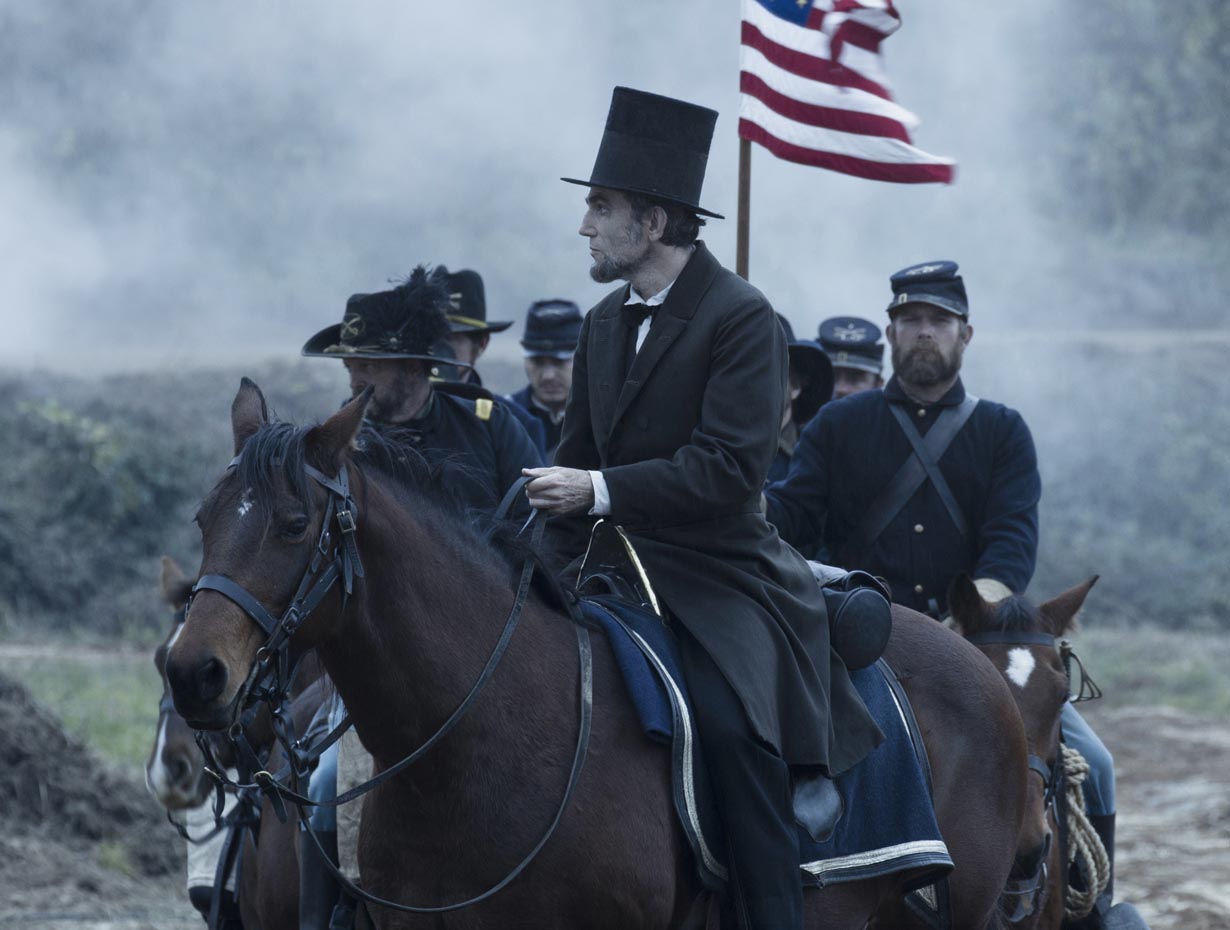
Even a great hat can't distract from that, Mr. President
Unfortunately, his window of opportunity was closing fast.  The Confederacy was weakening.  It was only a matter of time before they were completely defeated.  But once the Confederate states rejoined the Union, the chances of passing an anti-slavery amendment would be nil.  Not only would there be pro-slavery Southerners voting, but much of the support for anti-slavery legislation was garnered from the belief that repealing slavery would end the war faster; with the war over, racism would win the day.  That left Lincoln with one chance.  Assuming everyone in his political party would vote for him (which was a stretch), the 13th Amendment was still a few votes shy of passing --- but there were several men in the opposing party that had lost their elections and were just waiting to be replaced.  If Lincoln's men could convince enough of these lame ducks --- and his own party --- to vote for the amendment, history could be made.  And, as luck would have it, there was one more date available for a Congressional vote before all the peace hits the fan!
"What will it take to get your vote?  A threesome is not off the table."

The acting in Lincoln is, not surprisingly, excellent.  Daniel Day-Lewis is THE thespian stud of our times, and he brought his A-game here.  Day-Lewis went against the traditional interpretation of the character by making him slouch, feel old, and speak with a soft tone, but he also managed to demand all of the attention in every scene he was in.  As luck would have it, that is practically every single scene in the film.  I think some of my favorite moments were the scenes where he relied on nonverbals.  This is a fairly talky character, so having the quiet moments as highlights is just a testament to Day-Lewis' acting prowess.
Example: right here, Lincoln was this close to killing everyone in a 30 foot radius
Leading the exemplary supporting cast was Tommy Lee Jones, who played a perennially cranky character.  Shock!  I love it when Jones gets a role that lends itself to his acerbic delivery, and this is easily one of his best.
Sally Field played Mrs. Mary Todd Lincoln, who is known historically for being a bit crazy.  Field managed that well enough, but I didn't think her role was anything special.
Buck up, Sally.  Sulking is not attractive in any time period.
Despite that, Field did a lot with the part and was surprisingly magnetic onscreen.  David Strathairn was good as the eternally exasperated William "I Heart Alaska" Seward.  He didn't really have much room to grow as a character, but served well as a mouthpiece to the logistics Lincoln was facing.  James Spader, John Hawkes, and Tim Blake Nelson played the three men tasked with drumming up support among the opposition; all three are fine actors, but I would have preferred it if Spader wasn't the one doing most of the work here.
Spader, realizing that this role has nothing to do with deviant sex acts
Hal Holbrook was fine as an obstacle for Lincoln to overcome, although I think this role was a little underdeveloped.  Speaking of which, Joseph Gordon-Levitt was a waste of space as Lincoln's eldest son.  One of these days, JGL will play a big role in a big movie --- it's inevitable, given his talent and the people he works with --- but the whiny, over-privileged son of the president is not that role.
"What if I tried pouting more?"
Rounding out the cast, Lee Pace was solid in the strawman role of "that really racist guy."  This is the first time I have seen Pace play an unlikable character, and he did so reasonably well.

Lincoln was the result of director teaming up with , king of the difficult-subject-screenplay.  With regards to the direction, Spielberg nailed all the technical aspects.  Design, costumes, filling the cast with nary a bad actor, etc. --- Spielberg is too big of a director to accept anything but the best in these regards.  While he has never been the strongest director in terms of cinematography, Spielberg still managed to snag several memorable shots of an American icon.
He also handled the actors quite well.  Having a great cast obviously helps with that, but Day-Lewis, Jones, and Field were all deserving of their award nominations, and Spielberg was ultimately responsible for that. 

I think Kushner did a solid job with the plot and the dialogue.  Both Lincoln and Thaddeus Stevens (Tommy Lee Jones) had some fantastic lines, and transforming this political issue into an interesting story was an impressive feat.  Lincoln is missing something, though.  I want to say that it is something immaterial, like "heart," but I can do better than that.  This is a smart script, no doubt.  It is just not an emotional one.  American culture has reached a point where racism is justly vilified.  It definitely still exists, but racists are generally acknowledged as assholes, as they should be. 
"Amend that.  It should read 'total fucking assholes'"
This might have been a brave film as late as 1975, but in 2012, the subject matter isn't compelling enough on its own.  This needed an emotional anchor to twist the audience's stomach in knots while we waited for the inevitable, and that was lacking.  There were some attempts.  Thaddeus Stevens' change of policy was intriguing, but underdeveloped.  Abraham and Mary Todd shared a scene where they got to bare their souls, but it wasn't nearly enough to warm an otherwise cold story.
"You act like a little culture will kill you!"
The fault is not Kushner's alone, of course.  Lincoln has been Spielberg's baby for years, and he managed to put out a smart, well-acted and -directed film without that crucial element that makes you cry at the end.

I was expecting a lot from Lincoln, and only got most of what I hoped for.  This is technically a better film that Spielberg's last effort, War Horse, but that movie drew me in, despite my objections.  Lincoln is more cerebral, but leaves emotions at the door, and that turned out to ultimately be a mistake.  Even without something tugging at my heartstrings, it is hard to dismiss Daniel Day-Lewis reinventing an American icon.  With all the good and the not-quite-bad, Lincoln gets

Thursday, June 9, 2011

Leaves of Grass

I like Edward Norton as an actor, but I haven't really noticed him in movies over the past few years.  Looking at his filmography, I have to go back to 2003's The Italian Job for a movie of his that I actually liked, and he's not even very good in it.  I stumbled across Leaves of Grass more or less by accident, and the cover gave me pause; Edward Norton was pulling an Eddie Murphy and acting against himself in a comedy?  Okay, I'm intrigued.
Sadly, neither of these men are Tyler Durden.

In case you are wondering, this movie takes its title from a book of poems by Walt Whitman.  Whitman published the collection when he was thirty-six, but he continued to revise and edit it until he died at age seventy-one.  While that history doesn't really have much to do with the movie (or does it?), I've always found that interesting.
OCP: obsessive-compulsive poet

The film focuses on the Kincaid brothers, Bill (Edward Norton) and Brady (Edward Norton).  Bill is a quiet professor of classical philosophy, who spends his time critiquing the critiques other professors have made about classical philosophers.  Brady is a redneck drug dealer with enough scientific smarts to design and build his own state-of-the-art hydroponic marijuana warehouse.  Brady finds himself in a bit of a pickle when the local drug kingpin, Pug (Richard Dreyfuss), starts to breathe down his neck; Pug put up the money for the pot lab and wants either his investment repaid or for Brady to start dealing hard drugs.  Brady and his dim-witted friend, Bolger (Tim Blake Nelson, who also directed the movie), come up with a plan, but it requires Bill to come home for a visit.  That's a problem, because Bill hasn't returned --- or even returned phone calls or letters --- since he left to go to college.  How would you get your estranged twin brother to return home after twenty-odd years?  If your answer was "fake your own crossbow-related death," then this movie might not have any surprises for you.  Once he's home in the deep South (which is in Oklahoma?) again, Bill faces his fears and reevaluates his life, and gets entangled in his brother's shenanigans.

One of the difficult choices filmmakers are forced to make when making a comedy is how silly to make it.  Do you go insultingly broad, like the Wayans, or do you go for the 1% chance of a cult hit, like in Napoleon Dynamite?  Or **ugh** do you go just go for predictable stupidity in a romantic comedy?  Writer/director Tim Blake Nelson opts to go the most difficult route, that of the black comedy.  I love black comedies in theory; the idea of cracking jokes at inappropriate times appeals to my inner asshole.  Unfortunately, I don't think Nelson truly succeeds in this attempt.  There are some funny moments and lines of dialogue (I can think of two that involve crossbows), but the humor level is pretty low, unless you count references to pot smoking as knee-slappers.  As a drama, Leaves of Grass doesn't really come together, either.  I thought Nelson directed the funeral scene at the end well enough, but the rest was pretty emotion-free.

On the other hand, I thought the acting was pretty decent.  Edward Norton did a fine job in both roles, but I didn't ever really care for either one.  It was momentarily amusing to see Norton as a redneck, but that novelty wore off quickly.  Neither brother was particularly interesting, either, which made this movie harder to watch.  I enjoyed Tim Blake Nelson as Norton's sidekick; no one can play a well-meaning idiot better than Nelson.  Keri Russell pops up to play a poetry-spouting, catfish-punching local, and she's decent enough.  It was interesting to see Richard Dreyfuss as a villain, and his rant about drug dealers being anti-Semitic was...unusual, I guess.  Susan Sarandon played the mentally fragile mother of the brothers, Melanie Lynskey pretended that she was pregnant, and musician Steve Earle looked really, really ugly.  Nobody gave a bad performance, but many of the characters were unmemorable or just dull.
Which came first, the accent or the facial hair?

I can't say that I enjoyed this movie as either a drama or a comedy, but it has some redeeming value.  The story wasn't confusing and a few of the jokes were funny.  I think the best thing about this movie is that it doesn't assume that people with thick Southern accents are stupid.  As Brady, Edward Norton has a few interesting and intelligent things to say, even if he is saying them with a mullet.  Unfortunately, the script is not strong enough to make the occasional funny bits into a cohesive or interesting whole, despite a solid cast.  I think the biggest problem with the movie is that it doesn't embrace or take advantage of Norton in his dual roles.  You don't make a movie with an actor playing multiple parts unless you're making at least one of those characters into a joke; failing that, you go the Adaptation route and make a genuinely weird movie.  Leaves of Grass does neither, opting for pretty conventional characters, even if they are rednecks.  When I prepared to watch this movie, my only hope was that it would be better than Norton's last dark comedy, Death to Smoochy.  This movie doesn't have the highs and lows of that film, but it disappoints, just the same.

Sunday, May 29, 2011

Syriana

 Syriana is a challenging film to watch.  Its title alone --- which I don't believe the movie ever directly addresses --- refers to the idea of people or countries molding other nation-states however they see fit, and the hubris behind such thinking.  As you might have guessed, this isn't a romantic comedy.

The plot behind Syriana, while comprehensible, is very complex, so I'm not going to waste any time detailing it.  It would take me forever and you wouldn't want to read it anyway, since this is a film where paying attention to the story is the only way not to get lost.  The basic idea is that the world dependency on foreign oil is bad for a number of reasons.  Way to take a stand, Hollywood.  It also addresses the need for oil states to develop their own identities, the effectiveness of the CIA, and the costs/benefits of high-level corruption.  What makes Syriana interesting is that it chooses to handle these issues simultaneously, so we can see how each issue impacts another.  You won't see how everything fits together for some time, as there are four storylines that exist largely independent of each other until the final quarter of the movie.  When they dovetail together, though, you are left with something to think about.  Or not.  One thing that everyone can agree on is that this is definitely not an action movie.
I did a Google Image search for "syriana action" and found this.
The cast of Syriana is shockingly noteworthy, although many of these actors do not get a whole lot of screen time.  George Clooney won his only Oscar for his role as a CIA agent who specializes in protecting American interests in the Middle East.  The big news with his performance here is that Clooney gained some weight and a beard to play the part; I don't know how much that impacts his character.  Was this an Oscar-winning performance?  Eh.  It's a fine effort among an ensemble cast, but I don't find it particularly outstanding.  Matt Damon is also fine as a consultant hired by the prince of the oil-rich emirate to make the nation more fiscally sound.  His character is also handling marital issues and a family tragedy, so Damon has the opportunity to show off some complex skills in this film; I thought he did a very good job, given the businesslike script.  Jeffrey Wright plays a lawyer that has been hired to smooth the way for an enormous oil company to merge with a smaller one that has cornered a key market; his job is convince the antitrust people that the merger is corruption-free.  I like seeing Wright in key supporting roles, but I thought his character here was a too void of emotions.  I never really had a sense of his character, and the recurring attempt to give him depth just felt clumsy.  Those are the big three, as far as characters in this movie go.  None of them are fascinating in their own right, but they are all quite believable as ordinary people that are good at their respective jobs.
This is not Ocean's 14

There is a fourth storyline that addresses the plight of immigrant workers in the Middle East and the allure of militant Islam.  Of the three actors in this story, only the missile-buying militant (Amr Waked) acts with any sort of regularity, and it shows.  The two innocent youngsters are played by two innocent actors without much more than half a dozen visible emotions between them.

And then there's the rest of the cast.  In George's storyline, William Hurt does his typical good acting thing as a confidant and Mark Strong plays a very very bad man.  Both roles are easily within the acting range of these men, but it was nice to see them handled so well.  In Damon's story, Amanda Peet plays his wife; while not a particularly strong role, she didn't screw it up, which is much better than Peet's leading roles.  I thought Alexander Siddig was very likable as the progressive-minded Prince Nassir, possibly the most positive portrayal of a Middle Eastern Muslim I have seen in years.  In Wright's story, Chris Cooper plays a domineering business owner with an abrasive personality (shocker!), Christopher Plummer is one of those white men who like to be the power behind the throne, David Clennon is interested in corruption, and Tim Blake Nelson plays a corrupt oilman.  Of all these capable actors, only Nelson delivers anything exceptional.  He gives a speech about corruption (he's unapologetically pro-corruption, by the way) that was the highlight of the movie for me.  I would show a video clip of his rant, but apparently nobody on the internet cares about TBN (as his buddies undoubtedly call him) laying some truth down on Jeffrey Wright.  I was able to find my favorite scene of his from O Brother, Where Art Thou? though:


This is a difficult movie to direct, I'm sure, and I thought that Stephen Gaghan did a respectable job here.  I do not believe he got any great performances out of his wealth of actors (with the exception of Nelson), but he did do a good job piecing this film together in a comprehensible whole.  He doesn't dumb down the story (which was loosely based on See No Evil, a memoir by an ex-CIA agent), instead choosing to overwhelm viewers with the plot.  That choice may alienate some viewers, and that's understandable.  Personally, I was able to follow along, even though I was irritated by his seemingly arbitrary choices on when to cut to another storyline, which storyline to cut to, and when to include a caption on the screen to indicate where it was taking place.  The film looks decent enough, although the camera work is nothing special.  That's not too surprising, since Gaghan is an award-winning writer, not a director; he co-wrote this movie, as well as Traffic.

As much as I appreciate what Syriana does right --- an interesting and relevant political story, interweaving plot threads, and moral shades of gray --- there are just too many things that it does wrong or simply avoids to make it a great movie.  The only character in the film that has a full character arc is Clooney's, and that development is mostly off-camera and is cut short.  There are so many characters and so little time given to them that it was hard to care about any.  I realize that, as a plot-driven "issue" movie, that isn't really the point of the film.  I also don't care.  There are three potentially interesting stories in this film (the terrorists-in-training one was predictable and dull) and all three had the acting talent to make them work.  The fact that this isn't an acting tour de force (or at least fun to watch) is almost criminal.  There are five Oscar winners involved with this movie, and the best scene features Tim Blake Nelson monologuing?  That makes no damn sense, and I like Nelson.
Not as much as Lisa does, though.
I also didn't find the story to be particularly revelatory.  Maybe I'm cynical, but the CIA trying to control foreign governments to get America what resources it needs sounds pretty accurate.  The stuff of bastards?  Sure.  But it makes sense, from a "me first and screw everyone else" point of view.  Nelson's speech was the only interesting take on these issues in the whole movie, and that's a shame because I think this could have been so much more interesting.  The whole story with Damon and Siddig had potential --- how to introduce political and socioeconomic change effectively within an orthodox Islamic culture has relevance, right? --- but didn't have enough time to develop on its own.  Clooney's CIA agent (with a heart of gold) could have had his own movie.  Wright's legal storyline takes on thriller overtones as soon as his boss starts playing king maker.  But when you squeeze these stories into one (well-edited, mind you) movie, they don't have room to grow.  Syriana has some great ideas in it, but the barrage of plot simply distracts you from the fact that you can't care for any of these characters.